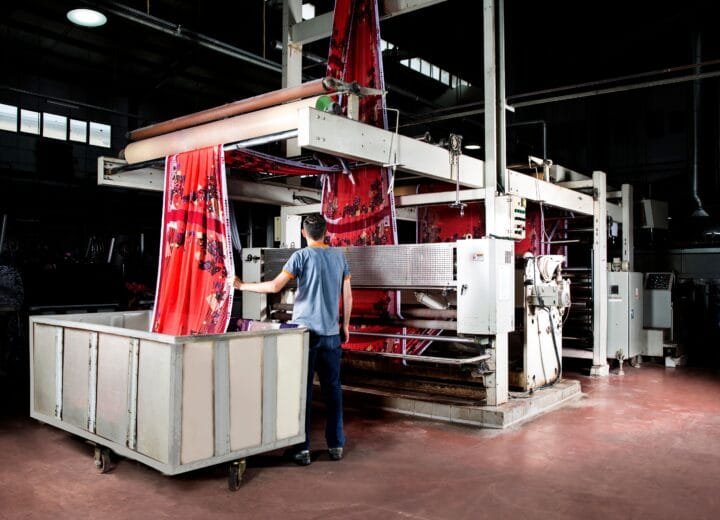
The industrial landscape of Egypt is undergoing a powerful evolution. Positioned uniquely as a trade gateway, Egypt’s manufacturing sector contributes approximately 17% to the national GDP. However, operating within these competitive domestic and regional markets presents unique challenges. Local manufacturers frequently battle volatile operational costs, manual production tracking, high rework rates, and underutilized asset capacity.
To thrive globally and locally, businesses must move beyond survival mode. Discovering exactly how to increase productivity in manufacturing is no longer a long-term aspiration, it is an immediate operational necessity.
The Core Challenges Facing Egyptian Factories
Operational Excellence assessments across emerging markets consistently reveal that the gap between a factory’s current output and its full potential is rarely caused by a lack of ambition. Instead, it is typically the result of foundational systemic gaps:
- Siloed Operations: Production, maintenance, and quality departments rarely communicate using synchronized, real-time data.
- Hidden Process Waste: Long material travel distances and high work-in-process (WIP) inventory clog shop floor capacity.
- Skill Gaps: Frontline operators often lack structured training in structured data interpretation and continuous improvement frameworks.
To solve these, factory owners must adopt a phased roadmap combining process optimization with targeted digital tools.
5 Frameworks to Drive Manufacturing Productivity in Egypt
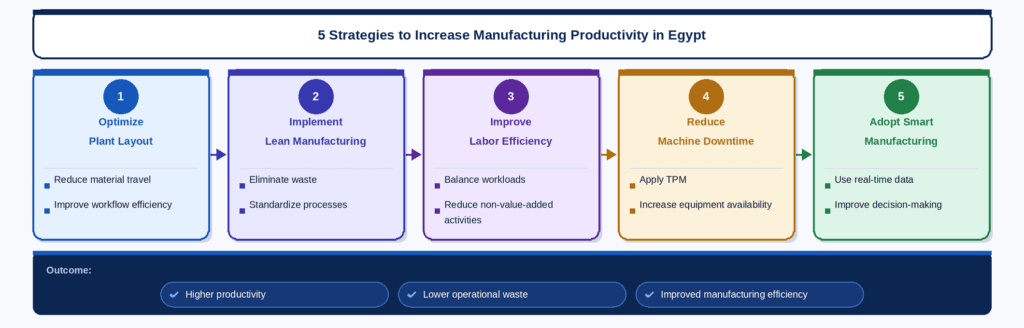
1. Optimize Material Flow and Plant Layout
A common mistake in many factories is assuming that increasing output requires purchasing expensive new machinery or expanding the physical footprint. In reality, massive capacity is hidden within the existing floor plan.
When material paths are poorly designed, your operation suffers from extended waiting times and unnecessary material handling. By applying process optimization and industrial engineering principles, facilities can transition from traditional functional layouts to integrated work cells.
First-Hand Insight: In our operational engagements, restructuring shop floor layouts and aligning sequential steps has reduced material travel distances by over 40%, unlocking up to a 15% to 20% increase in output without a single pound of capital expenditure (capex).
2. Implement Lean Methods to Improve Factory Productivity
To systematically improve factory efficiency in Egypt, companies must identify and eliminate the eight forms of waste (Muda), particularly overproduction, waiting time, and defects.
| Traditional Disorganized Floor Plan | Optimized Cellular Layout |
| Long material travel distances | Streamlined material flow |
| Frequent production bottlenecks | Reduced bottlenecks |
| Excessive movement between workstations | Efficient workstation arrangement |
| Higher operational waste | Minimal waste and improved productivity |
Using tools like Value Stream Mapping (VSM), management can visualize the entire production cycle from raw material receipt to finished goods dispatch. This visibility enables teams to identify bottlenecks, establish standard work instructions, and ensure operators consistently achieve optimal cycle times. This foundation supports sustainable operational improvement and builds a culture of continuous improvement.
3. Conduct Time and Motion Studies for Labor Efficiency
With a large labor pool available, maximizing human resource utilization is vital. A structured Time and Motion Study to increase productivity in Egypt helps identify exactly how much of an operator’s shift is spent on value-adding work versus non-value-adding tasks (such as searching for tools or waiting for materials).
By standardizing tasks and balancing the production line, you minimize operator fatigue, improve safety, and significantly reduce labor cost per unit.
4. Deploy Total Productive Maintenance (TPM) to Reduce Downtime
You cannot achieve factory productivity improvement in Egypt if your machines are constantly breaking down. Relying purely on reactive maintenance destroys production schedules and drives up emergency spare parts costs.
Implementing a Total Productive Maintenance (TPM) framework shifts the factory floor from a reactive state to a proactive one. Training operators to perform basic daily maintenance checks (Autonomous Maintenance) ensures minor issues are flagged before they escalate into catastrophic equipment failures, radically reducing downtime to improve manufacturing productivity in Egypt.
5. Adopt a Pragmatic Approach to Industry 4.0
There is significant noise surrounding Industry 4.0 manufacturing in Egypt. However, the most critical rule of digital transformation is simple: Fix your processes before you buy technology.
Rather than executing a risky, capital-heavy “big bang” technological overhaul, manufacturers should adopt a phased smart factory roadmap:
- Phase 1: Clean and stabilize processes using Lean principles, and establish manual or simple digital production dashboards.
- Phase 2: Integrate low-cost smart sensors on legacy machinery to capture real-time Overall Equipment Effectiveness (OEE).
- Phase 3: Scale advanced automation and deep data analytics across multiple lines or sites.
Driving Excellence Across Egypt’s Industrial Zones
Whether your facility is located in the plastics, textile, chemical, or food processing sectors, true Operational Excellence requires strategic alignment between corporate targets and shop-floor execution. Key performance indicators (KPIs) like OEE, cycle time, and first-pass yield must be tracked daily via short interval control meetings via robust operations management.
| Operational Improvement Method | Primary Impact |
| Lean Layout Optimization | Reduces unnecessary movement, improves material flow, and maximizes available floor space |
| Time & Motion Line Balancing | Improves workforce efficiency and increases production output |
| Total Productive Maintenance (TPM) | Reduces downtime and maximizes equipment availability |
| Phased Digital Transformation Tools | Enables real-time monitoring and data-driven decision-making |
By focusing on process efficiency first, building internal workforce capabilities, and deploying digital solutions for manufacturing productivity in Egypt where they add clear financial value, local plants can transform their operations into highly resilient, globally competitive powerhouses.
Frequently Asked Questions (FAQs)
What are the main drivers of manufacturing productivity improvement strategies in Egypt?
The most effective strategies focus on eliminating operational waste through Value Stream Mapping, optimizing plant floor layouts to minimize material movement, standardizing operator workflows, and transitioning from reactive to preventive machine maintenance.
How can a factory in Egypt start reducing downtime to improve manufacturing productivity?
Start by tracking your downtime reasons accurately for two to three weeks. Categorize the root causes of major machine stoppages, and implement basic autonomous maintenance practices where operators take ownership of daily cleaning, lubrication, and inspection.
Does upgrading to Industry 4.0 guarantee factory efficiency in Egypt?
No. Introducing advanced digital tools or automation into an inefficient, messy process only accelerates the generation of waste. True efficiency happens when you lean out and stabilize the process manually before layering on digital tracking systems or smart tools.
Why is a Time and Motion Study important for factory productivity improvement methods in Egypt?
It provides objective, data-backed visibility into labor utilization. It removes guesswork, allows management to balance production lines evenly, eliminates bottlenecks, and helps design ergonomic workstations that maximize output per worker safely.