
Sustainable growth is increasingly becoming a defining factor for business success in Kenya. Organizations are no longer evaluated purely on financial performance, but also on how effectively they manage environmental, social, and governance (ESG) risks and opportunities. ESG consultants are helping organizations across Kenya turn sustainability into a growth strategy.
As expectations from investors, regulators, customers, and global supply chains continue to evolve, ESG is becoming a key consideration in long-term business resilience and competitiveness.
At Faber Infinite, we see ESG not as a separate sustainability function, but as a structured way of helping organizations make better, more informed business decisions. When properly integrated into strategy and governance, ESG becomes a tool for identifying risk, improving transparency, and strengthening long-term value creation.
Key Takeaways
- ESG supports sustainable growth by helping organizations align business strategy with environmental, social, and governance priorities.
- ESG consultants focus on materiality, strategy development, governance integration, and reporting readiness.
- Sustainable growth is increasingly linked to investor confidence and stakeholder expectations.
- ESG helps organizations identify risks and opportunities that may not be visible through financial analysis alone.
- In Kenya, ESG considerations are becoming increasingly relevant across multiple sectors including finance, manufacturing, agriculture, and energy.
What Sustainable Growth Means in Today’s Business Environment
Sustainable growth refers to an organization’s ability to achieve long-term business success while effectively managing environmental, social, and governance factors that may influence performance.
This goes beyond short-term expansion and focuses on building resilience, adaptability, and responsible value creation.
In practical terms, sustainable growth involves:
- Making informed strategic decisions
- Managing long-term risks
- Improving operational resilience
- Strengthening stakeholder trust
- Ensuring responsible resource use
- Enhancing governance and accountability
Organizations that adopt this approach are better positioned to navigate uncertainty and shifting market expectations.
Why ESG Is Becoming Central to Growth in Kenya
Across Kenya, ESG considerations are increasingly influencing how businesses operate and grow.
This shift is being driven by several factors:
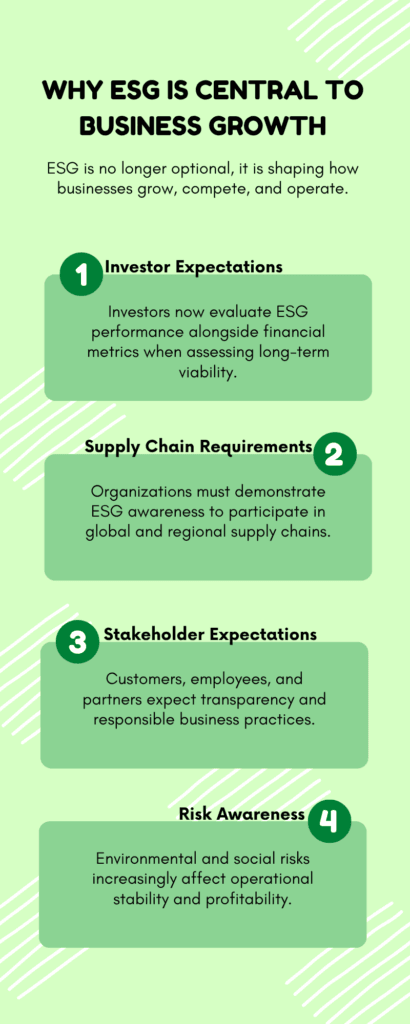
Investor Expectations
Investors are increasingly assessing ESG performance alongside financial indicators when evaluating long-term business viability.
Supply Chain Requirements
Many organizations are now required to demonstrate ESG awareness and sustainability practices to participate in regional and global supply chains.
Stakeholder Expectations
Customers, employees, and business partners increasingly expect organizations to demonstrate responsible and transparent practices.
Risk Awareness
Businesses are becoming more aware that environmental and social risks can directly impact operational stability and profitability.
As a result, ESG is becoming part of strategic decision-making rather than a standalone reporting requirement.
The Role of ESG Consultants in Supporting Sustainable Growth
An ESG consultant in Kenya supports organizations by helping them structure and integrate ESG considerations into business strategy and governance systems.
Rather than focusing on execution or operational delivery, ESG consulting is centered on building clarity, frameworks, and decision-making structures that support sustainable growth.
At Faber Infinite, this typically involves working with organizations to:
- Identify key ESG priorities
- Conduct materiality assessments
- Develop ESG strategies aligned with business goals
- Strengthen governance structures
- Improve ESG reporting readiness
- Support stakeholder engagement processes
This structured approach ensures that ESG is embedded in how organizations think, plan, and make decisions.
Materiality as the Foundation of Sustainable Growth
Materiality assessment is one of the most important tools in ESG consulting.
It helps organizations identify which environmental, social, and governance issues are most relevant to their business model and stakeholders.
Instead of attempting to address every possible sustainability issue, organizations focus on the factors that have the greatest potential impact on:
- Business performance
- Risk exposure
- Stakeholder expectations
- Long-term strategy
This ensures ESG efforts are focused, efficient, and strategically aligned.
ESG Strategy and Business Alignment
A strong ESG strategy connects sustainability priorities directly to business objectives.
This involves translating ESG insights into structured plans that support:
- Long-term growth
- Risk management
- Operational resilience
- Governance improvement
- Stakeholder confidence
ESG consultants help organizations move from high-level sustainability intent to structured, measurable strategic direction.
Importantly, ESG strategy is not separate from business strategy, it is increasingly becoming part of it.
ESG and Governance Integration
Strong governance is essential for effective ESG performance.
ESG consultants support organizations in strengthening governance structures to ensure sustainability considerations are properly integrated into decision-making processes.
This may include:
- Defining ESG oversight responsibilities
- Strengthening board-level awareness of ESG risks
- Improving internal accountability structures
- Embedding ESG into risk management systems
When governance and ESG are aligned, organizations are better equipped to respond to emerging challenges and opportunities.
ESG and Reporting Readiness
As ESG expectations continue to evolve, organizations are increasingly expected to communicate their sustainability performance in a structured and transparent way.
ESG consultants help businesses prepare for this by supporting reporting readiness through:
- Identifying relevant ESG disclosure areas
- Structuring internal ESG data collection approaches
- Aligning with established frameworks such as Global Reporting Initiative (GRI) and the International Sustainability Standards Board (ISSB)
- Improving consistency and clarity of ESG information
The focus is not on assurance, but on helping organizations build internal capability and clarity around ESG reporting.
How ESG Supports Long-Term Business Performance
When integrated effectively, ESG contributes to sustainable growth by improving how organizations understand and manage their operating environment.
Key benefits of this include:
Stronger Decision-Making
ESG provides additional insights beyond financial metrics, supporting more informed strategic decisions.
Improved Risk Awareness
Organizations can identify and respond to environmental, social, and governance risks earlier.
Enhanced Stakeholder Trust
Transparent ESG practices strengthen relationships with investors, customers, employees, and partners.
Better Strategic Alignment
ESG ensures that sustainability considerations are embedded in long-term business planning.
The Future of Sustainable Growth in Kenya
As ESG expectations continue to evolve, organizations that integrate sustainability into their strategic decision-making processes will be better positioned for long-term success.
Sustainable growth is increasingly about clarity, resilience, and informed decision-making, not just expansion.
ESG consultants play a key role in enabling this shift by helping organizations structure how they think about sustainability, risk, and value creation.
At Faber Infinite, we believe that the future of business growth in Kenya will be shaped by organizations that can effectively connect ESG insights to strategic decisions and long-term resilience.
Frequently Asked Questions
What is sustainable growth in ESG?
Sustainable growth refers to business development that balances financial performance with environmental, social, and governance considerations to ensure long-term resilience and value creation.
How do ESG consultants support sustainable growth?
ESG consultants help organizations identify material ESG issues, develop strategies, improve governance structures, and align sustainability with business objectives.
Why is ESG important for business growth in Kenya?
ESG is increasingly important due to investor expectations, supply chain requirements, stakeholder pressure, and the need to manage long-term risks.
What is a materiality assessment in ESG?
A materiality assessment identifies the ESG issues that are most relevant to an organization’s operations, stakeholders, and long-term performance.
Contact us