
The role of an ESG consultant in Kenya is evolving rapidly as organizations increasingly recognize that sustainability is not separate from business performance, it is a core driver of long-term value creation.
Across industries, businesses are under growing pressure from investors, regulators, lenders, and global supply chains to demonstrate how they manage environmental, social, and governance (ESG) factors. In response, ESG consulting has become a strategic function that helps organizations structure their sustainability approach in a practical and business-aligned way.
At Faber Infinite, we view ESG not as a reporting obligation, but as a decision-making framework that helps organizations understand risk, identify opportunity, and strengthen long-term resilience.
Key Takeaways
- ESG consultants help organizations integrate sustainability into strategy and governance.
- The role focuses on materiality assessments, ESG strategy development, reporting alignment, and stakeholder engagement.
- ESG is increasingly linked to business resilience, investor confidence, and operational clarity.
- In Kenya, ESG expectations are growing across multiple sectors, especially finance, manufacturing, agriculture, and energy.
- ESG consultants help organizations move from fragmented sustainability actions to structured, strategic approaches.
What Is an ESG Consultant?
An ESG consultant is a professional who helps organizations understand and manage their environmental, social, and governance priorities in a structured and strategic way.
Rather than treating ESG as a standalone function, consultants work with leadership teams to embed sustainability considerations into business strategy, governance structures, and decision-making processes.
In Kenya’s evolving sustainability landscape, this role is becoming increasingly important as organizations navigate changing expectations from stakeholders and global markets.
Why ESG Consulting Is Growing in Kenya
The demand for ESG consultants in Kenya is driven by several interconnected trends.
Increasing Investor Expectations
Investors are placing greater emphasis on ESG performance as part of assessing long-term business resilience and risk exposure.
Supply Chain Requirements
Many organizations are now required to demonstrate sustainability performance to participate in global supply chains.
Evolving Stakeholder Expectations
Customers, employees, and communities increasingly expect transparency around environmental and social impact.
Business Risk Awareness
Organizations are becoming more aware that environmental and social risks can directly affect operational stability and long-term profitability.
These shifts are making ESG advisory a critical function for forward-looking organizations.
What Does an ESG Consultant Do in Kenya?
The role of an ESG consultant varies depending on the organization’s size, industry, and level of ESG maturity. However, most ESG consulting engagements focus on a few core areas.
Materiality Assessments
Materiality assessment is one of the foundational steps in ESG advisory.
It helps organizations identify and prioritize the ESG issues that are most relevant to their operations and stakeholders.
Rather than attempting to address every sustainability issue, organizations focus on what matters most to business performance and stakeholder expectations.
This process helps ensure that ESG efforts are both relevant and strategically aligned.
ESG Strategy Development
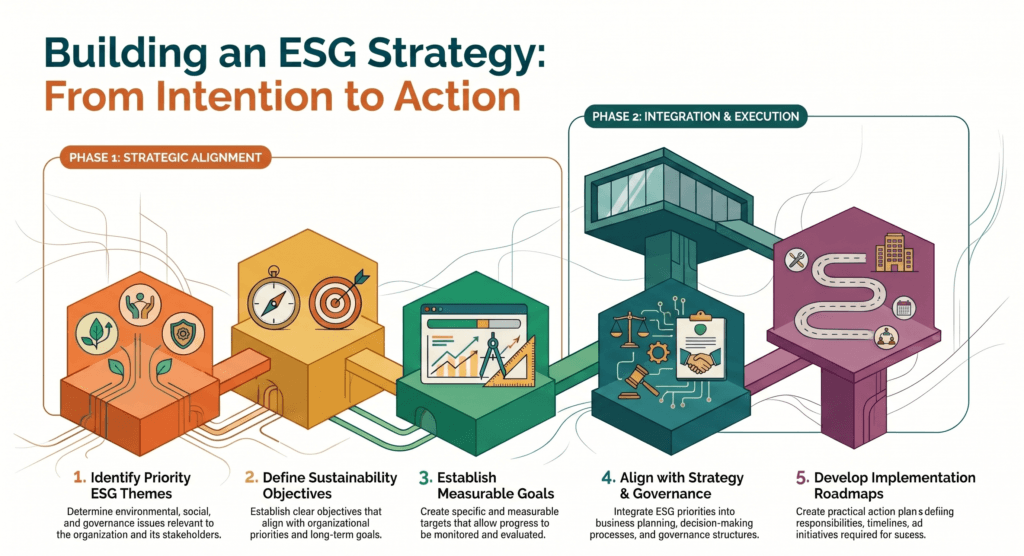
ESG consultants support organizations in developing clear and structured ESG strategies.
This involves translating sustainability priorities into practical direction that aligns with overall business objectives.
An ESG strategy typically includes:
- Identification of priority ESG themes
- Definition of strategic sustainability objectives
- Establishment of measurable goals
- Alignment with business strategy and governance
- Development of implementation roadmaps
At its core, ESG strategy helps organizations move from intention to structured action.
ESG Reporting and Disclosure Support
Organizations are increasingly expected to communicate their ESG performance in a clear and consistent manner.
ESG consultants help businesses develop reporting approaches that improve transparency and align with commonly used sustainability frameworks.
This includes:
- Identifying relevant ESG disclosure priorities
- Structuring reporting approaches
- Supporting data organization and consistency
- Aligning disclosures with recognized frameworks such as Global Reporting Initiative (GRI) and the International Sustainability Standards Board (ISSB)
Rather than focusing on assurance or verification, ESG consulting focuses on helping organizations build internal clarity and reporting readiness.
Governance and Risk Integration
Strong governance is central to effective ESG performance.
ESG consultants work with organizations to integrate sustainability considerations into governance and risk management structures.
This may include:
- Strengthening ESG oversight at leadership level
- Embedding ESG into decision-making processes
- Supporting risk identification and management approaches
- Enhancing accountability structures
This ensures ESG is not treated as an isolated initiative, but as part of core business governance.
Stakeholder Engagement
Understanding stakeholder expectations is essential for effective ESG strategy.
ESG consultants help organizations engage with stakeholders to better understand priorities, concerns, and expectations related to sustainability performance.
This engagement helps organizations:
- Improve trust and transparency
- Identify material ESG issues
- Strengthen communication strategies
- Align ESG priorities with stakeholder needs
ESG Consulting vs. Sustainability Advisory
While the terms are often used interchangeably, ESG consulting takes a more integrated approach.
Sustainability advisory may focus primarily on environmental or operational sustainability initiatives, while ESG consulting connects environmental, social, and governance factors directly to:
- Business strategy
- Risk management
- Governance structures
- Long-term value creation
This integrated perspective is increasingly important in today’s business environment.
The Future of ESG Consulting in Kenya
As ESG expectations continue to evolve, the role of ESG consultants will become increasingly important in helping organizations navigate complexity and uncertainty.
Rather than being limited to reporting or compliance, ESG consulting is becoming a strategic function that supports long-term business resilience and transformation.
Organizations that begin integrating ESG into decision-making today are better positioned to adapt to future expectations and build sustainable competitive advantage.
At Faber Infinite, we believe ESG is ultimately about enabling organizations to make better decisions, decisions that strengthen both business performance and long-term sustainability.
Frequently Asked Questions
What does an ESG consultant do in Kenya?
An ESG consultant helps organizations identify material sustainability issues, develop ESG strategies, improve governance structures, and support ESG reporting readiness aligned with recognized frameworks.
Why is ESG consulting important?
ESG consulting helps organizations integrate sustainability into business strategy, manage risks, and respond to growing stakeholder expectations.
How is ESG different from sustainability consulting?
ESG consulting takes a broader approach by integrating environmental, social, and governance factors into strategy, risk management, and governance systems.
What is materiality in ESG?
Materiality refers to identifying the ESG issues that are most relevant to an organization’s business performance and stakeholder expectations.
Contact us