
Operational costs are becoming a growing challenge for businesses across Kenya.
Rising input prices, inflation, supply chain inefficiencies, and increased competition are putting pressure on profitability across manufacturing, retail, logistics, and service-based industries. As a result, organizations are no longer treating cost control as a short-term financial exercise, but as a structured operational discipline.
Instead of relying on across-the-board budget cuts, many businesses are shifting toward process-driven approaches that focus on improving efficiency, eliminating waste, and redesigning how work gets done.
This is why operational cost reduction in Kenya has evolved into a structured practice supported by process improvement, data analysis, and operational consulting.
Many organizations also work with operational cost reduction services in Kenya to identify inefficiencies and implement long-term improvements that strengthen profitability.
What Actually Drives Operational Costs
While external factors such as inflation and taxes influence business expenses, most cost challenges originate from internal inefficiencies within operations.
Over time, these inefficiencies accumulate and significantly increase the cost of doing business.
1. Inefficient Business Processes
Many organizations operate with workflows that were never formally designed. As a result, processes often include:
- Redundant approval steps
- Unnecessary handoffs between departments
- Delays caused by unclear responsibilities
- Repeated manual tasks
These inefficiencies increase cycle time and operational effort without adding value.
2. Poor Resource Utilization
In many Kenyan businesses, resources are not fully optimized. This includes:
- Underutilized staff capacity
- Inefficient machine usage in production environments
- Poor material planning and allocation
When resources are not aligned with demand, costs rise without corresponding productivity gains.
3. Rework and Quality Issues
Errors in production or service delivery lead to rework, which directly increases costs. Common causes of rework and quality issues include:
- Inconsistent processes
- Lack of standard operating procedures (SOPs)
- Limited quality controls
Rework consumes time, labor, and materials without generating additional value.
4. Inventory and Supply Chain Inefficiencies
Poor forecasting and planning often result in:
- Overstocking
- Stockouts
- Excess holding costs
- Emergency procurement expenses
These issues are especially common in manufacturing and distribution environments.
5. Manual and Paper-Based Systems
Many organizations still rely on manual processes for documentation, approvals, and reporting. This leads to:
- Slower processing times
- Higher administrative workload
- Increased error rates
Digitization often becomes a key driver of cost reduction in such environments.
Core Methods for Operational Cost Reduction
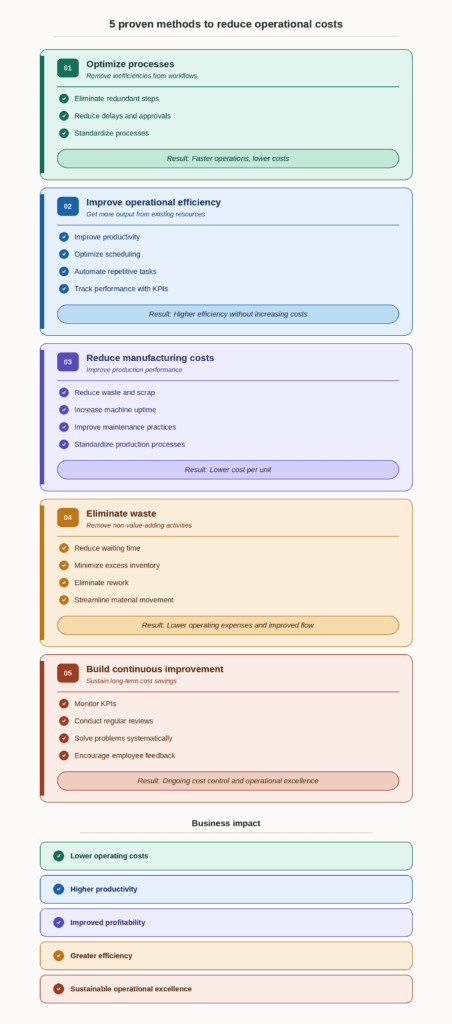
Sustainable cost reduction requires structured, system-based approaches rather than isolated cost-cutting measures.
1. Process Optimization for Cost Reduction
One of the most effective approaches is process optimization for cost reduction. This involves redesigning workflows to remove inefficiencies and improve flow.
Typical improvements include:
- Mapping end-to-end processes to identify delays
- Eliminating redundant steps and approvals
- Reducing handoffs between departments
- Standardizing processes to reduce variation
For example, simplifying a procurement process by reducing unnecessary approval layers can significantly cut cycle times and administrative effort.
Process optimization reduces wasted time, effort, and operational friction while improving consistency.
2. Operational Efficiency Improvement Methods
Operational efficiency improvement methods focus on increasing output without increasing resources.
Some common strategies include:
- Workforce productivity optimization
- Better task allocation and scheduling
- Automation of repetitive tasks
- Improved resource utilization
- KPI-based performance tracking
In many organizations, relatively small efficiency gains can lead to significant cost savings without requiring major capital investment.
Efficiency improvements are often the fastest route to measurable cost reduction.
3. Manufacturing Cost Reduction Strategies
In production environments, manufacturing cost reduction strategies play a key role in improving profitability.
These typically focus on:
- Reducing material waste and scrap
- Improving machine uptime and reliability
- Implementing preventive maintenance systems
- Optimizing production batch sizes
- Standardizing production processes
Reducing downtime and defects has a direct impact on cost per unit and overall profitability.
4. Waste Elimination Approach
A central principle of Lean systems is the waste elimination cost reduction approach.
Common forms of wastes that can be eliminated include:
- Waiting time between process steps
- Excess production beyond demand
- Unnecessary movement and transportation
- Inventory buildup
- Rework due to defects
- Overprocessing activities
Eliminating waste reduces cost without reducing output or quality, making it one of the most sustainable cost reduction strategies.
5. Continuous Improvement Cost Control Systems
Sustainable cost reduction requires ongoing monitoring rather than one-time interventions.
Continuous improvement cost control systems typically include:
- Regular performance reviews
- KPI dashboards and reporting systems
- Structured problem-solving frameworks
- Employee feedback mechanisms
- Operational audits
These systems ensure that improvements are maintained and expanded over time, preventing cost creep.
The Role of Consulting in Cost Reduction
Many organizations in Kenya engage manufacturing strategy consulting firms and operational specialists to support structured cost reduction initiatives.
These firms typically provide:
- Operational diagnostics and assessments
- Process mapping and analysis
- Industry benchmarking
- Lean and Six Sigma expertise
- Implementation support
Their role is to help organizations identify inefficiencies quickly and implement measurable improvements using structured methodologies.
How Cost Reduction Improves Business Performance
A common question is how operational cost reduction improves business margins.
The relationship is straightforward:
When operating costs decrease while revenue remains stable, profit margins improve.
This creates opportunities to:
- Reinvest in business growth
- Improve pricing competitiveness
- Strengthen financial resilience
- Expand operations sustainably
Cost reduction is therefore not only a financial exercise but a strategic performance improvement tool.
Why Process Improvement Is Essential
At the core of all effective cost reduction strategies is process improvement. Without addressing underlying process inefficiencies, cost reduction efforts tend to be temporary.
Process optimization ensures that inefficiencies are eliminated at the root cause level rather than repeatedly treated as symptoms.
This is why structured operational cost reduction consulting engagements in Kenya typically begin with process mapping and operational analysis.
Conclusion
Operational cost reduction is a critical priority for businesses in Kenya operating in an increasingly competitive and cost-sensitive environment.
While external pressures such as inflation and supply chain challenges contribute to rising expenses, most inefficiencies originate within internal processes, resource utilization, and workflow design.
By adopting structured approaches such as process optimization, operational efficiency improvement, waste elimination, and continuous improvement systems, organizations can achieve sustainable cost advantages.
Businesses that invest in operational cost reduction consulting in Kenya are better positioned to improve profitability, strengthen competitiveness, and build long-term operational resilience.
Frequently Asked Questions
How can operational cost reduction improve business margins in Kenya?
Operational cost reduction improves margins by lowering the cost of operations while maintaining output, resulting in higher profitability without increasing revenue.
Why is operational cost reduction important for Kenyan businesses?
It is important because rising input costs, inflation, and competition reduce profitability, making efficiency essential for survival and growth.
What are the most effective cost reduction strategies?
The most effective strategies include process optimization, waste elimination, operational efficiency improvement, and continuous improvement systems.
How does process improvement reduce costs?
Process improvement reduces costs by eliminating inefficiencies, reducing delays, improving workflow design, and minimizing waste and rework.
Can cost reduction be sustainable?
Yes. Sustainable cost reduction is achieved through continuous improvement systems that ensure efficiency gains are maintained and expanded over time.
Contact us