
Operational cost pressures are rising sharply across Kenya’s business landscape.
Inflation, increasing energy and fuel prices, supply chain disruptions, and intense competition are squeezing margins across the industrial sector. As a result, businesses are under pressure not just to grow revenue, but to operate more efficiently.
In this environment, operational cost reduction has become a core business priority in Kenya rather than an optional improvement initiative. Organizations that fail to control costs risk shrinking margins and reduced competitiveness, while those that build efficient systems gain long-term resilience.
Many businesses in Kenya now engage operational cost reduction consulting to systematically identify inefficiencies and implement structured cost-saving strategies.
Understanding Real Cost Pressures in Kenyan Businesses
Operational costs are influenced by both external market conditions and internal inefficiencies. While external factors are visible, internal inefficiencies are often the biggest source of avoidable costs.
External cost pressures include:
- Rising fuel and transport costs
- Currency fluctuations affecting imports
- Increasing energy and utility prices
- Global supply chain instability
Internal inefficiencies include:
- Poorly designed workflows
- Excessive manual processes
- Weak resource allocation systems
- High defect and rework rates
- Lack of standardized processes
Over time, these internal issues quietly increase operational expenses and reduce business efficiency.
Why Operational Cost Reduction Has Become Critical
1. Shrinking Margin Pressure
Many Kenyan businesses are experiencing shrinking margins. Even when revenue remains stable, rising input costs reduce profitability unless operations become more efficient.
2. Increasing Competition
Local and regional competition forces businesses to operate leaner. Companies with lower operational costs can price more competitively and gain market share.
3. Need for Scalable Growth
Sustainable growth requires cost efficiency. Without structured systems, scaling operations often leads to disproportionately higher expenses.
Core Operational Cost Reduction Strategies in Kenya
Businesses are increasingly adopting structured operational cost reduction strategies in Kenya that focus on improving efficiency rather than simply cutting budgets.
1. Process Redesign and Optimization
One of the most effective levers is process optimization for cost reduction, which focuses on improving how work flows across the organization.
This includes:
- Removing redundant steps
- Reducing bottlenecks and delays
- Improving cross-department coordination
- Standardizing workflows to reduce variation
Well-optimized processes reduce wasted effort and improve speed and consistency.
2. Operational Efficiency Improvement Methods
Operational efficiency improvement methods focus on producing more output with fewer resources.
Common approaches include:
- Workforce productivity improvements
- Automation of repetitive tasks
- Better planning and scheduling systems
- Improved resource utilization
Even small efficiency gains can significantly reduce cost per unit of output.
3. Manufacturing Cost Reduction Strategies
In production-based industries, manufacturing cost reduction strategies are essential for protecting profitability.
These include:
- Reducing machine downtime
- Improving maintenance systems
- Minimizing defects and scrap
- Optimizing production scheduling
- Increasing equipment utilization
Better manufacturing efficiency directly translates into lower production costs.
4. Waste Elimination Cost Reduction Approach
A key principle of Lean systems is the waste elimination cost reduction approach, which removes non-value-adding activities.
Common forms of waste targeted through this approach include:
- Waiting time between process steps
- Excess inventory or overproduction
- Rework caused by defects
- Unnecessary movement or transportation
- Overprocessing or duplication of tasks
Eliminating waste improves both cost efficiency and operational flow.
5. Continuous Improvement Cost Control Systems
Sustainable cost reduction requires long-term systems rather than one-time projects.
Continuous improvement cost control systems typically include:
- KPI dashboards and performance tracking
- Regular operational reviews
- Structured problem-solving frameworks
- Employee-driven improvement programs
These systems ensure cost savings are maintained and continuously improved over time.
Role of Manufacturing Strategy Consulting Firms
Many Kenyan organizations work with manufacturing strategy consulting firms to implement structured cost reduction programs.
These consulting firms provide:
- Operational diagnostics and benchmarking
- Process optimization and redesign
- Lean and Six Sigma implementation
- Performance measurement systems
- Continuous improvement frameworks
Their value lies in combining expertise with structured execution to deliver measurable cost improvements.
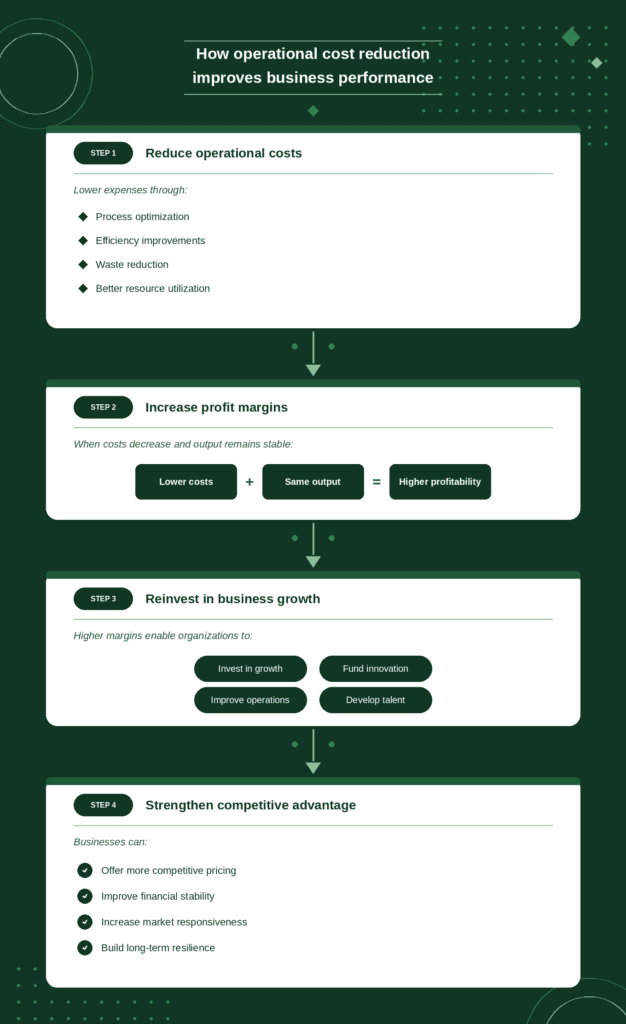
How Operational Cost Reduction Improves Business Performance
A common question is how operational cost reduction improves business margins. In Kenya.
The answer is straightforward:
When operational costs decrease while output remains stable, profit margins increase.
This enables businesses to:
- Improve financial stability
- Reinvest in growth and innovation
- Offer more competitive pricing
- Strengthen resilience during downturns
Cost reduction is therefore not just a savings exercise; it is a profitability strategy.
Why Process Improvement Is Central to Cost Reduction
Process improvement ensures that inefficiencies are addressed at the root cause level rather than treated as symptoms.
Instead of repeatedly fixing problems, organizations redesign workflows to prevent:
- Waste
- Delays
- Errors
- Inefficiencies
This is why most of Kenya’s operational cost reduction consulting engagements begin with process mapping and workflow analysis.
How Businesses Achieve Sustainable Cost Reduction
Sustainable operational cost reduction is achieved through structured systems rather than isolated cost-cutting efforts.
Organizations typically combine:
- Process optimization frameworks
- Operational efficiency improvement methods
- Data-driven decision-making
- Continuous improvement systems
- Expert Kenya operational cost reduction consulting support
Together, these approaches create long-term cost stability and operational resilience.
Conclusion
Operational cost reduction is now a strategic necessity for Kenyan businesses operating in a competitive and cost-sensitive environment.
While external pressures such as inflation and supply chain challenges continue to rise, most cost inefficiencies originate internally through poor processes, waste, and inefficient resource utilization.
Kenyan organizations that invest in structured operational cost reduction strategies are better positioned to improve margins, increase competitiveness, and build long-term resilience.
By focusing on process optimization, waste elimination, operational efficiency, and continuous improvement, businesses can build systems that support sustainable performance; not just short-term savings.
Frequently Asked Questions
Why is operational cost reduction important for Kenyan companies?
It helps businesses control rising expenses, protect profit margins, and remain competitive in a cost-sensitive market environment.
How can operational cost reduction improve business margins in Kenya?
By reducing operational expenses while maintaining output, Kenyan businesses increase profitability without needing additional revenue.
What role does process improvement play in cost reduction in Kenya?
It removes inefficiencies at the root cause level, ensuring cost savings are sustainable rather than temporary.
How do firms achieve sustainable operational cost reduction in Kenya?
Through structured systems like process optimization, continuous improvement, data-driven management, and operational efficiency frameworks.
What are the most effective cost reduction strategies?
Process optimization, waste elimination, operational efficiency improvement methods, and manufacturing cost reduction strategies.