
As operational costs continue to rise across Kenya’s manufacturing industry, many organizations turn to short-term cost-cutting measures such as budget reductions or workforce downsizing. While these approaches may provide temporary relief, they rarely deliver sustainable results because they fail to address the underlying causes of inefficiency.
The real driver of long-term cost reduction is not cutting costs, but improving the processes that create them.
In Kenya, organizations are increasingly achieving operational cost reduction through Process Excellence by improving workflows, eliminating waste, and strengthening operational systems.
Many businesses in Kenya also engage operational cost reduction consulting providers to implement structured, measurable improvement frameworks.
What Is Process Excellence in Cost Reduction?
Process Excellence refers to the systematic design, optimization, and continuous improvement of business processes to maximize efficiency and minimize waste.
It integrates three core disciplines:
- Lean principles for waste elimination
- Six Sigma methodologies for reducing variation
- Continuous improvement systems for long-term performance stability
Instead of treating cost as a financial outcome, Process Excellence focuses on improving the operational system that generates those costs.
Why Process Excellence Is the Foundation of Cost Reduction
Many cost reduction initiatives fail because they focus on financial targets rather than operational causes.
Process Excellence addresses the root drivers of inefficiency, including:
- Poorly designed workflows
- Redundant or unnecessary process steps
- Lack of standardization across teams
- Inefficient resource allocation
- High defect and rework rates
When these issues are resolved, costs naturally decline without compromising output quality or service levels.
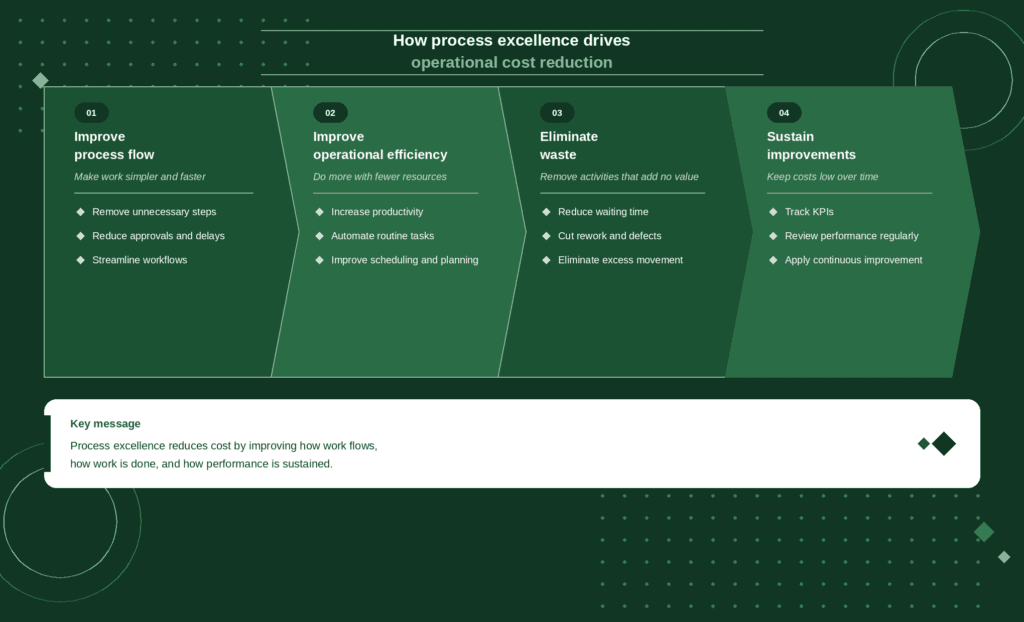
How Process Excellence Drives Operational Cost Reduction
1. Process Optimization for Cost Reduction
A key element of Process Excellence is process optimization for cost reduction, which focuses on redesigning workflows to eliminate inefficiencies.
This typically involves:
- Mapping end-to-end processes
- Removing redundant steps
- Reducing unnecessary approvals and handoffs
- Streamlining decision-making points
Optimized processes reduce delays, improve flow, and significantly lower operational effort.
2. Operational Efficiency Improvement Methods
Operational efficiency improvement methods focus on increasing output using the same or fewer resources.
Common approaches include:
- Workforce productivity balancing
- Automation of repetitive tasks
- Improved scheduling and planning systems
- Better utilization of equipment and resources
These improvements directly reduce cost per unit and improve overall profitability.
3. Waste Elimination Cost Reduction Approach
A central principle of Process Excellence is the waste elimination cost reduction approach, which removes non-value-adding activities.
The types of waste eliminated include:
- Waiting time in workflows
- Excess inventory or overproduction
- Unnecessary movement of materials or people
- Rework caused by defects
- Overprocessing steps that add no value
Eliminating waste improves both cost efficiency and operational speed.
4. Manufacturing Cost Reduction Strategies
In production environments, manufacturing cost reduction strategies are essential for maintaining competitiveness and profitability.
These strategies include:
- Reducing machine downtime
- Improving production line efficiency
- Optimizing batch sizes and scheduling
- Strengthening preventive maintenance systems
- Minimizing scrap and defects
Manufacturing efficiency has a direct impact on cost per unit and overall scalability.
5. Continuous Improvement Cost Control Systems
Sustainable cost reduction depends on continuous improvement cost control systems that ensure ongoing optimization rather than one-time gains.
These systems typically include:
- KPI dashboards and performance tracking
- Regular operational reviews
- Structured problem-solving frameworks
- Employee-driven improvement initiatives
This ensures that efficiency gains are sustained and continuously improved over time.
Role of Consulting in Process Excellence
Many organizations rely on operational cost reduction consulting in Kenya to implement Process Excellence frameworks effectively.
Consultants typically support organizations through:
- Operational diagnostics and gap analysis
- Process mapping and redesign
- Lean and Six Sigma implementation
- Performance measurement systems
- Change management support
Their role is to accelerate transformation and ensure that improvements are measurable and sustainable.
Manufacturing Strategy Consulting Firms in Kenya
In Kenya, manufacturing strategy consulting firms play an important role in aligning Process Excellence with business strategy.
They help organizations:
- Improve production efficiency
- Reduce operational costs
- Strengthen quality systems
- Build scalable operational models
- Support long-term competitiveness
This ensures that cost reduction efforts contribute directly to business growth, not just short-term savings.
How Process Excellence Improves Business Performance
When Process Excellence reduces inefficiencies and improves productivity, businesses lower operational costs while maintaining or increasing output. This directly leads to improved profit margins.
How Firms Achieve Sustainable Cost Reduction in Kenya
Sustainable operational cost reduction is achieved by embedding improvement into business systems rather than treating it as a one-time initiative.
Organizations typically:
- Implement process optimization frameworks
- Adopt operational efficiency improvement methods
- Use continuous improvement systems
- Engage operational cost reduction consulting for expert Kenya-specific support
This creates long-term stability and operational resilience.
What Role Does Process Improvement Play in Cost Reduction in Kenya?
Process improvement plays a central role by identifying inefficiencies at the workflow level and eliminating them at the source.
This prevents recurring waste, reduces operational friction, and ensures that cost savings are sustainable rather than temporary.
Conclusion
Operational cost reduction through Process Excellence is one of the most effective strategies for improving long-term profitability in Kenyan businesses.
Rather than relying on short-term cost-cutting, organizations that focus on Process Excellence build efficient, scalable, and resilient operations.
By implementing structured operational cost reduction strategies in Kenya supported by consulting expertise and continuous improvement systems, businesses can reduce costs while improving performance.
Companies that invest in Process Excellence today position themselves for stronger margins, improved efficiency, and long-term competitive advantage.
FAQs
How can operational cost reduction improve business margins in Kenya?
It improves margins by reducing operational waste and increasing efficiency, allowing businesses to maintain output while lowering costs.
Why is operational cost reduction important for Kenya companies?
It helps businesses remain competitive and profitable in a market where costs are rising and margins are under pressure.
How do firms achieve sustainable operational cost reduction in Kenya?
Through process optimization, continuous improvement systems, and structured operational efficiency methods.
What role does process improvement play in cost reduction in Kenya?
It eliminates inefficiencies at the workflow level, ensuring long-term and sustainable cost savings.
What are the most effective cost reduction strategies?
Process optimization, waste elimination, operational efficiency improvement methods, and continuous improvement systems.
Contact us