Sustainable profitability in Kenya’s increasingly competitive business environment depends on far more than periodic cost-cutting exercises. Many organizations succeed in reducing expenses temporarily through hiring freezes, budget restrictions, or operational tightening, but these gains often fade once pressure eases or growth resumes. The underlying issue is that most cost challenges are not financial; they are structural.
This is why operational cost reduction in Kenya is evolving into a long-term operational discipline focused on improving systems, redesigning processes, and eliminating inefficiencies at their root cause. Instead of reacting to rising costs, organizations are now focusing on how work is designed, executed, and measured.
Across Kenya’s manufacturing sector, businesses are increasingly working with operational cost reduction consulting providers to build structured, repeatable systems that deliver sustainable efficiency improvements rather than temporary savings.
Why Most Cost Reduction Efforts Fail
Traditional cost-cutting strategies often fail because they focus on symptoms rather than causes. While reducing budgets or limiting spending may show short-term improvements on financial statements, the operational inefficiencies that created high costs in the first place remain unchanged.
In many cases, reactive cost reduction leads to unintended consequences such as:
- Reduced service quality and customer satisfaction
- Employee burnout due to excessive workload pressure
- Operational disruptions and delays
- Hidden inefficiencies resurfacing after a short period
- Declining productivity and morale
In Kenya’s dynamic economic environment, external constraints like inflation, energy prices, and supply chain volatility continue to rise. These constraints are especially costly too. Businesses that rely on reactive cost-cutting often find themselves trapped in cycles of repeated savings and recurring inefficiencies.
Sustainable improvement requires a different approach: addressing the design of work itself, not just the cost of work.
Key Drivers of High Operational Costs in Kenya
Understanding the root causes of operational costs is essential before any meaningful reduction can take place. In most Kenyan organizations, high costs are not caused by a single issue but by interconnected inefficiencies across multiple functions.
1. Poor Process Design
Many workflows evolve informally over time without structured optimization. This leads to duplicated tasks, unnecessary approvals, and inefficient sequencing of work.
2. Underutilized Resources
Labor, equipment, and materials are often not fully optimized due to weak planning, forecasting, or scheduling systems.
3. High Error and Rework Rates
Defects in production or service delivery lead to rework, which increases costs without adding value.
4. Supply Chain Inefficiencies
Poor coordination between procurement, inventory, and logistics creates overstocking, stockouts, and avoidable delays.
5. Manual and Fragmented Systems
Many organizations still rely on manual data handling or disconnected systems, increasing administrative burden and error rates.
These internal inefficiencies often contribute more to rising costs than external factors such as inflation or taxes.
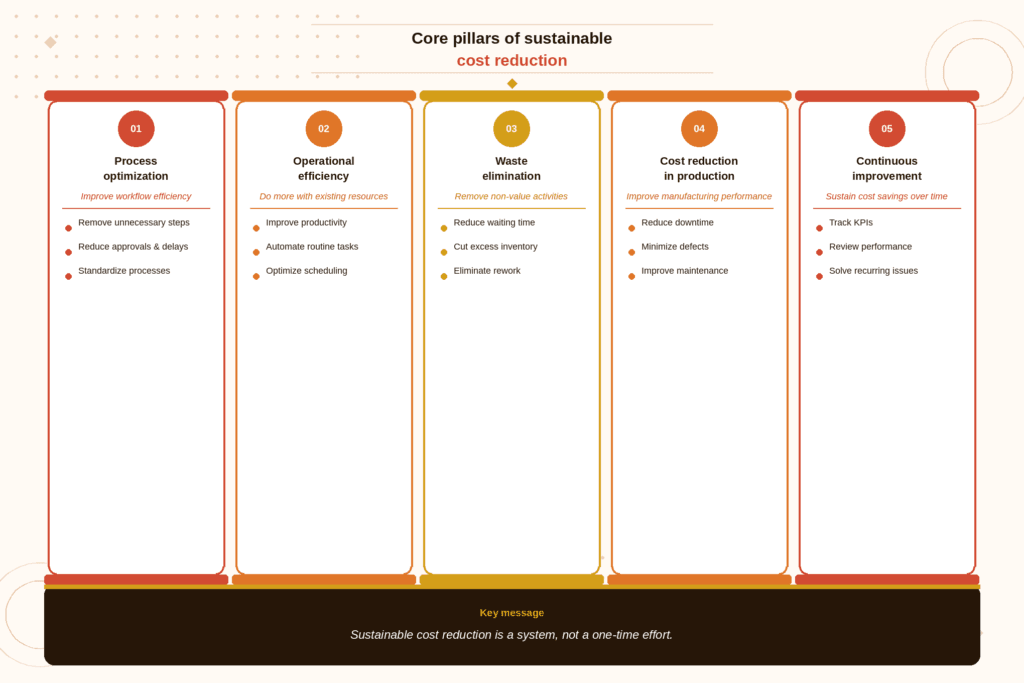
Core Pillars of Sustainable Cost Reduction
Sustainable operational cost reduction is not achieved through isolated interventions. It is built on structured systems that improve how work flows across the organization. Five core pillars form the foundation of long-term cost efficiency.
1. Process Optimization
Process optimization for cost reduction focuses on redesigning workflows to eliminate inefficiencies and improve operational flow.
This typically includes:
- Mapping end-to-end processes to identify delays
- Removing redundant steps and approvals
- Reducing unnecessary handoffs between departments
- Aligning processes with value-adding activities
- Standardizing workflows to reduce variation
In many organizations, structured process redesign can reduce operational time and effort by 20–40% without requiring additional investment.
2. Operational Efficiency Improvement
Methods of operational efficiency improvement aim to increase output while minimizing resource consumption.
These methods include:
- Workforce productivity optimization
- Automation of repetitive tasks
- Improved scheduling and workload balancing
- Better asset and equipment utilization
- KPI-based performance management systems
Efficiency improvements are often the fastest route to cost reduction because they maximize existing capacity rather than requiring new resources.
3. Waste Elimination
A key principle of sustainable cost reduction is the waste elimination approach, which targets non-value-adding activities across operations. Common forms of waste tackled here include:
- Waiting time between process steps
- Excess inventory and overproduction
- Unnecessary movement of people or materials
- Rework caused by defects
- Overprocessing and duplicated effort
Eliminating waste improves both cost structure and operational speed simultaneously, making processes leaner and more predictable.
4. Manufacturing Efficiency
In manufacturing environments, structured manufacturing cost reduction strategies are essential for maintaining competitiveness.
Key strategies include:
- Reducing machine downtime and breakdowns
- Implementing preventive maintenance systems
- Improving production line balancing
- Minimizing scrap and defects
- Optimizing batch sizes and scheduling
Even small improvements in equipment utilization or uptime can significantly increase output without increasing capital investment.
5. Continuous Improvement
Sustainable cost reduction cannot exist without systems that maintain and improve performance over time.
Continuous improvement cost control systems typically include:
- KPI dashboards and performance tracking tools
- Regular operational reviews and audits
- Structured problem-solving frameworks
- Employee-driven improvement programs
- Root cause analysis and corrective action systems
Without these systems, initial cost savings tend to erode within months as old inefficiencies return.
Role of Consulting in Sustainable Cost Reduction
Many organizations in Kenya engage operational cost reduction consulting providers to accelerate and structure transformation efforts.
Consultants typically provide:
- Operational diagnostics and inefficiency identification
- Process redesign and optimization frameworks
- Lean and Six Sigma implementation support
- Performance measurement system design
- Change management and capability building
The value of consulting lies not only in identifying inefficiencies but in ensuring that improvements are implemented correctly and sustained over time.
Consulting Firms for Manufacturing Strategy in Kenya
In Kenya, consulting firms specializing in manufacturing strategy play a critical role in aligning operational improvements with long-term business strategy.
They help organizations:
- Improve production efficiency and throughput
- Reduce overall operational costs
- Strengthen quality management systems
- Build scalable operational models
- Improve supply chain performance and resilience
This ensures that cost reduction initiatives do not operate in isolation but contribute directly to business growth and competitiveness.
Strategic Impact of Sustainable Cost Reduction
When operational cost reduction is embedded into systems rather than treated as a one-time initiative, it creates long-term strategic advantages.
Key benefits include:
- Higher profit margins through reduced waste and inefficiency
- Stronger resilience during economic uncertainty
- Improved competitiveness in local and regional markets
- Scalable operations without proportional cost increases
This shift reframes cost reduction from a defensive action into a strategic growth enabler that supports long-term business sustainability.
Conclusion
Achieving sustainable operational cost reduction in Kenya requires a shift from reactive cost-cutting to structured system improvement. Businesses that focus on process optimization, efficiency improvement, and continuous improvement frameworks build stronger, more resilient operations capable of adapting to changing economic conditions.
Rather than relying on temporary financial controls, organizations in Kenya that invest in operational cost reduction strategies create long-term value through operational discipline and Process Excellence. By leveraging structured consulting support and embedding continuous improvement into daily operations, businesses can reduce costs sustainably while improving overall performance, scalability, and competitiveness.
Frequently Asked Questions
How can operational cost reduction improve business margins in Kenya?
Operational cost reduction improves margins by lowering the cost of operations while maintaining or increasing output. This allows businesses to generate higher profit without increasing revenue.
Why is operational cost reduction important for companies in Kenya?
It is important because rising input costs reduce profitability and competitiveness. Structured cost reduction helps businesses remain efficient, stable, and competitive in challenging markets.
How do firms achieve sustainable operational cost reduction in Kenya?
Firms achieve sustainability through process optimization, continuous improvement systems, waste elimination strategies, and structured operational efficiency improvements that prevent inefficiencies from returning.
What role does process improvement play in cost reduction in Kenya?
Process improvement removes inefficiencies at the workflow level, reducing delays, errors, and waste. This ensures cost reduction is structural and long-lasting rather than temporary.
What are the most effective operational cost reduction strategies in Kenya?
The most effective strategies include process optimization, waste elimination, operational efficiency improvement, and continuous improvement.
Contact us