In many manufacturing facilities, productivity challenges are not always caused by lack of capacity or equipment.
More often, output is affected by small operational inefficiencies that accumulate during daily production and reduce total output over time.
These issues are usually not obvious at first glance, but they directly affect how much a factory produces per shift, per day, and per month.
The good news is that manufacturing productivity can often be improved quickly when the right operational constraints are addressed first.
This article outlines five practical and fast-impact ways manufacturers can increase productivity without major restructuring or long implementation cycles.
1. Reduce Unplanned Downtime During Production
One of the fastest ways to improve manufacturing productivity is to reduce the time machines are not running.
Even short interruptions in production significantly reduce total output over a shift.
In many factories, downtime is caused by:
- Unexpected machine breakdowns
- Missing materials during production
- Delays in maintenance response
- Poor shift handovers
However, there are also hidden forms of downtime that are often ignored, such as:
- Machines waiting for setup adjustments
- Short stops due to minor faults
- Waiting time between production cycles
These small interruptions may not appear serious individually, but together they significantly reduce total output.
Reducing downtime does not always require major investment. Often, it starts with improving readiness before production begins and ensuring quick response when issues occur.
When machines run more consistently, output increases immediately.
2. Improve How Work Flows Between Production Stages
Productivity is often limited not by individual processes, but by delays between processes.
This shows up as:
- Work waiting between departments
- Materials piling up at one stage
- Uneven production speeds across the line
In real factory environments, flow problems often happen because:
- One stage produces faster than the next
- Material handling takes longer than expected
- Work-in-progress (WIP) is not managed properly
When flow is improved, production becomes smoother and more continuous, and bottlenecks reduce naturally.
Even small improvements in flow stability can lead to noticeable increases in daily output because less time is lost between steps.
3. Make Better Use of Machines and Labour During Shifts
In many factories, machines and workers are available but not fully utilized.
Common inefficiencies include:
- Machines sitting idle during production time
- Workers waiting for instructions or materials
- Unbalanced workload across teams
A key reason this happens is not lack of resources, but lack of coordination during active production time.
For example:
- Materials arrive after machines are already idle
- Operators are not assigned immediately to available machines
- Production scheduling does not match real-time conditions
Improving manufacturing productivity often comes down to ensuring that production time is continuously converted into output time.
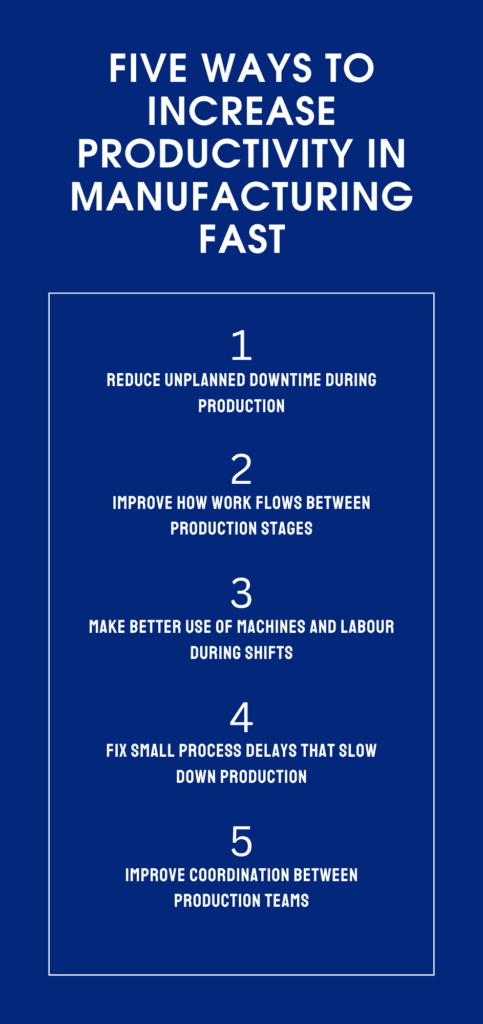
4. Fix Small Process Delays That Slow Down Production
Not all manufacturing productivity losses come from major breakdowns.
Many factories lose time through small, repeated delays such as:
- Slow material retrieval
- Unclear operating steps
- Unnecessary movement between tasks
- Waiting for approvals or instructions
On the shop floor, these delays often feel insignificant, but they accumulate throughout the day.
For example:
- A 2-minute delay repeated 20 times becomes almost an hour of lost production time
- Repeated material searching disrupts machine rhythm
- Unclear instructions cause repeated stoppages
When these small interruptions are removed, production becomes faster and more predictable.
5. Improve Coordination Between Production Teams
Productivity is not only a machine issue; it is also a coordination issue.
In many manufacturing environments, delays happen because teams are not fully aligned during production execution.
This can include:
- Production waiting for materials from procurement
- Maintenance not responding quickly to issues
- Communication gaps between shifts
One of the most common causes is lack of real-time information flow between teams.
When coordination improves:
- Issues are resolved faster
- Downtime reduces
- Production becomes more stable
This has a direct impact on overall factory output.
Why These Five Areas Improve Manufacturing Productivity
These five areas work because they directly affect the time available for production.
Productivity increases when:
- Machines run more consistently
- Less time is lost between processes
- Workers spend more time on productive tasks
- Disruptions are reduced across the system
Unlike long-term transformation projects, these improvements can often deliver results within days or weeks depending on implementation.
How Factories Typically See Results From These Changes
In most manufacturing environments, improvements in productivity do not appear evenly across all areas. Instead, they show up first in the form of reduced delays, smoother shift transitions, and more consistent machine running time.
For example, once downtime is reduced and coordination improves, factories often notice that production no longer “starts and stops” frequently during the day. This creates a more stable rhythm of output, which makes planning and delivery more predictable.
Similarly, when small delays such as waiting for materials or instructions are removed, operators spend more time actively producing rather than waiting or searching for resources. Over time, this shift increases total output without increasing working hours or equipment.
What makes these improvements important is that they compound. A small gain in each area can add up to a significant increase in overall manufacturing productivity across weekly and monthly production cycles.
Why This Matters for Manufacturing in Kenya
Manufacturers in Kenya operate in a competitive environment where delays and inefficiencies directly affect cost and delivery performance.
Improving manufacturing productivity quickly helps factories:
- Increase output without new investment
- Reduce cost per unit
- Improve delivery reliability
- Stay competitive in regional markets
Even small improvements in daily production efficiency can create a significant impact over time.
Once short-term productivity improvements are achieved, the next step is building structured systems that ensure performance is sustained and continuously improved.
This moves from fast fixes to long-term Operational Excellence.
Conclusion
Increasing manufacturing productivity quickly is possible when factories focus on the areas that directly affect production time.
Reducing downtime, improving flow, using resources effectively, removing small delays, and strengthening coordination are some of the fastest ways to improve output.
In manufacturing systems, small operational improvements often lead to immediate and visible performance gains.
FAQs
What is the fastest way to increase manufacturing productivity?
Reducing unplanned downtime is usually the fastest way to increase output.
Why does production slow down even when machines are working?
Because delays often occur between processes, not only within machines.
How can factories improve productivity without new equipment?
By improving flow, reducing delays, and using existing machines and labour more effectively.
What causes small delays in manufacturing?
Common causes include material handling inefficiencies, unclear processes, and coordination gaps.
Can productivity be improved quickly in factories?
Yes, many improvements can deliver results within days or weeks if focused on the right areas.