
Inventory management plays a central role in how businesses operate across Kenya. It directly affects cash flow, customer satisfaction, production continuity, and overall operational efficiency.
However, many companies continue to struggle with recurring challenges such as stockouts, excess inventory, inaccurate records, and unpredictable supply availability.
These issues are rarely caused by a single operational failure. Instead, they result from weak or incomplete inventory management strategies that fail to connect demand planning, procurement, warehousing, and execution into a structured system.
This article explores the key inventory management strategies companies in Kenya need to improve control, efficiency, and overall business performance.
What Inventory Management Means for Companies in Kenya
Inventory management is not just tracking stock or recording purchases. It is the structured system a company uses to:
- Plan what stock is required
- Determine optimal stock levels
- Decide when and how to reorder
- Align inventory with real demand
- Manage working capital tied to stock
When this system is not clearly defined, inventory decisions become reactive. Companies respond to shortages or excess stock after they happen instead of preventing them in advance.
A structured approach ensures inventory supports business operations rather than disrupting them.
Why Inventory Strategy Matters More Than Tools or Software
Many companies invest in inventory software, spreadsheets, or Enterprise Resource Planning (ERP) systems expecting immediate improvement.
While these tools are useful, they cannot fix underlying strategic weaknesses.
The real performance gap is not in tools; it is in how inventory is managed strategically.
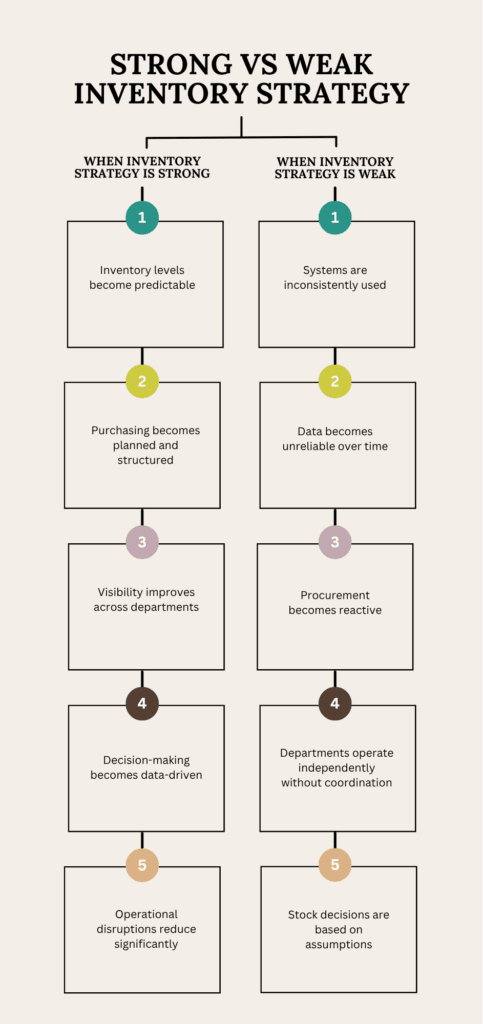
When strategy is weak:
- Systems are inconsistently used
- Data becomes unreliable over time
- Procurement becomes reactive
- Departments operate independently without coordination
- Stock decisions are based on assumptions
When strategy is strong:
- Inventory levels become predictable
- Purchasing becomes planned and structured
- Visibility improves across departments
- Decision-making becomes data-driven
- Operational disruptions reduce significantly
In short, systems execute strategy; they do not replace it.
Key Inventory Management Strategies for Companies in Kenya
Successful companies do not rely on one approach. They combine multiple strategies depending on the nature of their operations.
1. Demand-Driven Inventory Strategy
This strategy focuses on aligning inventory levels with actual and expected demand.
Instead of ordering stock based on assumptions or fixed schedules, companies use:
- Historical sales data
- Seasonal demand patterns
- Consumption trends
- Customer order behavior
This helps reduce both overstocking and stock shortages.
In many Kenyan businesses, demand fluctuations are common due to market conditions, making this strategy especially important for stability.
2. Inventory Segmentation Strategy (ABC Approach)
Not all inventory items have the same importance or impact on business performance. Inventory segmentation helps companies categorize stock into groups such as:
- High-value or critical items
- Fast-moving products
- Slow-moving or low-priority stock
This classification allows better prioritization of attention, storage space, and financial resources.
High-impact inventory receives tighter control, while lower-priority stock is managed with simpler processes. This improves efficiency without increasing operational complexity.
3. Reorder Point and Replenishment Strategy
One of the most common causes of inventory disruption is unclear replenishment timing.
A structured reorder strategy ensures:
- Clear stock thresholds are defined
- Lead times are factored into planning
- Safety stock levels are established
- Procurement is triggered before stockouts occur
This reduces emergency purchasing, which is often more expensive and disruptive. It also ensures that operations such as production or sales are not interrupted due to missing materials.
4. Supplier and Lead Time Management Strategy
Inventory performance is closely tied to supplier reliability. Even well-planned inventory systems fail if suppliers are inconsistent.
Companies that are able to manage it well typically:
- Understand supplier lead time variability
- Build buffer planning into procurement cycles
- Evaluate supplier performance regularly
- Reduce dependence on unstable supply sources
In Kenya’s business environment, where supply chain delays can occur, this strategy is essential for maintaining continuity.
5. Inventory Visibility and Control Strategy
Without visibility, inventory management becomes guesswork.
This strategy focuses on ensuring companies can clearly track:
- Available stock at any given time
- Physical location of inventory across facilities
- Rate at which items are moving through inventory
- Replenishment needs
Improved visibility reduces duplication, errors, and unnecessary purchasing. It also improves coordination between procurement, warehouse, and finance teams.
6. Inventory Process Standardization Strategy
Many inventory problems occur because processes are not consistent across teams or locations.
Standardization ensures that:
- Stock is recorded the same way across departments
- Receiving and issuing procedures are consistent
- Documentation follows a defined structure
- Responsibility is clearly assigned
This reduces human error and improves reliability of inventory data over time.
Without standardization, even good systems gradually become unreliable.
Common Reasons Inventory Strategies Fail in Companies
Even when companies understand inventory strategy, implementation often fails due to operational gaps such as:
- Weak coordination between departments
- Inconsistent or delayed data entry
- Lack of forecasting discipline
- Over-reliance on manual tracking methods
- Absence of clear accountability for inventory accuracy
These issues turn inventory management into a reactive process instead of a structured system.
How Inventory Strategy Improves Business Performance
When properly designed and implemented, inventory strategies improve core business outcomes such as:
- Better cash flow management by reducing excess stock
- Improved order fulfillment and customer satisfaction
- Fewer production or sales disruptions
- More accurate procurement planning
- Reduced operational waste and inefficiency
Inventory becomes a controlled asset rather than a constant operational risk.
Why This Matters for Companies in Kenya
Businesses in Kenya operate in environments characterized by:
- Fluctuating demand patterns
- Supply chain delays and variability
- Working capital constraints
- Competitive market pressure
In this context, inventory management is not just an operational function; it is a strategic business capability.
Companies that implement structured inventory strategies are better positioned to:
- Maintain consistent service levels
- Respond effectively to market changes
- Optimize working capital usage
- Scale operations sustainably
Inventory strategy directly influences both stability and growth potential.
Conclusion
Inventory management in Kenya is not simply about tracking stock; it is about building structured strategies that connect demand, supply, and operations into a coherent system.
Companies that implement clear inventory management strategies are able to improve visibility, reduce inefficiencies, and strengthen financial and operational performance.
In today’s competitive environment, inventory strategy is not optional; it is a core driver of business stability and growth.
FAQs
What is inventory management in companies?
It is the structured process of planning, controlling, and optimizing stock levels to support business operations.
Why is inventory strategy important?
Because it ensures inventory levels match demand while maintaining efficiency and controlling costs.
What are the main inventory management strategies?
Demand planning, segmentation, reorder systems, supplier management, visibility, and process standardization.
Why do inventory strategies fail in companies?
Because of poor execution, weak coordination, and inconsistent data management.
Can inventory strategy improve profitability?
Yes, by reducing waste, improving cash flow, and preventing unnecessary stock buildup.