Waste reduction in Manufacturing Industry is the primary driver of efficiency — not just production speed or installed capacity. It is largely determined by how much of a factory’s time, resources, and effort are actually spent on value-adding production activities.
In many manufacturing operations in Kenya; efficiency losses are rarely caused by equipment shortages. Instead, they are driven by operational waste such as downtime, rework, poor workflow design, and inconsistent production execution.
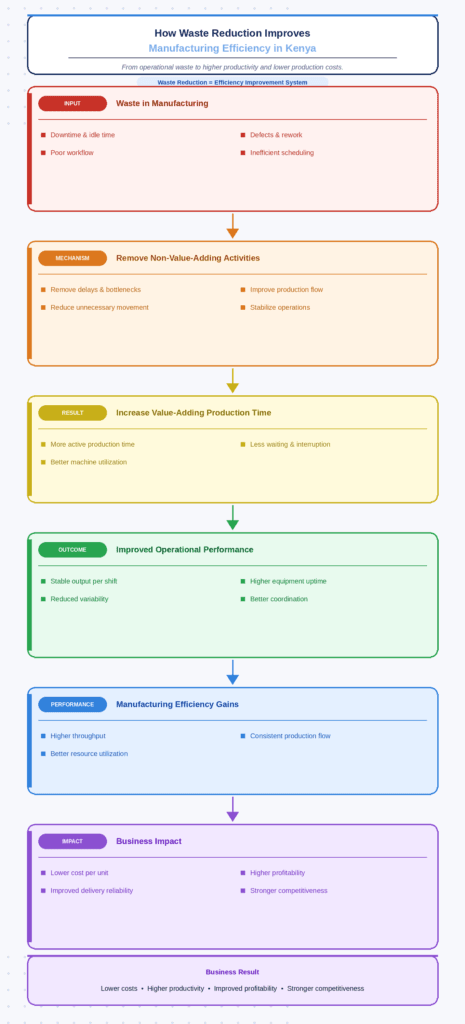
Waste reduction improves efficiency by removing non-value-adding activities, stabilizing production flow, and increasing the proportion of time spent on productive work. The result is higher output using the same resources.
This article explains how waste reduction improves manufacturing efficiency from an operational and systems perspective.
Waste Reduction in Manufacturing Industry: The Relationship Between Waste and Efficiency
Manufacturing efficiency refers to how effectively inputs such as labor, materials, energy, and machine time are converted into finished products.
Waste reduces this efficiency by consuming resources without contributing to output. Common forms include:
- Production downtime that interrupts workflow
- Defects and rework that duplicate effort
- Idle time caused by poor scheduling or bottlenecks
- Excess movement of materials and operators
- Poor production planning leading to imbalance
- Inefficient use of equipment capacity
In many factories, a significant portion of available production time is lost to non-value-adding activities, reducing overall output without any change in installed capacity.
What Waste Reduction Means in Manufacturing
In manufacturing systems, waste reduction refers to the structured elimination of non-value-adding activities in order to improve productivity, reduce cost per unit, and increase operational efficiency.
It focuses on improving how production systems function, not simply increasing production speed.
At a system level, it involves:
- Improving flow of materials and work
- Reducing operational interruptions
- Increasing process consistency
- Enhancing equipment utilization
- Improving planning and coordination across production stages
How Waste Reduction Improves Manufacturing Efficiency
1. Increases the Proportion of Value-Adding Time
One of the most important effects of waste reduction is increasing the percentage of time spent on actual production work.
When inefficiencies such as waiting, delays, and unnecessary handling are reduced, more time is available for value-adding activities, improving overall output without increasing workload.
2. Improves Production Flow Stability
Efficiency improves when production processes move in a smooth and predictable sequence.
Waste reduction helps eliminate interruptions caused by:
- Unbalanced workloads
- Material handling delays
- Poor sequencing of operations
As flow stabilizes, production becomes more consistent across shifts, reducing variability in output.
3. Reduces Downtime and Improves Equipment Utilization
Equipment downtime reduces effective production time and limits factory output.
When maintenance systems are structured and operational discipline improves, machines operate more reliably, leading to:
- Fewer unexpected stoppages
- More consistent production schedules
- Higher utilization of installed capacity
Even small improvements in uptime can significantly increase total output.
4. Improves Workforce Productivity
Waste often exists in how work is organized rather than in the workforce itself.
Inefficiencies such as unclear procedures, inconsistent task execution, and poor shift coordination reduce productivity.
When processes are standardized and workflows are clearly defined:
- Operators perform tasks more consistently
- Training becomes more effective
- Output variation between shifts reduces
This increases productivity without increasing labor costs.
5. Reduces Defects and Rework
Defects reduce efficiency because they require additional materials, time, and labor to correct.
Waste reduction improves quality performance by:
- Reducing process variation
- Strengthening operational discipline
- Improving in-process checks and controls
Fewer defects mean more of the factory’s effort results in usable output.
6. Improves Visibility for Operational Decision-Making
Efficiency improves when production performance is visible in real time.
Waste reduction systems improve visibility by strengthening tracking of:
- Downtime patterns
- Production output per shift
- Process performance indicators
This allows faster response to inefficiencies and reduces reliance on delayed reporting.
The Role of Structured Manufacturing Systems
Improving efficiency through waste reduction is typically supported by structured manufacturing systems such as Lean-based operational models.
These systems focus on eliminating non-value-adding activities across production processes, improving workflow discipline, and increasing operational stability.
In most manufacturing environments, structured systems lead to:
- More predictable production cycles
- Improved coordination between processes
- Reduced operational variability
- Higher throughput using existing resources
Why Inefficiencies Persist in Manufacturing Systems
Despite awareness of waste reduction principles, inefficiencies persist due to:
- Inconsistent operational standards
- Reactive maintenance practices
- Limited production visibility
- Weak process discipline across shifts
- Fragmented improvement efforts
These issues reinforce one another, making inefficiencies persistent unless addressed systematically.
How Manufacturers Improve Efficiency Through Waste Reduction
A structured improvement approach typically includes:
- Identifying key sources of operational waste
- Improving production flow and coordination
- Strengthening maintenance reliability
- Standardizing work execution
- Improving production monitoring and feedback systems
Sustainable improvement depends on system-level changes rather than isolated fixes.
Business Impact of Improved Efficiency
When waste is reduced, manufacturing efficiency improves across multiple dimensions:
Operational Impact
- Higher throughput using existing resources
- More stable production flow
- Reduced downtime
Financial Impact
- Lower cost per unit
- Reduced rework and scrap
- Improved profitability
Strategic Impact
- Increased competitiveness
- Better delivery reliability
- Improved scalability of operations
Conclusion
Waste reduction improves manufacturing efficiency by increasing value-adding production time, stabilizing workflows, improving equipment reliability, and enhancing overall system performance.
In Kenya’s manufacturing environment, where cost pressures and operational constraints are significant, improving efficiency through waste reduction provides a practical path to higher productivity without major capital investment.
Ultimately, efficiency gains are not achieved by working harder or faster, but by designing systems that eliminate unnecessary work.
FAQs
How does waste reduction improve manufacturing efficiency in Kenya?
Waste reduction increases value-adding production time by reducing downtime, defects, and process inefficiencies.
What is waste reduction in manufacturing?
It is the elimination of non-value-adding activities in production systems to improve efficiency and reduce cost.
Why is waste reduction important in manufacturing?
Because waste reduces output, increases costs, and limits the productive use of resources.
What are the main benefits of waste reduction for efficiency?
Higher throughput, lower downtime, improved quality, and more consistent production performance.
How do manufacturers improve efficiency through waste reduction?
By improving workflow, reducing operational waste, stabilizing processes, and strengthening production visibility.
Contact us