Manufacturing waste reduction is driven by a set of structured industrial techniques used to identify, measure, and eliminate inefficiencies across production systems.
Across Kenya’s industries, manufacturing waste reduction initiatives focus on reducing downtime, improving workflow efficiency, and increasing production stability without requiring additional capital investment.
In most factories, waste reduction is achieved through the combined application of manufacturing efficiency improvement techniques that operate across production, maintenance, quality, and planning systems.
Unlike strategic frameworks that define operational direction, these manufacturing waste reduction techniques function at the execution level in Kenya, directly influencing how production work is performed on the shop floor.
What Waste Means in Manufacturing Systems
In industrial engineering, waste refers to any activity that consumes resources without adding value to the final product.
In Kenyan manufacturing environments, waste typically appears in the following forms:
- Time waste (waiting, idle machines, delayed changeovers)
- Material waste (scrap, defects, rework cycles)
- Motion waste (unnecessary operator or material movement)
- Capacity waste (underutilized machines or labor)
- Flow waste (production imbalance and bottlenecks)
These inefficiencies often exist simultaneously within the same production system, reinforcing each other and reducing overall manufacturing efficiency.
Why Waste Persists in Kenya’s Manufacturing Operations
Despite the adoption of manufacturing waste reduction techniques, inefficiencies persist due to structural and operational limitations such as:
- Production systems that evolved without formal redesign
- Reactive maintenance rather than preventive systems
- Limited real-time production data visibility
- Inconsistent standard operating procedures(SOPs) across shifts
- Weak integration between planning and execution functions
These conditions make inefficiencies difficult to detect without structured manufacturing productivity optimization systems that combine measurement, analysis, and execution.
Core Manufacturing Waste Reduction Techniques Used in Kenya
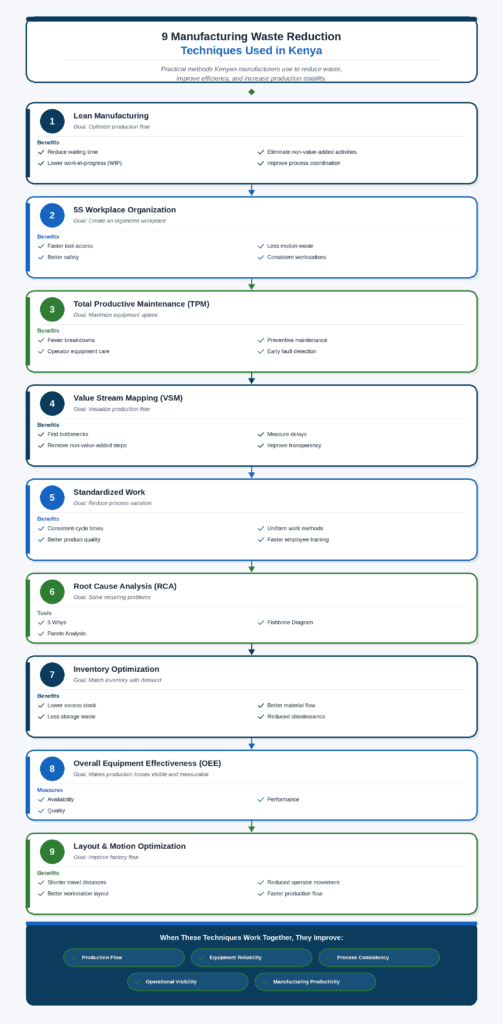
The following techniques represent the most widely applied manufacturing efficiency improvement techniques in Kenya.
1. Lean Manufacturing for Process Flow Optimization
Lean manufacturing is a system-level manufacturing efficiency improvement technique focused on optimizing flow across the entire production system.
It is applied to:
- Improve production flow between processes
- Reduce waiting time and delays
- Minimize work-in-progress (WIP) buildup
- Eliminate non-value-adding activities
In Kenya, Lean manufacturing is primarily used to improve flow efficiency and system coordination rather than optimize isolated operations.
2. 5S Workplace Organization System
5S is a foundational manufacturing waste reduction technique used to improve workplace structure, discipline, and visual control.
It is used to:
- Reduce time wasted searching for tools or materials
- Standardize workplace organization across shifts
- Reduce motion waste on the shop floor
- Improve safety and operational consistency
5S is often the starting point for manufacturing process waste reduction methods in Kenya because it stabilizes the working environment.
3. Total Productive Maintenance (TPM)
Total Productive Maintenance (TPM) is a manufacturing efficiency improvement technique focused on maximizing equipment reliability and uptime.
It is applied to:
- Reduce unplanned machine breakdowns
- Improve preventive maintenance routines
- Involve operators in basic equipment care
- Detect early signs of equipment failure
TPM plays a critical role in production waste control strategies in Kenya by improving production predictability and reducing downtime losses.
4. Value Stream Mapping (VSM)
VSM is a diagnostic manufacturing waste reduction technique used to visualize end-to-end production flow.
It is used to:
- Identify bottlenecks in production systems
- Measure waiting time between processes
- Highlight non-value-adding activities
- Improve system-level transparency
VSM is widely used in manufacturing productivity optimization programs across Kenya to convert operational inefficiencies into measurable data.
5. Standardized Work Procedures
Standardized work is a manufacturing efficiency improvement technique used to reduce variability in production execution.
It ensures:
- Consistent cycle times across shifts
- Uniform task execution methods
- Reduced variation in output quality
- Faster onboarding of new operators
Standardization is essential for scaling manufacturing efficiency through waste reduction in multi-shift environments.
6. Root Cause Analysis (RCA)
RCA is a manufacturing waste reduction technique used to eliminate recurring operational problems at their source.
It is applied using:
- 5 Whys analysis
- Fishbone (Ishikawa) diagrams
- Pareto analysis
RCA ensures that manufacturing process waste reduction methods address structural causes rather than recurring symptoms.
7. Inventory Optimization Techniques
Inventory optimization is focused on aligning inventory levels with actual production demand.
It helps to:
- Reduce excess stock levels
- Improve material flow efficiency
- Minimize storage constraints
- Prevent obsolescence and waste
This ensures inventory supports manufacturing productivity optimization objectives rather than creating hidden inefficiencies.
8. Overall Equipment Effectiveness (OEE)
OEE is a manufacturing performance measurement technique used to quantify production losses.
It measures:
- Availability losses (downtime)
- Performance losses (slow cycles)
- Quality losses (defects)
OEE is widely used in Kenya as a manufacturing efficiency improvement technique to make waste visible, measurable, and actionable.
9. Layout and Motion Optimization
Layout and motion optimization is a waste reduction technique focused on improving physical flow within production facilities.
It is used to:
- Reduce unnecessary material transportation
- Minimize operator movement
- Improve workstation placement
- Shorten production flow distances
This technique improves manufacturing efficiency by reducing physical inefficiencies in factory design.
How Manufacturing Waste Reduction Techniques Are Applied in Kenya
In most waste reduction programs, techniques are applied in a structured operational sequence:
- Assess current production performance using KPIs
- Identify major sources of operational waste
- Apply targeted manufacturing waste reduction techniques
- Standardize improved processes across shifts
- Monitor performance using continuous measurement systems
This structured approach ensures efficiency improvement techniques deliver consistent and measurable results across production systems.
System Integration Perspective
Waste reduction in manufacturing is most effective when techniques are applied as an integrated system rather than isolated improvements.
When Lean manufacturing, TPM, 5S, VSM, RCA, and OEE are combined, they create a connected improvement framework that strengthens:
- Production flow stability
- Equipment reliability
- Process consistency
- Operational visibility
This system-based approach is what differentiates sustainable productivity optimization programs from short-term improvement initiatives.
Conclusion
In Kenya’s manufacturing sectors, waste reduction techniques form the operational foundation for improving efficiency, reducing production losses, and stabilizing manufacturing performance.
When applied consistently, these techniques improve flow, reduce downtime, enhance process reliability, and increase overall system productivity.
In modern manufacturing environments, competitiveness is increasingly determined by how effectively these techniques are implemented across the production system.
Ultimately, manufacturing performance improves not through isolated fixes, but through the structured application of integrated waste reduction techniques across all operational layers.
Frequently Asked Questions
What are manufacturing waste reduction techniques in Kenya?
They are structured industrial methods used to eliminate inefficiencies such as downtime, defects, and process imbalance in manufacturing systems.
What are the most common manufacturing waste reduction techniques?
Common techniques include Lean manufacturing, 5S, TPM, Value Stream Mapping (VSM), Root Cause Analysis (RCA), and OEE tracking.
How does lean manufacturing reduce waste?
Lean manufacturing improves efficiency by optimizing production flow, reducing delays, and eliminating non-value-adding activities.
Why is 5S important in manufacturing waste reduction?
5S improves workplace organization, reduces motion waste, and creates consistent working conditions across production shifts.
What is the role of OEE in waste reduction?
OEE measures equipment performance and helps identify availability, performance, and quality losses in manufacturing systems.