Supply chains today operate in an environment defined by volatility. Global disruptions, inflationary pressure, shifting trade dynamics, and logistics instability have made risk management a central pillar of business continuity rather than a supporting function.
In Kenya, where businesses are increasingly integrated into regional and global trade networks, supply chain resilience has become a competitive differentiator. Organizations are moving away from reactive problem-solving toward structured risk anticipation and system-wide preparedness.
This shift has increased demand for supply chain consultant’s expertise, as companies seek to design more intelligent, adaptive, and resilient operating models.
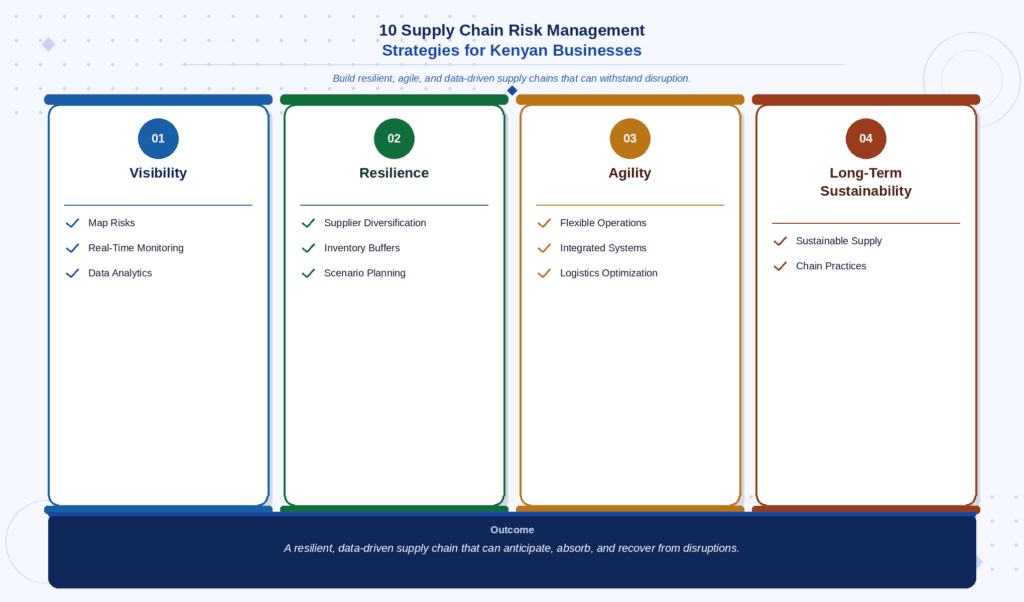
This article explores practical, proven strategies for strengthening supply chain risk management in Kenya through visibility, analytics, diversification, and operational transformation.
1. Understanding and Mapping Supply Chain Exposure
Effective risk management begins with clarity. Many disruptions become critical not because they are unpredictable, but because they are not visible early enough within the system.
A structured risk assessment typically examines the entire supply chain, from sourcing and production to distribution and last-mile delivery, to identify points of vulnerability.
Common exposure areas include supplier dependency, transportation delays, demand volatility, currency fluctuations, and regulatory constraints.
When mapped correctly, these risks stop being abstract challenges and become actionable priorities that can be systematically addressed through targeted operational improvements.
2. Building End-To-End Supply Chain Visibility
One of the most persistent weaknesses in supply chain systems is fragmented visibility. Without real-time operational insight, businesses often respond after disruptions have already impacted performance.
Modern supply chain systems are increasingly integrating digital dashboards, Enterprise Resource Planning (ERP) platforms, and logistics tracking tools to provide a unified operational view.
This visibility extends across inventory movement, supplier performance, demand signals, and shipment tracking.
The result is not just better reporting, but faster and more accurate decision-making, allowing organizations to respond before small inefficiencies escalate into major disruptions.
3. Strengthening Resilience Through Supplier Diversification
Over-reliance on a limited number of suppliers remains one of the most significant structural risks in supply chain design.
A more resilient approach involves diversifying sourcing strategies across multiple suppliers and, where possible, across different geographic regions.
This reduces exposure to localized disruptions such as production shutdowns, transport delays, or regulatory changes.
It also introduces flexibility into procurement systems, enabling businesses to switch suppliers when risk thresholds are exceeded.
In practice, supplier diversification is one of the most effective ways to stabilize operations in uncertain environments.
4. Using Data to Anticipate and Manage Risk
Data has become the foundation of modern supply chain resilience. Without it, risk management remains reactive and fragmented.
Through integrated analytics systems, businesses can monitor demand fluctuations, supplier reliability, inventory movement, and logistics performance in real time.
This enables early identification of disruption patterns and supports more informed planning decisions.
Rather than relying on static forecasts, organizations are increasingly adopting adaptive models that continuously refine predictions based on live data. This shift significantly improves both speed and accuracy in operational decision-making.
5.Inventory as a Strategic Risk Buffer
Inventory is no longer just a cost component, it is a strategic control mechanism in supply chain stability.
Poorly managed inventory systems either tie up excessive capital or leave businesses exposed during supply interruptions.
A balanced approach focuses on maintaining optimal safety stock levels while minimizing excess holding costs.
When properly structured, inventory systems act as buffers that absorb shocks without disrupting production or delivery schedules.
This balance between efficiency and resilience is now a core principle in modern supply chain design.
6. Designing Agile Supply Chain Systems
Traditional supply chains were built for efficiency. Modern supply chains must be built for adaptability.
Agility allows businesses to respond quickly to unexpected changes in demand, supply, or logistics conditions. This includes the ability to reroute shipments, adjust production schedules, and shift suppliers when necessary without operational breakdowns.
Agile supply chain systems rely heavily on digital integration and flexible operating structures that support rapid decision-making.
In volatile environments, agility often determines whether disruptions become minor delays or major failures.
7. Scenario Planning and Proactive Risk Simulation
One of the most effective approaches to supply chain resilience is scenario planning.
Instead of reacting to disruptions, organizations simulate potential risk events such as supplier failure, fuel price increases, port congestion, or currency fluctuations.
These simulations allow businesses to pre-design response strategies that can be activated immediately when needed.
This approach reduces uncertainty and strengthens organizational preparedness across multiple risk categories.
It shifts supply chain management from reactive correction to structured anticipation.
8. Integrating the Supply Chain Into a Unified System
Fragmented supply chains are inherently more vulnerable to disruption due to lack of coordination and inconsistent data flow.
A more resilient model involves integrating procurement, production, inventory, logistics, and distribution into a single connected system.
This end-to-end integration improves visibility, reduces inefficiencies, and ensures that decisions are aligned across all operational layers.
The result is a more stable and predictable supply chain structure that can scale effectively under changing conditions.
9. Sustainability as Part of Risk Resilience
Sustainability is increasingly intersecting with supply chain risk management. Environmental compliance, energy volatility, and resource constraints are becoming real operational risks rather than external considerations.
Sustainable supply chain practices: such as optimized routing, reduced emissions, and responsible sourcing; help reduce exposure to these risks while improving long-term cost stability.
As global ESG (Environmental, Social, and Governance) expectations rise, sustainability is also becoming a requirement for market access and competitiveness.
10. Strengthening Logistics and Distribution Networks
Logistics remains one of the most risk-sensitive areas of the supply chain, particularly in regions with infrastructure constraints.
Improving transport efficiency, optimizing delivery routes, and strengthening last-mile systems significantly reduces exposure to disruption.
Real-time shipment tracking and improved coordination between logistics partners further enhance reliability.
A well-structured distribution network ensures continuity even under external pressure.
11. The Evolving Role of Supply Chain Consultant
The role of supply chain consulting has shifted from operational troubleshooting to strategic system design.
Today, the focus is on building resilient, data-driven, and adaptive ecosystems rather than fixing isolated inefficiencies.
Key strategic questions now include how to build resilience into sourcing, how to optimize inventory under uncertainty, and how to reduce systemic exposure to risk.
This evolution reflects a broader shift in how businesses approach supply chain management in Kenya, moving from reactive operations to proactive system design.
Conclusion
Supply chain risk management has become a core requirement for business stability and growth in Kenya’s evolving economic environment.
Organizations that build visibility, diversify supply sources, integrate data systems, and adopt agile operating models are significantly better positioned to withstand disruption.
The future of supply chain performance will not be defined by efficiency alone, but by resilience, adaptability, and intelligence built into the system itself.
FAQs
What is supply chain risk management?
It is the process of identifying, assessing, and mitigating risks that can disrupt the flow of goods, services, or information across a supply chain.
Why is supply chain visibility important?
Supply chain visibility enables early detection of disruptions and supports faster, more accurate decision-making.
How does inventory help in risk management?
Inventory acts as a buffer that protects operations during supply interruptions while maintaining service continuity.
What makes a supply chain resilient?
Resilience comes from diversification, visibility, data-driven planning, and flexible operational design.
How do companies reduce supply chain risk?
By combining supplier diversification, scenario planning, digital monitoring, and integrated supply chain systems.
Contact us