Operational Efficiency in Manufacturing has become critical as Kenya’s industry operates under increasing pressure from rising input costs, energy instability, import dependency, and tighter regional competition under AfCFTA. In this environment, Operational Excellence is no longer a theoretical framework; it is a practical execution system that determines whether factories remain competitive or fall behind.
Unlike generic efficiency programs, Operational Excellence in manufacturing in Kenya is most effective when applied as a set of prioritized, field-tested execution strategies focused on flow, uptime, quality, and discipline at the shop-floor level.
This article outlines the most impactful Operational Excellence strategies used in Kenyan manufacturing environments, based on real factory constraints and implementation realities.
Insight: What Actually Drives Results First
In most Kenyan manufacturing plants, performance improvement does not come equally from all initiatives.
Typical impact distribution:
- Bottleneck elimination → 25–40% throughput impact
- Maintenance system stability → 20–35% downtime reduction
- Changeover optimization → 15–30% capacity gain
- Standard work enforcement → 10–25% defect reduction
- Continuous improvement systems → long-term compounding gains
Most factories fail because they implement “everything at once” instead of focusing on constraints first.
1. Bottleneck Elimination Strategy (Flow First Principle)
Most Kenyan factories do not suffer from overall inefficiency; they suffer from one or two dominant constraints that dictate total output.
Execution approach:
- Map full production flow end-to-end
- Identify the slowest constraint operation
- Measure queue buildup before and after constraint
- Increase capacity only at the constraint point
- Balance upstream and downstream workloads accordingly
Why it matters:
Improving non-bottleneck processes creates “false efficiency”; local improvements with no system-wide impact.
Kenya reality:
Many plants over-invest in fast machines while ignoring slow manual stations that actually limit throughput.
2. Planned Maintenance & Uptime Stability Strategy
Unplanned downtime remains one of the biggest hidden cost drivers in Kenyan manufacturing.
Common reality in factories:
- Reactive maintenance culture (“fix when it breaks”)
- Limited spare parts availability delays repairs
- Weak equipment history tracking
Execution approach:
- Implement preventive maintenance schedules per machine
- Track MTBF (Mean Time Between Failures)
- Introduce operator-level basic maintenance routines (autonomous maintenance)
- Maintain critical spare parts inventory buffers
Impact:
- 20–40% reduction in unplanned downtime
- More stable production planning cycles
- Improved asset lifespan and utilization
This is often the first major stability lever in Operational Excellence consulting engagements in Kenya.
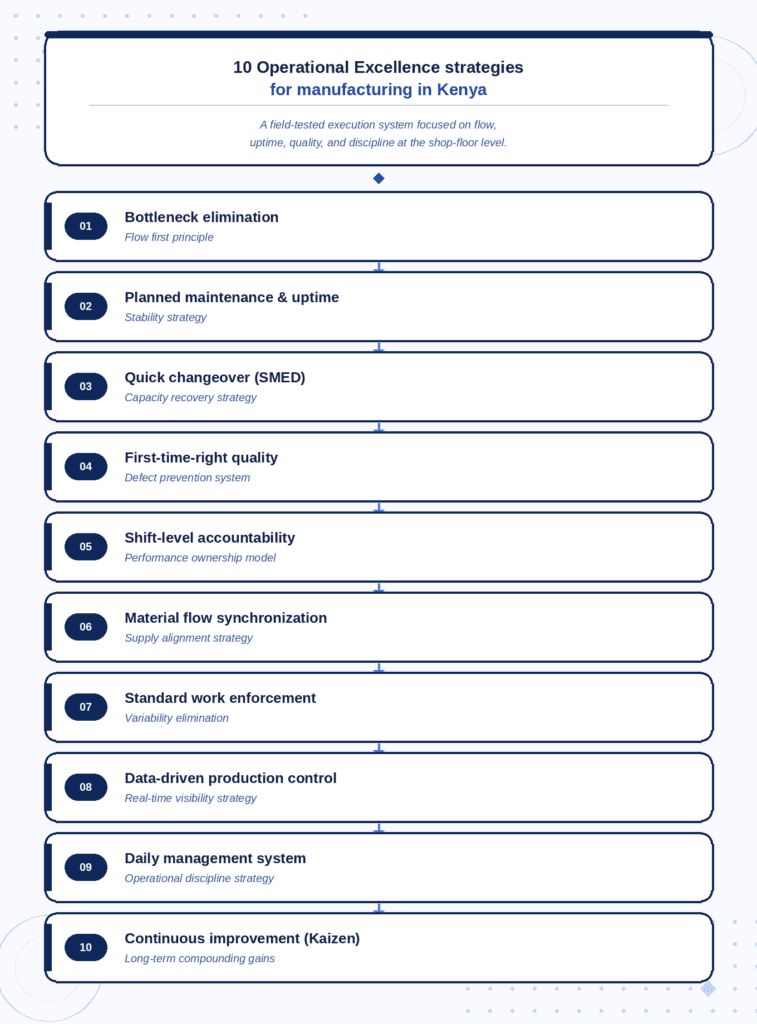
3. Quick Changeover Strategy (SMED, or Single-Minute Exchange of Dies System)
Long machine changeovers are a silent capacity killer in batch-based manufacturing.
Execution approach:
- Separate internal vs external setup activities
- Pre-stage tools, materials, and change parts before stoppage
- Standardize changeover steps into documented sequences
- Train operators for parallel execution of tasks
Kenya-specific constraint:
Many factories lose 1–3 hours per changeover due to informal setup methods and missing tooling readiness.
Impact:
- 15–30% increase in usable machine time
- More production cycles per shift
- Reduced batch delays and scheduling pressure
4. First-Time-Right Quality Strategy (Defect Prevention System)
Many Kenyan factories operate on a “inspect and fix” model instead of “build quality at source.”
Execution approach:
- Identify top recurring defect categories (Pareto focus)
- Conduct root cause analysis (5 Whys / Fishbone)
- Introduce in-process quality checkpoints
- Empower operators with stop-the-line authority
Kenya reality:
In many businesses, defects are accepted as “normal production loss” rather than system failures.
Impact:
- 20–50% reduction in rework
- Lower material waste
- Improved customer consistency and fewer returns
5. Shift-Level Accountability System (Performance Ownership Model)
One of the most overlooked inefficiencies in Kenyan manufacturing is lack of shift ownership clarity.
Execution approach:
- Assign KPIs per shift (not only plant-level KPIs)
- Track output, downtime, scrap per shift
- Conduct structured 10–15 minute shift handover meetings
- Use visible daily performance boards on shop floor
Impact:
- 10–25% productivity improvement without capital investment
- Reduction in “invisible downtime”
- Improved discipline and accountability
In Kenya, this is a low-cost but high-impact operational performance optimization lever.
6. Material Flow Synchronization Strategy
Even efficient machines fail when materials do not arrive on time or in the correct sequence.
Execution approach:
- Implement pull systems (Kanban where possible)
- Define minimum/maximum inventory thresholds
- Reduce batch size variability
- Align procurement schedules with production planning
Kenya reality:
Material delays are often caused by procurement lag, import lead times, and poor internal coordination.
Impact:
- Reduced idle machine time
- Lower working capital tied in inventory
- Improved production continuity
7. Standard Work Enforcement Strategy
Variability in execution is one of the biggest hidden causes of inefficiency.
Execution approach:
- Document best-known method for each task
- Train all operators to standard method
- Audit adherence weekly
- Update standards when improvements are validated
Kenya reality:
In many plants, “how work is done” depends on individual operator habits rather than defined systems.
Impact:
- 15–35% reduction in process variation
- Stable cycle times across shifts
- Predictable output quality
8. Data-Driven Production Control Strategy
Many factories still rely on manual logs or delayed reporting, limiting decision speed.
Execution approach:
- Track Overall Equipment Effectiveness (OEE)
- Digitize downtime categorization
- Implement real-time production dashboards
- Standardize data capture at machine level
Kenya constraint:
Low adoption of Manufacturing Execution Systems (MES) and Enterprise Resource Planning (ERP) systems in factories leads to decision-making delays of 1–2 shifts.
Impact:
- Faster root cause identification
- Improved production planning accuracy
- Reduced firefighting culture
9. Daily Management System (DMS Strategy)
Without structured daily control, even good improvements degrade over time.
Execution approach:
- 15–30 minute daily production review meetings
- Visual KPI boards on shop floor
- Defined escalation rules for deviations
- Standard problem-resolution workflow
Impact:
- Sustains performance improvements
- Reduces operational drift
- Builds management discipline at floor level
This is a core pillar in Kenya for mature Operational Excellence service systems.
10. Continuous Improvement System (Kaizen Engine)
Sustainable Operational Excellence depends on embedding improvement into daily operations.
Execution approach:
- Weekly Kaizen problem-solving sessions
- Employee suggestion systems (structured, not informal)
- Root cause analysis culture (5 Whys discipline)
- Monthly performance review cycles
Impact:
- Continuous incremental efficiency gains
- Strong operational culture
- Long-term competitiveness improvement
How Operational Efficiency in Manufacturing Works as a System
Operational Excellence is not a collection of tools; it is a system of interdependent improvements:
- Bottleneck elimination drives flow
- Maintenance stabilizes uptime
- SMED increases capacity
- Standard work stabilizes output
- Daily management sustains discipline
- Continuous improvement compounds gains
Together, they form a self-reinforcing manufacturing Operational Excellence system in Kenya.
Conclusion
In Kenyan manufacturing environments, the biggest constraint is rarely technology.
It is execution discipline across shifts, machines, and supervisory layers.
Factories that outperform competitors are not those with the most advanced systems, but those that consistently apply structured operational discipline every single day.
FAQs
What are the most impactful Operational Excellence strategies in manufacturing?
Bottleneck elimination, planned maintenance systems, SMED, standard work enforcement, and continuous improvement systems.
How does operational efficiency improve manufacturing in Kenya?
It increases throughput, reduces downtime, lowers production waste, and stabilizes output across shifts.
What is the first step in Operational Excellence implementation?
Identify bottlenecks through end-to-end process mapping before introducing improvements.
Why is maintenance strategy critical in Kenyan factories?
Because unplanned downtime is one of the highest hidden cost drivers due to reactive repair culture and spare part delays.
How do consultants support Operational Excellence?
They provide structured diagnostics, prioritize constraints, and implement proven systems for sustainable factory performance improvement.
Contact us