Manufacturing productivity consulting is becoming a core driver of industrial competitiveness in Kenya as manufacturers respond to rising production costs, energy volatility, supply chain instability, and increasing pressure to deliver consistent quality at lower unit costs.
In many Kenyan factories, the constraint is no longer demand or capacity; it is hidden inefficiency across processes, equipment usage, and workforce coordination.
This is where productivity consultants working with Kenyan manufacturers play a critical role: diagnosing operational losses, redesigning production systems, and implementing structured improvement frameworks that unlock capacity without major capital investment.
This article explores how manufacturing productivity improvement in Kenya is achieved through practical consulting strategies, field-tested industrial methods, and structured performance systems used across various manufacturing models.
What Do Productivity Consultants Do for Kenyan Manufacturers?
In practice, productivity consultants focus on identifying and eliminating constraints that reduce output efficiency across the entire production system.
Core responsibilities of consultants include:
- End-to-end productivity assessment for manufacturers
- Identification of production bottlenecks and flow constraints
- Reduction of machine downtime and micro-stoppages
- Workforce productivity and skills utilization analysis
- Implementation of Lean manufacturing systems
- Optimization of material flow and inventory movement
- Deployment of KPI-based performance tracking systems
In many Kenyan manufacturing environments, consultants also address structural inefficiencies such as manual reporting delays, weak maintenance planning, and inconsistent shift-to-shift execution discipline.
Why Manufacturing Productivity Matters in Kenya
The demand for manufacturing productivity services in Kenya is driven by structural pressures that affect almost every industrial segment:
- Rising raw material and logistics costs
- High dependency on imported inputs
- Limited automation in mid-sized factories
- Inefficient production planning systems
- Energy instability affecting machine uptime
- Increasing regional competition from the East African Community (EAC)
In this environment, operational productivity enhancement is no longer optional; it is a survival and competitiveness requirement.
The Reality of Productivity Loss in Kenyan Factories
From field-based manufacturing assessments, productivity losses are typically not caused by a single issue but by accumulated small inefficiencies.
Common patterns include:
- 10–25% loss from unplanned downtime and micro-stoppages
- 15–30% inefficiency due to poor changeover management
- Material losses caused by inconsistent handling processes
- Rework cycles due to quality variation between shifts
- Idle time caused by poor production scheduling alignment
These losses often remain invisible in financial reporting but significantly reduce actual plant output.
Core Productivity Consulting Strategies in Manufacturing
1. Lean Manufacturing Systems
Lean manufacturing remains the foundation of most productivity improvement programs.
It focuses on eliminating non-value-adding activities (waste) across production systems.
Key Lean tools used:
- 5S workplace organization
- Value Stream Mapping (VSM)
- Kaizen continuous improvement cycles
- Just-in-Time (JIT) inventory systems
- Root cause analysis (5 Whys, Fishbone diagrams)
In Kenyan factories, Lean systems are particularly effective in reducing overproduction, waiting time, excess movement, and rework loops.
2. Bottleneck-Driven Optimization
One of the most important consulting principles is:
A factory cannot be optimized globally until the bottleneck is optimized locally.
Typical execution steps:
- Map full production flow
- Identify the slowest constraint process
- Measure queue buildup before and after constraint
- Increase capacity only at bottleneck point
- Balance upstream and downstream operations
This approach prevents false efficiency improvements and directly increases system throughput.
In most Kenyan factories, bottlenecks are not always physical machines but often material delays or inconsistent shift handovers.
3. Industrial Productivity Improvement Methods
These methods combine engineering and operational redesign techniques:
- Line balancing for smoother throughput
- OEE (Overall Equipment Effectiveness) tracking
- Process re-engineering and simplification
- Preventive maintenance scheduling systems
- Energy usage optimization per production unit
When applied correctly, these methods improve output without additional machinery investment.
4. Enhanced Data Visibility
Modern productivity consulting increasingly relies on data visibility.
Typical implementations include:
- Real-time production dashboards
- Machine monitoring
- Automated downtime tracking systems
- ERP-integrated production planning
- Digital shift reporting tools
This shift reduces decision lag and improves responsiveness to operational disruptions.
5. Workforce Productivity Enhancement Systems
Workforce inefficiencies in many plants are driven more by inconsistent execution standards than by lack of technical skill.
Consulting interventions include:
- Standard operating procedure (SOP) development
- Skills gap analysis and targeted training
- Shift balancing and workload optimization
- Performance-based incentive systems
- Reduction of unnecessary motion and manual handling
Workforce optimization often delivers some of the fastest measurable productivity gains.
Productivity Diagnostics: The Starting Point
Before improvements are implemented, factory productivity consultants in Kenya conduct structured diagnostic assessments.
A proper diagnostic phase often reveals that the biggest losses occur in areas management previously assumed were functioning normally.
This includes:
- Time and Motion Studies (TMS)
- Machine utilization audits
- Production flow mapping
- Quality defect pattern analysis
- Supply chain and material flow review
The output is a clear baseline of losses, constraints, and improvement opportunities.
A Practical Productivity Improvement Framework for Kenyan Factories
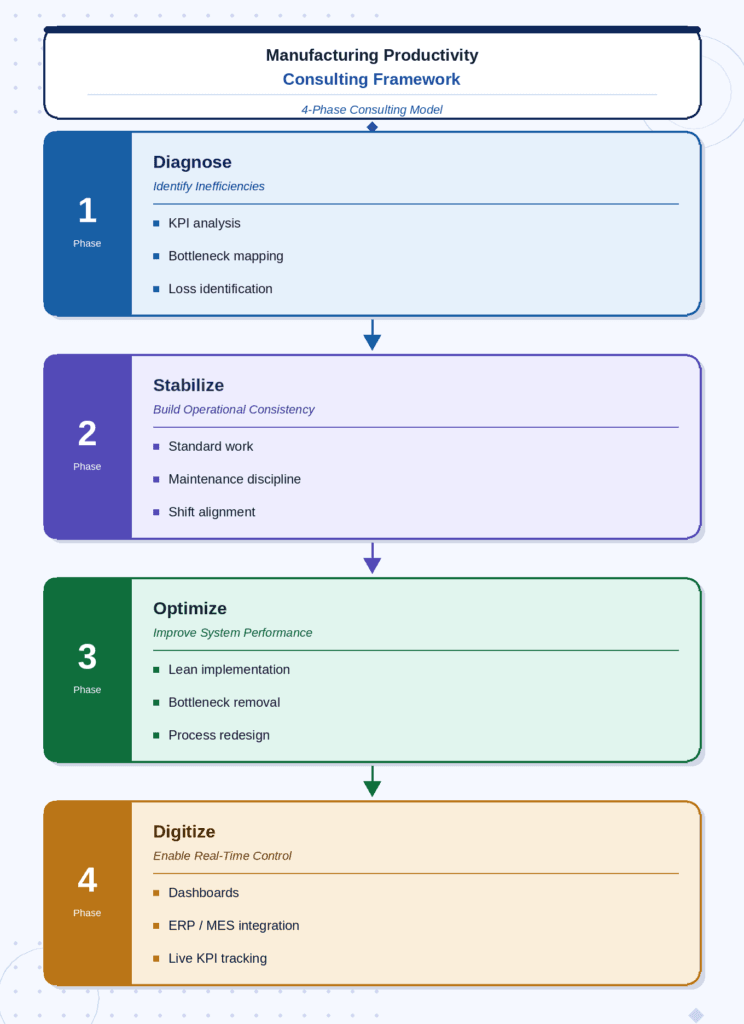
Most successful consulting engagements follow a structured 4-phase model:
1. Diagnose
Identify inefficiencies using data, observation, and KPI analysis.
2. Stabilize
Reduce variability through standard work, maintenance discipline, and workflow alignment.
3. Optimize
Apply Lean, bottleneck removal, and process redesign for efficiency gains.
4. Digitize
Introduce dashboards, tracking systems, and real-time performance monitoring.
This framework ensures improvements are not isolated fixes but a continuous performance system.
How to Improve Productivity in Kenyan Manufacturing
A structured approach typically includes:
- Baseline productivity measurement (OEE, cycle time, defects)
- Bottleneck identification and elimination
- Lean system implementation across processes
- Maintenance system strengthening (preventive + predictive)
- Workforce training and SOP standardization
- Real-time production monitoring systems
Sustainable improvement depends on consistency, not one-time intervention.
Why Hire Productivity Improvement Consultants in Kenya?
Organizations engage consultants for three primary reasons:
Speed of Diagnosis
External experts identify inefficiencies faster due to cross-industry experience.
Structured Implementation
They apply proven frameworks instead of trial-and-error approaches.
Objective Perspective
They detect inefficiencies that internal teams often normalize over time.
This leads to faster ROI and more stable improvement outcomes.
What’s Included in Productivity Consulting
Professional consulting engagements often include:
- Factory productivity audits
- Lean transformation programs
- Process redesign and optimization
- Supply chain efficiency improvements
- Workforce training programs
- Digital productivity system implementation
- KPI development and performance tracking systems
These services are usually tailored based on factory size, industry type, and maturity level.
Which Productivity Methods Work Best in Kenyan Factories?
The most effective methods include:
- Lean manufacturing systems
- Theory of Constraints (TOC)
- Total Productive Maintenance (TPM)
- Six Sigma quality improvement
- 5S workplace discipline systems
These methods are effective because they are low-cost, scalable, and adaptable to both SMEs and large industrial plants.
How Productivity Consulting Benefits Kenyan Manufacturing
Key outcomes include:
- Increased production efficiency and throughput
- Reduced cost per unit of production
- Improved product quality consistency
- Better utilization of workforce and machinery
- Stronger supply chain resilience
- Higher profitability margins
Ultimately, productivity consulting enables factories to scale without proportional cost increases.
Conclusion
Manufacturing productivity consulting is becoming essential for factories operating in Kenya’s increasingly competitive and cost-sensitive environments.
The biggest productivity gap in Kenyan manufacturing is not technology; it is execution consistency and process discipline.
Through structured manufacturing productivity improvement strategies such as Lean systems, bottleneck optimization, workforce alignment, and data-driven decision-making, Kenyan factories can unlock significant operational gains without major capital investment.
Sustainable improvement comes from systems, not isolated interventions; and this is where structured productivity consulting delivers the most value.
FAQs
What do productivity consultants do for manufacturers in Kenya?
They analyze factory operations, identify inefficiencies, and implement structured improvement systems to increase output and reduce waste.
How is productivity improved in Kenyan manufacturing?
Through Lean systems, bottleneck removal, maintenance optimization, workforce training, and real-time performance tracking.
Why is productivity consulting important?
It provides structured frameworks, faster diagnosis, and objective operational improvements that internal teams may miss.
Which methods work best in Kenyan factories?
Lean Manufacturing, TPM, TOC, Six Sigma, and 5S systems are the most widely effective.
What is the first step in productivity improvement?
A structured productivity diagnostic that establishes baseline performance and identifies key loss points.
Contact us