
Inventory optimization helps businesses maintain the right amount of stock at the right time while minimizing costs and meeting customer demand. A supply chain consultant supports this process by improving demand forecasting, inventory planning, supplier coordination, and data-driven decision-making, enabling organizations across Kenya to operate more efficiently and respond better to changing market conditions.
Key Takeaways
- Inventory optimization balances product availability with inventory carrying costs.
- Data-driven forecasting improves inventory accuracy and reduces stock imbalances.
- Supply chain consultants help businesses align inventory strategies with operational goals.
- Digital technologies provide greater visibility across procurement, warehousing, and distribution.
- Continuous monitoring and performance measurement are essential for long-term inventory improvement.
Why Inventory Optimization Matters for Kenyan Businesses
Inventory is one of the largest working capital investments for many organizations. Whether operating in manufacturing, retail, healthcare, agriculture, or distribution, maintaining too much inventory ties up capital and increases storage costs, while maintaining too little inventory can lead to stockouts, production delays, and lost sales.
As Kenya continues to strengthen its position as a regional trade and logistics hub, businesses face increasing pressure to improve inventory performance while responding to changing customer expectations, fluctuating demand, and global supply chain disruptions.
This is where an experienced supply chain consultant in Kenya plays a valuable role. Rather than focusing solely on reducing inventory levels, consultants work with organizations to develop balanced inventory strategies that improve service levels, optimize working capital, and support long-term business growth.
Organizations that improve supply chain planning and digital capabilities are generally better positioned to respond to market volatility and improve operational performance. Likewise, supply chain visibility and planning are key priorities for supply chain leaders.
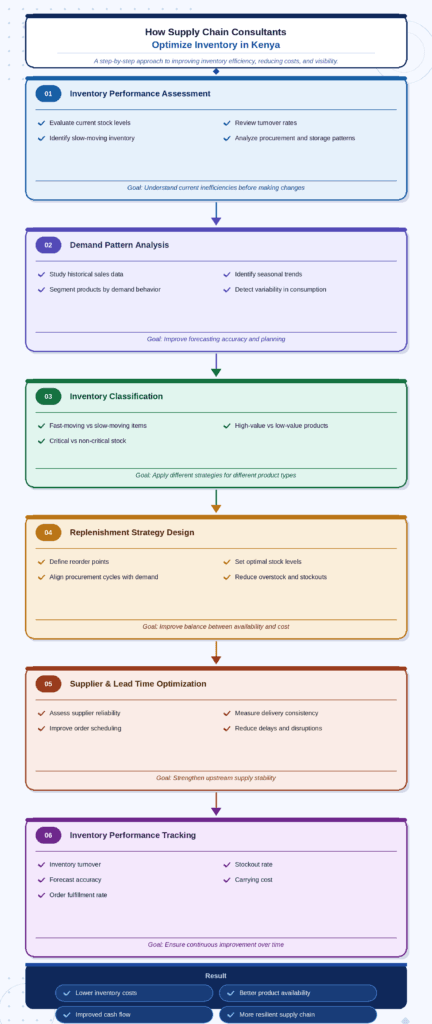
Understanding Inventory Optimization
Inventory optimization is the process of determining the right quantity of inventory to maintain across the supply chain while balancing customer demand, operational efficiency, and financial performance.
Instead of simply reducing stock levels, effective optimization aims to answer several important questions:
- What inventory should be stocked?
- How much inventory is required?
- Where should inventory be located?
- When should products be replenished?
- How can businesses respond to demand fluctuations?
By answering these questions through structured analysis rather than assumptions, businesses can improve inventory turnover, reduce waste, and increase service reliability.
Expert Tip: Inventory reduction should never be the primary objective. The goal is to optimize inventory based on customer demand, supplier reliability, and business priorities rather than pursuing the lowest possible stock levels.
Common Inventory Challenges Across Kenya
Many organizations continue to rely on manual planning processes or disconnected systems, making it difficult to maintain accurate inventory levels.
Some of the most common challenges include:
Limited Demand Visibility
Without reliable demand forecasts, businesses often order inventory based on historical trends or intuition, increasing the risk of overstocking or stock shortages.
Long Supplier Lead Times
Supplier delays can significantly affect inventory planning, particularly for imported goods or products sourced from multiple suppliers.
Excess Safety Stock
Businesses sometimes compensate for uncertainty by carrying more inventory than necessary, increasing storage costs and tying up working capital.
Inaccurate Inventory Data
Poor data quality can lead to purchasing errors, inaccurate forecasts, and inefficient warehouse operations.
Fragmented Supply Chain Systems
When procurement, warehousing, finance, and sales systems are not integrated, organizations struggle to obtain a complete picture of inventory performance.
How SCM Consultants Improve Inventory Performance in Kenya
Conducting Comprehensive Inventory Assessments
An SCM consultant begins by evaluating current inventory processes, policies, and performance indicators.
This assessment typically examines:
- Inventory turnover
- Stock accuracy
- Reorder policies
- Warehouse utilization
- Procurement processes
- Supplier performance
- Demand planning methods
The objective is to identify operational inefficiencies before recommending improvements.
Improving Demand Forecasting
Accurate forecasting forms the foundation of inventory optimization.
Modern supply chain consulting service providers in Kenya increasingly rely on historical sales data, market trends, seasonality, and business intelligence tools to develop more reliable forecasts.
Improved forecasting helps organizations:
- Reduce excess inventory
- Minimize stockouts
- Improve procurement planning
- Support production scheduling
- Increase customer satisfaction
Effective demand planning enables organizations to improve inventory performance while supporting better collaboration across supply chain functions.
Expert Tip: Forecasts should be reviewed regularly rather than created once and left unchanged. Updating forecasts as market conditions evolve helps businesses respond more effectively to changes in demand.
Optimizing Inventory Policies
Not every product requires the same inventory strategy.
Consultants often classify inventory based on factors such as demand variability, profitability, and business importance.
This may involve techniques including:
- ABC inventory analysis
- Safety stock optimization
- Reorder point planning
- Economic order quantity analysis
- SKU (Stock Keeping Unit) rationalization
These methods help organizations allocate inventory more efficiently while improving overall operational performance.
Leveraging Data Analytics for Better Decision-Making
One of the most significant developments in Kenya’s supply chain management is the growing use of analytics to support inventory planning.
Rather than relying on spreadsheets alone, businesses increasingly use dashboards and reporting tools to monitor inventory performance in real time.
Analytics can provide insights into:
- Slow-moving inventory
- High-demand products
- Supplier performance
- Warehouse efficiency
- Forecast accuracy
- Inventory turnover
This supports faster, evidence-based decisions across procurement and operations.
Strengthening Supplier Collaboration
Inventory performance depends not only on internal processes but also on supplier reliability.
Supply chain consultants help organizations strengthen supplier relationships through improved communication, performance measurement, and collaborative planning.
Better supplier collaboration contributes to:
- Shorter lead times
- More reliable deliveries
- Improved replenishment planning
- Reduced emergency purchasing
- Greater supply chain resilience
Expert Tip: Track supplier performance using consistent metrics such as on-time delivery, lead time reliability, and product quality. These indicators can reveal risks before they disrupt inventory availability.
The Role of Digital Technologies in Inventory Optimization
Digital transformation is reshaping inventory management across Kenya.
Organizations are increasingly integrating technologies such as:
- Enterprise Resource Planning (ERP) systems
- Warehouse Management Systems (WMS)
- Business Intelligence platforms
- Inventory planning software
- Predictive analytics tools
These technologies provide greater visibility into inventory movements and improve coordination across procurement, warehousing, and distribution.
According to World Economic Forum, digital supply chain technologies play a growing role in improving transparency, efficiency, and resilience across global supply chains.
Selecting the Right Supply Chain Consulting Firms for Kenya
When businesses evaluate supply chain consulting firms in Kenya, it is important to consider more than just technical capability.
Key factors include:
Understanding of Local Market Conditions
Kenya’s logistics infrastructure, import dependencies, and regional trade dynamics require localized expertise.
Data Readiness and System Integration
Consultants should assess whether existing systems can support analytics-driven inventory optimization.
Change Management Capability
Inventory optimization often requires changes in procurement behavior, warehouse operations, and sales planning.
Focus on Practical Implementation
Strategies must be actionable, not theoretical. The goal is operational improvement, not just analysis.
Expert Tip: The success of inventory optimization depends more on execution discipline than on advanced tools. Even simple models deliver strong results when consistently applied.
How Inventory Optimization Supports End-to-End SCM Transformation
Inventory optimization is not an isolated function. It is a core component of broader end-to-end SCM transformation initiatives in Kenya.
When integrated properly, it supports:
- Improved procurement planning
- More efficient warehouse operations
- Better transportation scheduling
- Stronger financial forecasting
- Higher customer satisfaction
As organizations mature, inventory optimization evolves from reactive stock management to predictive and proactive supply chain planning.
The Strategic Value of Inventory Optimization in Kenya
For many Kenyan enterprises, working capital efficiency is a critical business priority. Inventory represents a major portion of that capital.
By improving inventory planning and leveraging data-driven decision-making, businesses can:
- Free up working capital
- Reduce operational inefficiencies
- Improve responsiveness to market demand
- Strengthen supply chain resilience
- Support sustainable growth
The increasing adoption of supply chain consulting services across Kenya reflects a shift toward more structured, analytics-driven supply chain management practices.
According to the World Bank, improving logistics and supply chain efficiency is a key factor in enhancing economic competitiveness in emerging markets, including Kenya.
Frequently Asked Questions
What is inventory optimization in supply chain management?
Inventory optimization is the process of maintaining the right balance of stock to meet customer demand while minimizing holding costs and avoiding stockouts.
How do supply chain consultants optimize inventory in Kenya?
They analyze demand patterns, improve forecasting, implement inventory classification methods, optimize safety stock, and use data analytics to improve decision-making.
Why is inventory optimization important for businesses in Kenya?
It helps businesses reduce working capital tied up in stock, improve cash flow, avoid stockouts, and respond more effectively to demand fluctuations and supply disruptions.
What KPIs are important for inventory management?
Key KPIs include inventory turnover, days of inventory on hand, stockout rate, forecast accuracy, and carrying cost of inventory.
What tools are used for inventory optimization?
Common tools include ERP systems, warehouse management systems, BI dashboards, predictive analytics tools, and supply chain planning software.
Contact us