
Data-driven supply chain consulting uses analytics, forecasting models, and real-time operational data to improve decision-making across procurement, inventory, logistics, and demand planning. In Kenya, this approach helps businesses increase visibility, reduce inefficiencies, optimize inventory levels, and build more resilient and responsive supply chains.
Key Takeaways
- Data improves accuracy in demand forecasting and inventory planning
- Supply chain visibility enables faster and better decision-making
- Analytics helps reduce costs and improve operational efficiency
- Consultants support businesses in aligning data with supply chain strategy
- Digital transformation is key to modern supply chain performance in Kenya
Why Data-Driven Supply Chains Matter in Kenya
As Kenyan enterprises expand across manufacturing, retail, agriculture, healthcare, and distribution, supply chains are becoming more complex and interconnected. Traditional planning methods based on intuition or historical averages are no longer sufficient in environments where demand shifts rapidly and supply disruptions are increasingly common.
A supply chain consultant specializing in Kenyan markets helps organizations transition from manual decision-making to structured, data-driven processes that improve accuracy, responsiveness, and overall efficiency.
The shift toward analytics-based decision-making is not just a technology upgrade, it represents a fundamental change in how supply chains are managed.
The Role of Data in Modern Supply Chain Consulting
Data is now at the center of every major supply chain decision, from procurement planning to last-mile delivery.
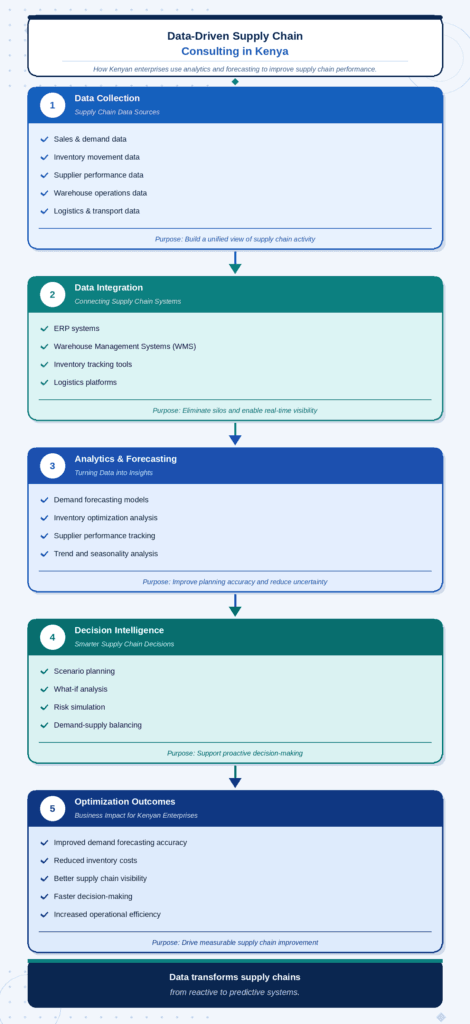
Key data sources include:
- Sales and demand data
- Inventory movement records
- Supplier performance data
- Warehouse operations data
- Transportation and logistics data
- Customer behavior trends
When properly integrated, this data provides a complete picture of supply chain performance and highlights inefficiencies that are often invisible in traditional systems.
Expert Tip: Data value comes from consistency, not volume. Clean, structured, and regularly updated data is more useful than large but unreliable datasets.
How Supply Chain Consultants Use Data Analytics
1. Demand Forecasting and Planning
One of the most important applications of data in supply chain consulting is demand forecasting.
Consultants use historical trends, seasonality patterns, and market signals to improve forecasting accuracy.
This helps businesses:
- Reduce stockouts
- Avoid overstocking
- Improve procurement planning
- Align production schedules with demand
Better forecasting directly leads to improved inventory efficiency and customer satisfaction.
2. Inventory Optimization Through Data Insights
Data-driven inventory planning allows businesses to identify:
- Slow-moving stock
- High-demand products
- Excess inventory accumulation
- Seasonal fluctuations
This supports smarter decisions about reorder levels, safety stock, and product availability.
Unlike traditional approaches, decisions are based on measurable patterns rather than assumptions.
3. Supply Chain Visibility and Performance Tracking
A major challenge for many organizations is lack of visibility across the supply chain.
Data integration enables end-to-end visibility across:
- Suppliers
- Warehouses
- Distribution channels
- Retail or customer delivery points
This visibility allows faster identification of disruptions and better coordination across departments.
4. Supplier Performance Analytics
Suppliers play a critical role in supply chain stability. Data helps track supplier reliability using indicators such as:
- On-time delivery performance
- Lead time consistency
- Product quality metrics
- Order fulfillment accuracy
This allows businesses to make more informed sourcing decisions and reduce operational risks.
Expert Tip: Supplier performance should be reviewed regularly using standardized KPIs. Inconsistent tracking often leads to hidden inefficiencies in the supply chain.
5. Decision Intelligence in Supply Chain Planning
Advanced supply chain consulting increasingly focuses on decision intelligence, using data not just to describe what is happening, but to guide what should happen next.
This includes:
- Scenario planning
- What-if analysis
- Risk simulations
- Demand-supply balancing
These approaches help businesses prepare for uncertainty and improve strategic decision-making.
Data-Driven Transformation in Kenya’s Supply Chains
Across Kenya, supply chains are increasingly shifting from manual, spreadsheet-driven decision-making toward integrated, data-driven operating models. This transformation is being driven by the need for greater visibility, faster decision-making, and improved alignment between procurement, inventory, logistics, and demand planning functions.
However, many organizations are still in the early stages of this transition. While data is being generated across different systems, it is often not fully leveraged for decision-making due to structural and operational gaps.
Common challenges include:
- Fragmented systems across departments that prevent a unified view of supply chain performance
- Limited integration between Enterprise Resource Planning (ERP), inventory, and logistics platforms, resulting in data silos
- Inconsistent reporting structures, where metrics differ across teams or business units
- Lack of structured analytics capability, limiting the ability to turn data into actionable insights
- Heavy reliance on manual reporting processes, which slows down decision cycles and increases errors
These challenges often result in reactive supply chain management, where decisions are made after disruptions occur rather than being anticipated in advance.
An SCM consultant in Kenya typically helps organizations address these gaps by assessing existing data environments, identifying inefficiencies, and aligning data capabilities with operational and strategic supply chain objectives. This includes improving data flow across functions and enabling more consistent and reliable decision-making frameworks.
From a broader industry perspective, the World Economic Forum highlights that digital transformation in supply chains is becoming a key driver of resilience, transparency, and competitiveness; particularly in emerging markets where operational variability is higher.
Building a Data-Driven Supply Chain Strategy
Developing a data-driven supply chain is not simply about adopting new technology tools. It requires a structured transformation approach that aligns people, processes, and systems around consistent data usage and decision-making practices.
A mature data-driven supply chain strategy typically evolves through the following stages:
Step 1: Data Assessment and Mapping
Organizations begin by evaluating all existing data sources across procurement, inventory, warehousing, logistics, and sales functions. This includes assessing:
- Data accuracy and completeness
- System overlap and duplication
- Gaps in reporting visibility
- Data ownership across departments
The objective is to understand what data exists, where it resides, and how reliable it is for decision-making.
Step 2: Process Alignment and Standardization
Once data sources are understood, supply chain processes must be aligned to ensure that data is captured consistently at each operational stage.
This includes standardizing:
- Procurement workflows
- Inventory recording practices
- Warehouse transaction processes
- Demand planning inputs
Without process alignment, even advanced systems fail to produce reliable insights.
Step 3: Technology Integration and System Connectivity
At this stage, organizations focus on connecting core systems such as:
- ERP platforms
- Warehouse Management Systems (WMS)
- Inventory tracking tools
- Transportation and logistics systems
Integration ensures that data flows seamlessly across functions, enabling a unified view of supply chain performance.
Step 4: Analytics Enablement and Visualization
Once data is integrated, analytics capabilities are introduced to transform raw data into actionable insights. This may include:
- Interactive dashboards for real-time visibility
- Demand forecasting models
- Inventory performance reporting
- Supplier performance tracking
The goal is to move from descriptive reporting (“what happened”) to diagnostic and predictive insights (“why it happened” and “what will happen next”).
Step 5: Continuous Improvement and Model Refinement
A data-driven supply chain is not static. It requires continuous refinement of models, assumptions, and reporting structures based on changing market conditions and operational feedback.
This ensures that forecasting accuracy improves over time and that decision-making remains aligned with real-world conditions.
Challenges in Data-Driven Supply Chains
While the benefits of data-driven supply chain management are significant, implementation is often complex and requires overcoming both technical and organizational barriers.
Key challenges include:
- Poor data quality and inconsistency, which reduces trust in analytics outputs
- Disconnected systems that limit end-to-end visibility across the supply chain
- Organizational resistance to process change, especially where manual systems are deeply embedded
- Limited internal analytics capability, making it difficult to interpret or act on data insights
- Dependence on manual reporting, which slows down responsiveness and increases error rates
These challenges often prevent organizations from fully realizing the value of their digital investments.
Addressing them typically requires a combination of process redesign, capability building, and structured guidance from a supply chain consultant, who can help align operational realities with data-driven planning principles.
Strategic Value for Kenyan Enterprises
For businesses operating in Kenya’s evolving economic and logistics environment, adopting a data-driven supply chain approach delivers significant strategic advantages.
These include:
- Improved demand forecasting accuracy, leading to better inventory planning and reduced stock imbalances
- Greater operational efficiency, through reduced manual processes and improved workflow coordination
- Enhanced inventory management, including better stock visibility and optimized replenishment decisions
- Stronger supplier performance management, supported by measurable and consistent KPIs
- Increased responsiveness to market changes, enabling faster adaptation to demand and supply fluctuations
As supply chains become more interconnected and customer expectations continue to rise, data is no longer optional, it is a core enabler of competitiveness and resilience.
Organizations that invest in structured supply chain analytics and planning in Kenya are better positioned to improve service levels while maintaining cost efficiency.
Frequently Asked Questions
What is data-driven supply chain consulting?
It is the use of analytics, data systems, and forecasting tools to improve supply chain decision-making across procurement, inventory, logistics, and demand planning.
Why is data important in supply chain management?
Data helps businesses improve forecasting accuracy, reduce costs, optimize inventory, and respond more effectively to changes in demand and supply conditions.
How do supply chain consultants use data?
They analyze operational data to improve forecasting, optimize inventory levels, track supplier performance, and enhance supply chain visibility.
What are the challenges of data-driven supply chains?
Common challenges include poor data quality, lack of integration, limited analytics capability, and resistance to process change.
How can businesses in Kenya improve supply chain analytics?
By integrating systems, improving data quality, adopting analytics tools, and working with supply chain consultants to align strategy with operational data.