In manufacturing, performance challenges are often attributed to equipment limitations, capacity constraints, or process inefficiencies. However, in many real-world factory environments, the deeper issue is not system design, it is execution consistency.
Across Egyptian manufacturing environments, it is common to see significant variation in performance between shifts, departments, and even consecutive production days, despite having clearly defined processes and operational systems in place.
This variation is not primarily technical. It is behavioral and structural. It comes from how daily work is managed, how decisions are made on the shop floor, and how consistently issues are followed through.
Daily Work Management addresses this gap by embedding operational discipline into the daily rhythm of manufacturing operations. Instead of relying on individual management styles or informal coordination, it creates a structured system for controlling execution every day.
Key Takeaways
- Most manufacturing issues come from execution inconsistency, not system design
- Operational discipline breaks down without structured daily management routines
- Shift variation is a major but often invisible source of productivity loss
- Daily Work Management standardizes execution behavior across teams
- Sustainable performance depends on daily control, not periodic reporting
The Core Problem: Execution Drift in Manufacturing
Most factories operate with well-documented processes. Standard operating procedures (SOPs) exist, KPIs are defined, and responsibilities are assigned.
Despite this, performance often fails to match expectations.
The reason is execution drift, a gradual deviation between how work is designed and how it is actually executed on the shop floor.
This drift typically develops due to:
- Informal decision-making during production pressures
- Variation in supervisory behavior across shifts
- Inconsistent prioritization of daily tasks
- Weak or delayed follow-up on operational issues
- Lack of structured communication between departments
Over time, these small inconsistencies accumulate into measurable performance gaps.
Importantly, this is often misdiagnosed as a capacity or technical issue, when in reality it is a discipline and management system issue.
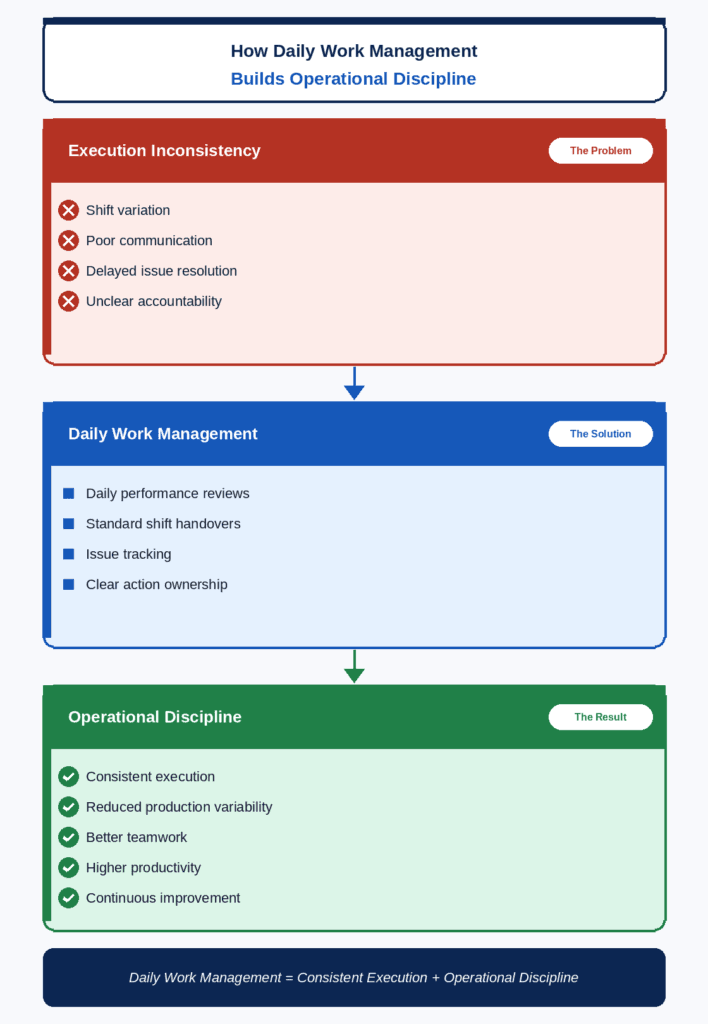
Why Operational Discipline Breaks Down
Operational discipline refers to how consistently an organization executes defined processes under real operating conditions.
It breaks down when daily management is not structured in a repeatable way.
Common failure points include:
- Performance reviews happening too late (weekly or monthly cycles)
- Issues being discussed without structured tracking
- Shift handovers relying on informal communication
- Unclear ownership of corrective actions
- Absence of standardized daily routines for supervision
When these conditions exist, factories naturally shift into reactive firefighting mode, where problems are addressed after impact rather than prevented or contained early.
This is where variability begins to increase.
Shift Variation: The Hidden Driver of Inefficiency
One of the most underestimated issues in manufacturing environments is shift variation.
Even when machines, materials, and processes remain constant, output often differs significantly between shifts.
This variation is caused by differences in:
- How supervisors prioritize daily work
- How issues are escalated and resolved
- How communication occurs between shifts
- How strictly processes are followed under pressure
The result is inconsistent performance that does not always appear clearly in aggregated monthly reports.
Instead, it appears as:
- Unexplained efficiency loss
- Fluctuating output levels
- Recurring small disruptions
- Unstable production performance
Without structured daily control, this variation becomes normalized.
How Daily Work Management Builds Operational Discipline
Daily Work Management introduces structure into daily execution by defining a consistent operational rhythm.
Rather than relying on individual judgment or informal coordination, it standardizes how work is managed across all shifts and departments.
This includes consistency in:
- Daily performance review routines
- Identification and escalation of operational issues
- Assignment and tracking of corrective actions
- Communication between shifts and teams
- Decision-making based on real-time operational data
The key shift is from “individual management style” to “system-driven execution behavior.”
This is where operational discipline becomes embedded, not in documentation, but in repetition of structured daily routines.
From Informal Execution to Structured Daily Control
In many factories without structured daily management systems, operations are largely informal in practice.
This leads to patterns such as:
- Problems being noticed only after affecting output
- Corrective actions being discussed but not tracked consistently
- Repeated issues resurfacing without resolution
- Changing priorities without structured alignment across shifts
This environment creates unpredictability in production performance.
With Daily Work Management in place, this structure changes:
- Issues are identified earlier in the day
- Actions are assigned with clear ownership
- Follow-ups are tracked until closure
- Daily performance is reviewed consistently across all shifts
This creates a controlled operating environment where variability is reduced and accountability becomes visible.
Why This Matters in Egyptian Manufacturing
Manufacturing environments in Egypt often share structural characteristics that amplify execution challenges:
- Multi-shift production systems with handover dependency
- Varying levels of workforce experience and training
- Reliance on supervisory decision-making at the shop floor level
- Fluctuating production priorities driven by demand changes
- Informal communication patterns between departments
In such environments, operational inconsistency is not occasional, it is systemic.
Daily Work Management becomes critical because it introduces a shared operating structure that reduces dependence on individual behavior and replaces it with standardized execution routines.
Building a Culture of Operational Discipline
Operational discipline is not created through policies alone. It is built through repetition, structure, and reinforcement.
Daily Work Management supports this by ensuring that:
- Performance is reviewed every day, not periodically
- Issues are not allowed to remain open without tracking
- Actions are clearly assigned and visible
- Accountability is part of daily operations, not post-analysis
Over time, this repetition changes organizational behavior.
Supervisors begin to operate with greater consistency. Teams become more aligned in execution. And variability in decision-making decreases.
This is how culture is formed, not through statements, but through daily operating systems.
Where Daily Work Management Fits in Manufacturing Systems
Daily Work Management is not a standalone methodology.
It functions as the execution layer that connects strategy to operational reality.
It supports broader systems such as:
- Lean manufacturing
- Operational Excellence
- Continuous improvement frameworks
However, its role is specific: ensuring that these systems are applied consistently at the shop floor level every single day.
Without it, even well-designed improvement systems tend to lose momentum over time due to inconsistent execution.
Conclusion
Most manufacturing performance challenges are not caused by the absence of systems or strategies, but by inconsistency in execution.
In Egyptian factories, this inconsistency is often driven by shift variation, informal decision-making, and a lack of structured daily operational control.
Daily Work Management addresses this by embedding operational discipline into the daily rhythm of manufacturing operations.
When applied consistently, it reduces execution variation, improves operational stability, and creates the foundation for sustained performance improvement.
Frequently Asked Questions
What is operational discipline in manufacturing?
Operational discipline is the consistent execution of defined processes, routines, and responsibilities across all shifts and production conditions.
Why is execution inconsistency such a common issue?
Because many factories rely on informal decision-making and lack structured daily routines that enforce consistent execution behavior.
How does Daily Work Management reduce shift variation?
It standardizes daily routines, communication, and performance reviews, ensuring all shifts operate under the same execution framework.
Is Daily Work Management a system or a mindset?
It is both a structured operational system and a behavioral framework that reinforces discipline through repetition.
Why is DWM important in Egyptian factories?
DWM is important because multi-shift operations, variable experience levels, and informal communication structures increase execution variability.
Contact us