
Lean Six Sigma consultants for Egypt’s industrial zones play a central role in improving manufacturing efficiency, reducing operational waste, and stabilizing product quality across large-scale production environments.
Industrial zones in Egypt typically include clusters of manufacturing facilities operating under high production pressure, export requirements, and cost constraints. In such environments, even small inefficiencies in workflow, quality control, or equipment utilization can lead to significant financial and operational losses.
This is why Lean Six Sigma consulting has become increasingly important for industrial zones seeking structured Operational Excellence rather than isolated improvements.
What Are Lean Six Sigma Consultants?
Lean Six Sigma consultants are process improvement specialists who help manufacturing organizations reduce waste, eliminate defects, and improve operational performance using structured methodologies.
They combine:
- Lean principles → focused on removing waste and improving flow
- Six Sigma methodology → focused on reducing process variation and defects
In industrial environments, their role goes beyond fixing isolated issues. They redesign and stabilize entire production systems to ensure long-term operational performance.
They typically work on:
- End-to-end process mapping
- Production bottleneck elimination
- Defect and variation reduction
- Overall Equipment Effectiveness (OEE) optimization
- Workflow standardization across facilities
- Capability building for internal teams
Why Egypt’s Industrial Zones Need Lean Six Sigma Consulting
Industrial zones face structural complexity that makes informal improvement approaches ineffective.
Common challenges include:
- High production variability across facilities
- Inconsistent quality standards between plants
- Equipment downtime affecting throughput
- Inefficient material movement across zones
- High rework and operational waste
- Fragmented performance tracking systems
Without a structured methodology, these issues scale quickly across multiple factories, increasing cost and reducing competitiveness.
Lean Six Sigma provides a system-wide framework to control this complexity through data-driven and standardized improvement methods.
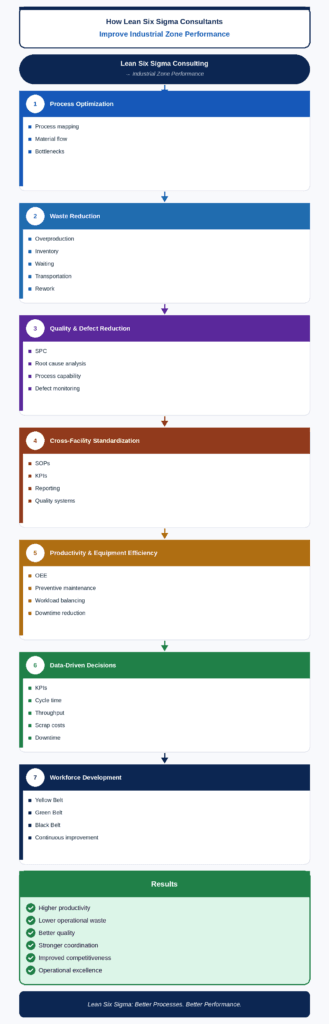
How Lean Six Sigma Improves Industrial Zone Performance
Lean Six Sigma improves industrial performance by integrating two complementary systems:
- Lean improves speed and flow
- Six Sigma improves quality and consistency
Unlike traditional improvement approaches that focus on individual departments, Lean Six Sigma works across entire value chains, making it especially suitable for industrial zones.
1. End-to-End Process Optimization
One of the most important contributions of Lean Six Sigma is its ability to optimize complete production systems rather than isolated processes.
Consultants typically analyze:
- Raw material flow across facilities
- Production line sequencing
- Inspection and quality checkpoints
- Warehouse and logistics movement
- Final delivery systems
Using tools like Value Stream Mapping (VSM), inefficiencies such as delays, redundant handling, and unnecessary steps are identified and removed. This improves synchronization across industrial systems and reduces operational fragmentation.
2. Waste Reduction Across Industrial Systems
Industrial zones generate multiple forms of waste that directly affect cost and efficiency.
Lean Six Sigma targets:
- Overproduction beyond demand
- Excess inventory accumulation
- Unnecessary transportation
- Machine idle time and downtime
- Rework from defects
- Inefficient workforce allocation
By eliminating these inefficiencies, organizations achieve smoother production flow and improved cost control at scale.
3. Defect Reduction and Quality Stability
Six Sigma focuses on reducing variation that leads to defects in manufacturing processes.
Common analytical tools include:
- Statistical Process Control (SPC)
- Root cause analysis (5 Whys, Fishbone Diagrams)
- Process capability analysis (Cp/Cpk)
- Defect trend monitoring systems
These tools help identify systemic quality issues rather than surface-level symptoms. The result is improved consistency and stronger alignment with export quality requirements.
4. Cross-Facility Standardization
Industrial zones often include multiple factories operating under different systems.
Without standardization, performance gaps emerge between facilities.
Lean Six Sigma consultants address this by:
- Standardizing operating procedures
- Aligning Key Performance Indicators (KPIs) across facilities
- Unifying quality control systems
- Implementing consistent reporting structures
This creates operational alignment across the entire industrial ecosystem.
5. Productivity and Equipment Efficiency Improvement
A major focus area of Lean Six Sigma is improving utilization of both machines and workforce.
This includes:
- Reducing downtime through preventive maintenance systems
- Balancing production line workloads
- Eliminating bottlenecks in workflow
- Improving OEE
The result is higher output using the same resource base.
6. Data-Driven Decision Making
Lean Six Sigma replaces assumption-based management with data-driven decision systems.
Key metrics used include:
- Defect rates
- Cycle time and throughput
- OEE performance
- Scrap and rework costs
- Downtime frequency
This enables early detection of inefficiencies and improves decision accuracy across operations.
7. Workforce Capability Development
Sustainable improvement requires internal capability building.
Consultants typically train teams at different levels:
- Yellow Belt: Basic awareness
- Green Belt: Project execution capability
- Black Belt: Advanced analytical leadership
This ensures that improvement culture continues beyond consultancy engagement.
Key Benefits of Lean Six Sigma Consulting for Industrial Zones
Organizations typically experience:
- Improved production efficiency
- Reduced operational waste
- Lower defect rates
- Better cross-facility coordination
- Improved supply chain performance
- Stronger export competitiveness
How Lean Six Sigma Consulting Engagements Typically Work
Lean Six Sigma consulting engagements typically begin with an assessment of an organization’s current processes, operational performance, and improvement objectives. Consultants work with leadership and operational teams to identify high-impact opportunities, establish measurable goals, and prioritize projects based on business value.
Once improvement priorities are defined, consultants collect and analyze process data to identify sources of waste, variation, bottlenecks, and quality issues. Using Lean principles and Six Sigma methodologies such as DMAIC, they develop targeted improvement plans that address root causes rather than symptoms.
After improvements are implemented, consultants help establish performance monitoring systems, Standard Operating Procedures (SOPs), and KPIs to ensure that results are sustained over time.
Many engagements also include workforce training and knowledge transfer so internal teams can continue driving continuous improvement after the consulting project has concluded. This structured approach enables organizations to achieve measurable operational improvements while building long-term process improvement capabilities.
Conclusion
Lean Six Sigma consultants for Egypt’s industrial zones play a critical role in transforming complex manufacturing ecosystems into structured, efficient, and data-driven systems.
By integrating Lean efficiency principles with Six Sigma quality control methodologies, industrial organizations can improve productivity, reduce operational waste, and stabilize production performance at scale.
In Egypt’s industrial clusters, this approach is increasingly becoming a foundational strategy for Operational Excellence and long-term competitiveness.
Frequently Asked Questions (FAQs)
What do Lean Six Sigma consultants do in industrial zones?
They improve manufacturing performance by reducing waste, eliminating defects, and optimizing production systems using structured methodologies.
Why is Lean Six Sigma important for industrial zones in Egypt?
Because it helps manage large-scale production complexity, improves efficiency, and ensures consistent quality across multiple facilities.
How does Lean Six Sigma improve industrial performance?
By reducing waste, stabilizing production processes, and improving workflow efficiency through data-driven analysis.
Is Lean Six Sigma widely adopted in Egypt’s industrial zones?
Yes, it is increasingly used as a standard approach for improving competitiveness and operational efficiency.