
Manufacturing industries in Egypt are increasingly adopting structured improvement methodologies such as Six Sigma and Lean Six Sigma to improve quality, reduce process variation, and enhance operational efficiency.
While frameworks like DMAIC explain how Six Sigma works, its real value becomes visible when applied in manufacturing environments where defects, downtime, and inefficiencies directly impact cost and productivity.
This article presents illustrative Six Sigma case studies based on common manufacturing improvement patterns in Egypt, showing how structured problem-solving typically improves quality and operational performance across industries.
These examples reflect realistic implementation scenarios seen across sectors such as textiles, automotive components, food processing, and packaging.
Disclaimer: The following case studies are representative examples based on common manufacturing improvement patterns observed in Egypt. They are intended to demonstrate how Six Sigma and Lean Six Sigma methodologies are typically applied across different manufacturing environments rather than describe individual client engagements.
Key Takeaways
- Six Sigma reduces manufacturing defects by addressing process variation
- DMAIC is the core structured methodology used in all improvement projects
- Most gains come from root cause elimination, not additional resources
- Lean Six Sigma improves both quality and operational efficiency
- Egyptian industries apply these methods across multiple manufacturing sectors
- Consultants support structured implementation and sustainability
Why Case Studies Matter in Six Sigma Consulting
Case studies are an important part of understanding Six Sigma because they demonstrate how structured methodologies are applied in real operational environments. While theoretical explanations describe tools and frameworks, case studies show how these methods are used to solve practical manufacturing problems.
They help organizations and decision-makers understand how DMAIC is implemented step by step, from identifying process issues to sustaining long-term improvements. Case studies also highlight the types of data collected, the analytical tools used, and the decision-making process behind selecting improvement actions.
Another important value of case studies is that they reveal patterns that are consistent across industries. For example, many manufacturing issues are caused by process variation, unclear standards, or inefficient workflows rather than lack of capacity. By studying multiple examples, organizations can better understand what types of solutions are most effective in similar situations.
Ultimately, case studies provide a practical reference point for applying Six Sigma principles and help bridge the gap between theory and real-world operational improvement.
Case Study 1: Textile Manufacturing Quality Improvement
Textile manufacturing in Egypt often deals with variability in raw materials and production conditions, which directly affects product quality.
Problem Context
Typical challenges include:
- Inconsistent fabric quality across batches
- Defects identified during final inspection
- Rework increasing production load
DMAIC Application
- Define: Identify key defect categories affecting final output
- Measure: Track defect frequency across production batches
- Analyze: Identify variation sources such as machine calibration drift and material inconsistency
- Improve: Standardize calibration routines and improve supplier quality checks
- Control: Introduce ongoing monitoring of defect patterns
Outcome Pattern
Common improvements typically include:
- Improved consistency in production output
- Reduced rework cycles
- Better alignment between production and quality control functions
Although the specific improvements vary depending on the production environment and process conditions, results of this type typically reflect stronger process control, improved operational consistency, and better alignment between production and quality functions. When supported by standardized procedures and continuous monitoring, these improvements also contribute to long-term stability and reduced variability in output.
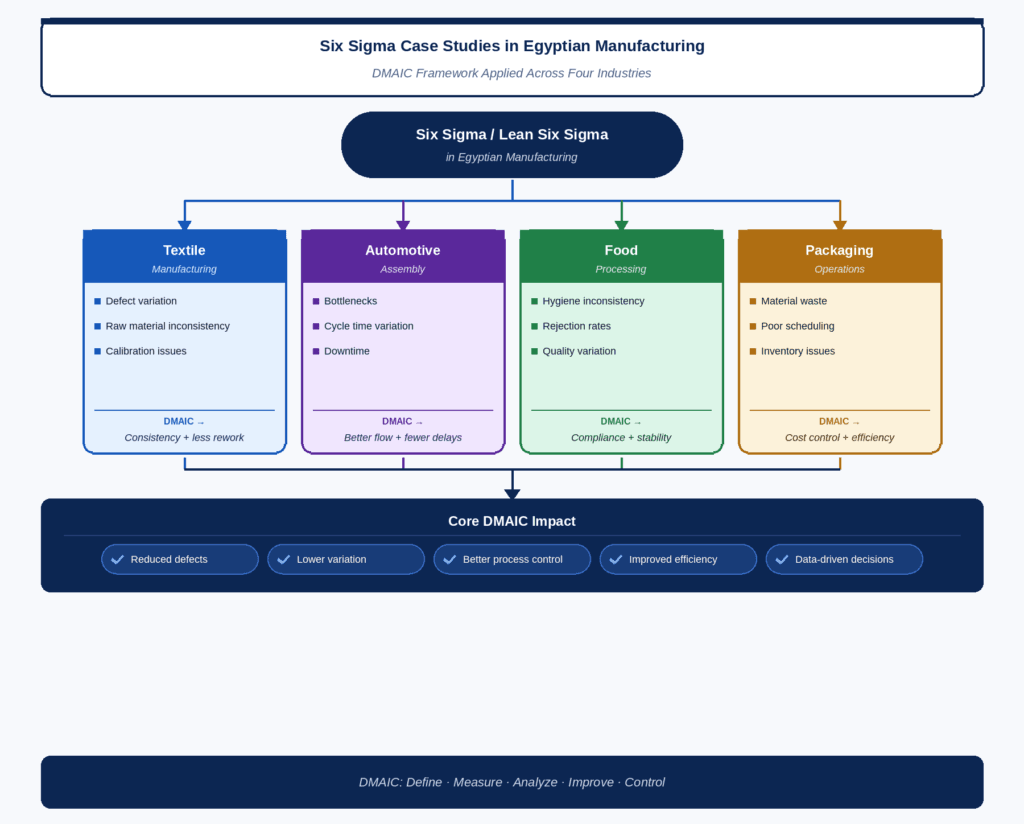
Case Study 2: Automotive Assembly Efficiency
Automotive component manufacturing requires stable production flow and consistent cycle times.
Problem Context
Common operational issues include:
- Bottlenecks in assembly stages
- Variation in cycle time across stations
- Downtime affecting production continuity
DMAIC Application
- Define: Map inefficiencies in assembly workflow
- Measure: Track cycle time and downtime variation
- Analyze: Identify bottlenecks and maintenance-related delays
- Improve: Balance production line and optimize preventive maintenance
- Control: Monitor cycle time stability over time
Outcome Pattern
Typical improvements include:
- Improved production flow stability
- Reduced cycle time variation
- Better coordination between production and maintenance teams
Even though the exact outcomes vary by industry and production conditions, results of this kind commonly reflect reduced process variation, improved operational predictability, and better data-driven control of manufacturing systems. With proper implementation of control mechanisms and continuous performance tracking, these improvements can be maintained and further optimized over time.
Case Study 3: Food Processing Quality Control
Food processing requires strict consistency and compliance with hygiene standards.
Problem Context
Common issues include:
- Variation in product consistency
- Rejection during quality inspection
- Inconsistent sanitation procedures
DMAIC Application
- Define: Identify quality and compliance gaps
- Measure: Track rejection rates and contamination risks
- Analyze: Identify process gaps in hygiene execution
- Improve: Standardize sanitation procedures and training
- Control: Implement continuous quality monitoring
Outcome Pattern
Typical improvements include:
- Improved product consistency
- Reduced rejection rates
- Stronger compliance discipline
Although each manufacturing environment produces different results, these types of improvements typically lead to higher process reliability, reduced variation in output, and more efficient coordination between production and quality control functions. Over time, sustained monitoring and structured process control help maintain these improvements and prevent regression to previous performance levels.
Case Study 4: Packaging Waste Reduction
Packaging operations often face inefficiencies related to material usage and production planning.
Problem Context
Common issues include:
- Excess material consumption
- Inefficient scheduling
- Poor inventory control
DMAIC Application
- Define: Identify waste sources across production flow
- Measure: Analyze material usage patterns
- Analyze: Identify inefficiencies in planning and scheduling
- Improve: Optimize production planning and inventory systems
- Control: Monitor material usage trends continuously
Outcome Pattern
Typical improvements include:
- Reduced material waste
- Improved planning accuracy
- Stronger operational cost control
While outcomes differ based on the specific process and operational context, improvements of this nature generally indicate more stable production systems, fewer process disruptions, and stronger alignment between operational steps. When reinforced with consistent measurement and standard operating procedures, these gains tend to become sustainable over time.
Key Insights from Six Sigma in Egypt
Across industries, Six Sigma implementations consistently show:
- Most manufacturing problems come from variation, not capacity
- Structured root cause analysis is more effective than reactive fixes
- Standardization improves long-term operational stability
- Data-driven decisions improve process reliability
- Lean Six Sigma strengthens both efficiency and quality outcomes
These insights explain why structured consulting support is increasingly adopted in manufacturing environments.
Role of Consultants in Six Sigma Projects
In many manufacturing environments, internal teams understand operational issues but lack structured methodologies to solve them systematically.
Six Sigma consultants typically support:
- Structured application of DMAIC methodology
- Identification of measurable process variables
- Training internal teams in problem-solving tools
- Ensuring long-term sustainability of improvements
This ensures improvements are not only implemented but maintained over time.
Common Success Factors in Six Sigma Projects
Successful Six Sigma projects share several characteristics regardless of the manufacturing environment or the specific process being improved. Organizations typically achieve the best results when improvement projects begin with clearly defined objectives, measurable performance indicators, and reliable process data. Leadership support, cross-functional collaboration, and employee engagement also play an important role in ensuring that improvements are implemented consistently and sustained over time.
Another critical success factor is following the DMAIC methodology without skipping phases. Collecting accurate data during the Measure Phase and identifying root causes during the Analyze Phase help organizations avoid implementing solutions that address symptoms rather than underlying issues. Standardization, performance monitoring, and ongoing training during the Control Phase help ensure that improvements continue delivering value after the project is completed.
By combining structured methodologies with continuous improvement practices, organizations can build repeatable systems that improve quality, reduce operational waste, and strengthen long-term operational performance.
Bridging Theory and Practice in Six Sigma
Six Sigma becomes most valuable when theoretical frameworks such as DMAIC are consistently applied to real-world operational challenges. By combining structured analysis, data-driven decision-making, and continuous improvement practices, organizations can transform manufacturing performance from reactive problem-solving to proactive process control.
Common Patterns Across Six Sigma Case Studies in Egypt
Across different manufacturing sectors, several consistent patterns emerge from Six Sigma implementations. Most process inefficiencies are driven by variation rather than lack of capacity, making root cause analysis a critical success factor in all environments.
Another common pattern is that improvements are most effective when they combine both technical tools (such as Statistical Process Control (SPC) and process mapping) and structured methodology (DMAIC).
Additionally, sustainability of improvements depends heavily on standardization and control mechanisms rather than initial implementation efforts.
These patterns demonstrate that regardless of industry, Six Sigma delivers the most value when applied as a structured system rather than a set of isolated tools.
Frequently Asked Questions (FAQs)
What are Six Sigma case studies?
Six Sigma case studies are structured examples showing how manufacturing problems are solved using DMAIC methodology to reduce defects and improve process efficiency.
Why are case studies important in Six Sigma?
They demonstrate how theoretical tools are applied in real manufacturing environments and help organizations understand expected improvement patterns.
What industries in Egypt use Six Sigma?
Six Sigma is commonly used across manufacturing sectors with process variability challenges.
What is the role of DMAIC in these case studies?
DMAIC provides the structured framework used to define problems, measure performance, analyze root causes, implement improvements, and maintain control.
Do Six Sigma consultants implement these improvements directly?
Consultants typically guide implementation, apply structured methodologies, and help internal teams build capability rather than replacing them.
How does Lean Six Sigma differ from Six Sigma?
Lean Six Sigma combines waste reduction (Lean) with variation reduction (Six Sigma), improving both efficiency and quality simultaneously.