
Inventory management is a critical operational function for businesses operating in Kenyan manufacturing markets.
As supply chains become more complex and working capital pressures increase, many organizations are turning to inventory management consultants to improve stock control, forecasting accuracy, and operational efficiency.
However, selecting the right inventory management consultants for Kenyan markets is not straightforward. Providers differ significantly in expertise, methodology, industry understanding, and implementation capability.
Some consultants focus heavily on software systems, others specialize in warehouse optimization, while a smaller group work on end-to-end inventory system transformation.
Because of this variation, businesses need a structured approach to evaluation rather than relying on cost, branding, or general claims.
This article explains how to choose the right inventory management consultants in Kenyan markets using practical, decision-focused criteria.
Why Consultant Selection Directly Affects Business Performance
Inventory is not just an operational function; it is directly tied to financial and operational performance.
Poor inventory management leads to:
- Stockouts and lost sales opportunities
- Excess stock and tied-up working capital
- Production delays in manufacturing environments
- Inconsistent customer fulfillment
- Inefficient warehouse utilization
These issues impact:
- Profitability
- Liquidity and cash flow
- Customer satisfaction
- Operational stability
Because of this, choosing the right consultant is not a technical decision alone; it is a business performance decision.
What Inventory Management Consultants Actually Do
Before selecting a consultant, businesses must understand their role clearly.
Inventory management consultants typically help organizations:
- Assess current inventory performance and inefficiencies
- Identify gaps in inventory control systems
- Improve demand forecasting and planning accuracy
- Design structured inventory management systems
- Optimize warehouse and storage operations
- Improve coordination between procurement, sales, and operations
In more advanced cases, they also align inventory systems with broader supply chain and financial planning functions.
However, the effectiveness of these outcomes depends heavily on consultant capability and approach.
Key Criteria for Choosing Inventory Management Consultants in Kenyan Markets
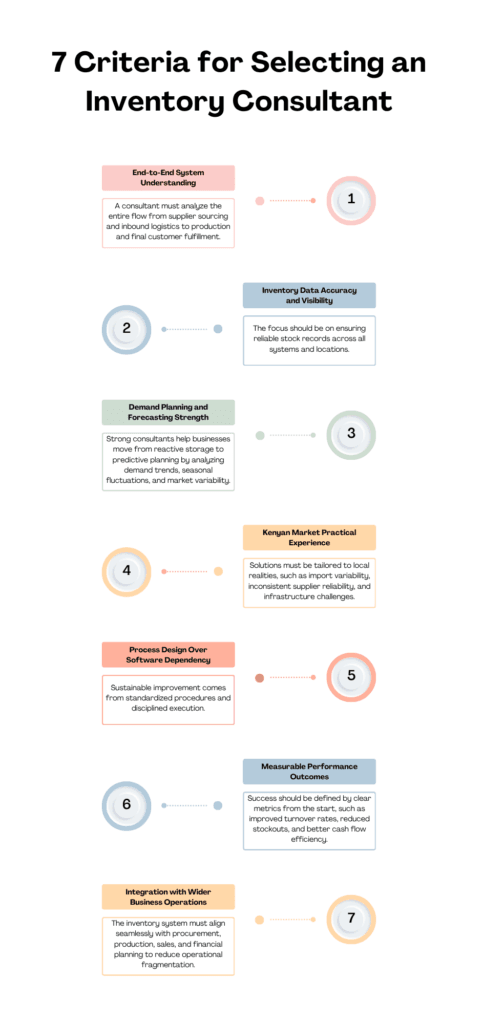
Rather than focusing on surface-level factors like cost or tools, businesses should evaluate consultants based on how they think and solve operational problems.
1. Understanding of End-To-End Inventory Systems
Strong consultants do not treat inventory as a standalone function.
They analyze the full inventory flow, including:
- Supplier sourcing and procurement
- Inbound logistics and receiving processes
- Warehouse storage and internal movement
- Production or sales consumption
- Distribution and customer fulfillment
Most inventory inefficiencies occur between these stages rather than within one isolated area.
A consultant who understands only warehousing or stock tracking is unlikely to deliver a complete solution.
2. Ability to Improve Inventory Data Accuracy and Visibility
One of the most common challenges Kenyan businesses face is unreliable inventory data.
A strong consultant should help companies improve:
- Accuracy of stock records across systems and locations
- Real-time or near real-time inventory visibility
- Consistency in stock updates and reporting
- Reconciliation between physical stock and system records
Without reliable data, inventory decisions become reactive and often incorrect.
Data integrity is the foundation of any effective inventory system.
3. Strength in Demand Planning and Forecasting
Inventory problems are often driven by poor demand forecasting rather than storage inefficiencies.
A capable consultant should help businesses:
- Analyze demand trends and patterns
- Identify seasonal fluctuations and market variability
- Align procurement cycles with actual consumption
- Reduce overstocking and stock shortages
Forecasting capability is one of the strongest indicators of consulting maturity.
Without it, inventory systems remain reactive instead of predictive.
4. Practical Experience in Kenyan Market Conditions
Inventory systems must reflect real operational environments.
In Kenyan markets, businesses often face:
- Supply chain delays and import variability
- Inconsistent supplier reliability
- Fluctuating demand patterns
- Working capital constraints
- Infrastructure and logistics challenges
A consultant with local or regional experience is better positioned to design solutions that are realistic and implementable rather than overly theoretical.
Contextual understanding significantly improves execution success.
5. Focus On Process Design Over Software Dependency
Many consultants emphasize tools such as Enterprise Resource Planning (ERP) systems or inventory software.
While these tools are useful, they cannot solve structural inefficiencies on their own.
Sustainable inventory improvement is built on:
- Standardized processes
- Clearly defined responsibilities
- Consistent stock handling procedures
- Disciplined execution across teams
Technology should support the system, not define it.
Businesses should be cautious of consultants who rely heavily on software without addressing underlying processes.
6. Ability to Define Measurable Performance Outcomes
Effective inventory consulting is outcome-driven.
Before engagement begins, consultants should clearly define success metrics such as:
- Reduced stockout frequency
- Improved inventory turnover rates
- Lower excess or obsolete inventory
- Improved order fulfillment accuracy
- Better cash flow efficiency
Without measurable outcomes, it becomes difficult to assess consulting impact objectively.
Strong consultants operate with clear performance indicators from the beginning.
7. Integration With Wider Business Operations
Inventory systems do not operate independently.
They are closely connected to:
- Procurement planning
- Production scheduling
- Sales forecasting
- Financial planning and cash flow management
- Logistics and distribution systems
A strong consultant ensures that inventory systems are aligned with all these functions.
This integration reduces operational fragmentation and improves overall efficiency.
Common Mistakes Businesses Make When Choosing Consultants
When choosing between consultants, many businesses make poor selection decisions driven by:
- Lowest cost option
- Software or tools offered
- Short-term promises of quick results
- Reputation without technical evaluation
These factors do not necessarily reflect consulting capability.
Inventory challenges are structural in nature and require long-term system thinking, not quick fixes.
What Strong Consulting Outcomes Look Like in Practice
When the right consultant is selected, businesses typically experience:
- Improved inventory accuracy and visibility
- Fewer stockouts and emergency procurement
- Better alignment between demand and supply
- Improved cash flow due to reduced excess stock
- More stable and predictable operations
Over time, inventory shifts from being a recurring challenge to a controlled business system.
Why This Matters for Businesses in Kenyan Markets
Businesses in Kenyan markets operate under conditions such as:
- Fluctuating demand cycles
- Supply chain disruptions
- Limited forecasting maturity
- Working capital constraints
In this environment, inventory management becomes a strategic capability rather than a back-office function.
Choosing the right consultant helps businesses build resilience, improve efficiency, and support long-term growth.
Conclusion
Choosing inventory management consultants in Kenyan markets requires a structured, systems-based evaluation approach.
The most effective consultants understand end-to-end inventory flows, improve data visibility, strengthen forecasting, and focus on process-driven transformation rather than tool dependency.
Businesses that apply a careful selection approach are more likely to build stable, efficient, and scalable inventory systems that support long-term operational success.
FAQs
What do inventory management consultants do?
They help businesses improve inventory accuracy, forecasting, and operational efficiency.
How do I choose the best consultants for Kenyan manufacturing markets?
Focus on system understanding, forecasting capability, process design, and measurable outcomes.
Why is local market experience important?
Because supply chains, demand patterns, and operational constraints vary significantly in Kenya.
Should consultants focus on software or processes?
Processes first, then tools. Software alone cannot fix structural inefficiencies.
What results should I expect?
Better stock control, improved cash flow, fewer stockouts, and stronger operational stability.