Daily Work Management (DWM) is a structured system used in manufacturing to monitor, manage, and control operational performance on a daily basis. It ensures that production activities are tracked consistently, issues are identified early, and corrective actions are followed through in a disciplined way.
Unlike periodic reporting systems that focus on weekly or monthly performance, Daily Work Management focuses on what happens today, on the shop floor.
For Egyptian manufacturers, this approach helps improve operational visibility, reduce response time to issues, and create more consistent production performance across shifts and departments.
This article explains what Daily Work Management (DWM) is, how it works in practice, and why it has become an essential part of modern manufacturing systems.
Key Takeaways
- Daily Work Management is a structured system for managing daily factory operations.
- It focuses on real-time visibility and fast issue resolution.
- It connects shop floor activity with operational goals.
- It is not software, it is a management discipline.
- It improves consistency across shifts and departments.
What Is Daily Work Management?
DWM is a management system that ensures operational performance is monitored and controlled through structured daily routines.
Instead of relying on delayed reports, it creates a rhythm of daily review, decision-making, and action tracking.
At its core, it ensures:
- Work performance is visible every day
- Deviations are identified immediately
- Corrective actions are assigned clearly
- Follow-ups are completed consistently
- Teams operate with shared priorities
It acts as a bridge between operational strategy and shop floor execution.
How Daily Work Management Works in Practice
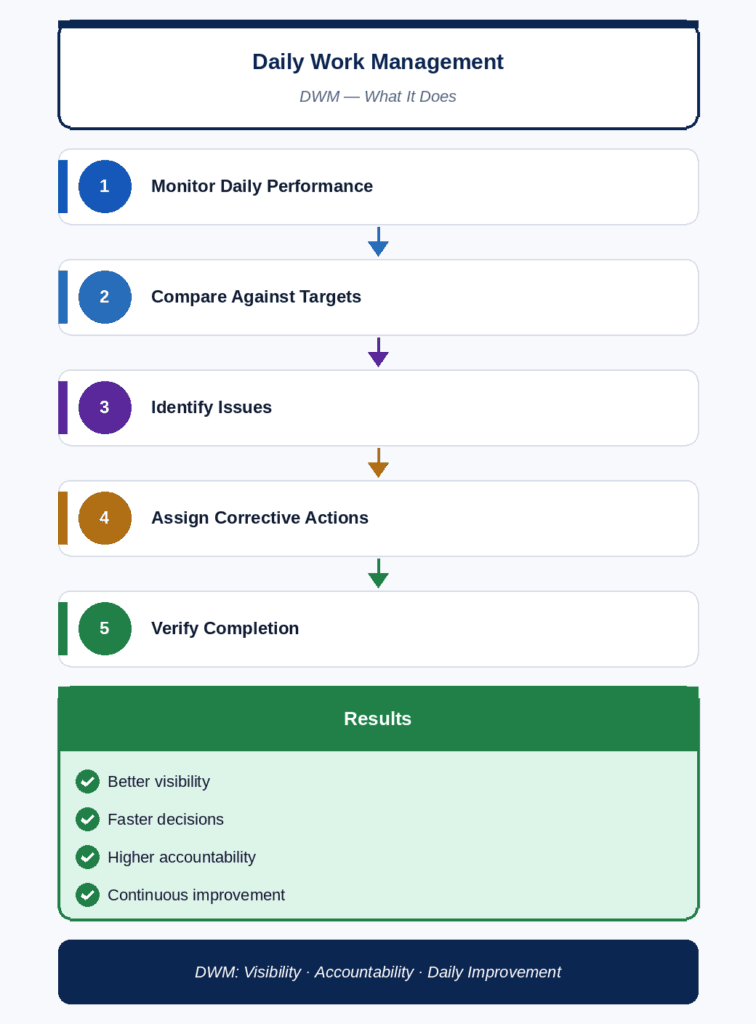
DWM operates as a continuous improvement cycle that helps manufacturing teams monitor performance, identify issues early, assign accountability, and ensure corrective actions are completed. Rather than being a one-time activity, it is a structured daily process that keeps operations aligned with production goals.
A typical Daily Work Management process includes five key steps:
Capture Daily Performance Data
Teams collect operational data such as production output, equipment downtime, quality defects, safety incidents, and Key Performance Indicators (KPIs). This provides an accurate picture of daily performance.
Review Performance Against Targets
Supervisors and frontline teams compare actual results with planned production targets and standard operating metrics to identify performance gaps.
Identify Abnormalities and Root Causes
Any deviation from expected performance, such as reduced productivity, increased scrap, equipment downtime, quality defects, or missed production targets, is identified for investigation. Teams perform root cause analysis to determine why the issue occurred and implement corrective actions to prevent it from recurring.
Assign Corrective Actions
Each issue is assigned to a specific owner with clear responsibilities, deadlines, and expected outcomes to ensure accountability.
Track Action Completion and Verify Results
Corrective actions are monitored until they are fully implemented and verified. The issue is only considered closed once the solution has proven effective and performance has returned to the expected standard.
By repeating this cycle every day, organizations create a proactive management system that prevents small operational issues from becoming larger production problems. Over time, Daily Work Management improves productivity, product quality, equipment reliability, and overall operational performance while supporting a culture of continuous improvement.
Core Components of Daily Work Management
Daily Work Management is built on a set of interconnected components that create operational structure and consistency. These include:
1. Performance Measurement System
Factories define a small set of daily KPIs to monitor performance, typically including:
- Production output
- Quality performance
- Equipment availability
- Delivery adherence
The focus is on decision-driving metrics, not reporting volume.
2. Visual Management System
Visual tools make performance visible at the shop floor level.
These can include:
- KPI boards
- Shift performance charts
- Downtime logs
- Action tracking boards
The goal is instant understanding without interpretation delays.
3. Daily Management Routines
Structured daily meetings ensure that performance is reviewed consistently.
These meetings are:
- Short
- Focused on exceptions
- Action-oriented
- Repeated at fixed times
They form the backbone of operational discipline.
4. Action Management System
Every identified issue must result in an action.
A proper system ensures:
- Clear ownership
- Deadlines
- Progress tracking
- Escalation rules
Without this, daily reviews become informational rather than operational.
5. Standardized Management Work
Just as production processes are standardized, management routines are also standardized.
This ensures:
- Consistency across shifts
- Predictable decision-making
- Reduced variation in management behavior
Why Daily Work Management Matters in Manufacturing
Manufacturing environments are highly sensitive to small disruptions. Even minor inefficiencies, if not addressed quickly, can compound into significant productivity losses.
Without structured daily management, organizations often experience:
- Delayed issue detection
- Repeated operational problems
- Inconsistent shift performance
- Weak accountability for actions
- Lack of visibility into real-time performance
Daily Work Management reduces these risks by ensuring that operational issues are surfaced and resolved quickly.
Why It Is Especially Important for Egyptian Manufacturers
In Egypt’s industrial environment, many factories operate under conditions that increase operational complexity, such as:
- Multi-shift production systems
- Fluctuating demand patterns
- Diverse product portfolios
- Varying workforce experience levels
In these conditions, consistency becomes more important than complexity.
Daily Work Management helps by:
- Creating structured daily control over operations
- Improving communication between shifts
- Reducing dependence on informal communication
- Standardizing decision-making processes
- Improving production stability
It provides a practical way to improve operational control without requiring large-scale transformation programs.
Daily Work Management vs Traditional Management
| Traditional Management | Daily Work Management |
| Weekly/monthly reporting | Daily performance reviews |
| Reactive decision-making | Proactive issue detection |
| Delayed corrective actions | Immediate action assignment |
| Fragmented communication | Structured routines |
| Informal follow-up | Systematic tracking |
The key difference is timing and discipline of execution, not tools or software.
Common Misunderstandings About Daily Work Management
Daily Work Management is often misunderstood in manufacturing environments.
It is not a reporting system
It is a decision-making and execution system.
It is not software
Tools can support it, but it is fundamentally a management discipline.
It is not a replacement for Lean
It is often a foundation that enables Lean systems to work effectively.
Conclusion
Daily Work Management is a structured approach to managing manufacturing operations on a daily basis. It improves visibility, strengthens accountability, and ensures that operational issues are addressed consistently rather than accumulated over time.
For Egyptian manufacturers, DWM provides a practical way to improve operational stability, enhance coordination across shifts, and create more predictable production performance.
When implemented correctly, it becomes the foundation for more advanced Operational Excellence and continuous improvement systems.
Frequently Asked Questions
What is Daily Work Management in manufacturing?
It is a structured system for managing daily operations by tracking performance, identifying issues early, and ensuring corrective actions are completed.
Is Daily Work Management a software system?
No. It is a management discipline that can be supported by tools but does not depend on software.
How does Daily Work Management improve operations?
It improves operations by increasing visibility, reducing response time to issues, and ensuring consistent follow-up on corrective actions.
What industries use Daily Work Management?
It is widely used in manufacturing industries, especially where multi-shift operations and production consistency are critical.
Why is it important in Egypt?
Because it helps improve operational control in environments with variability, complex production systems, and high coordination requirements.