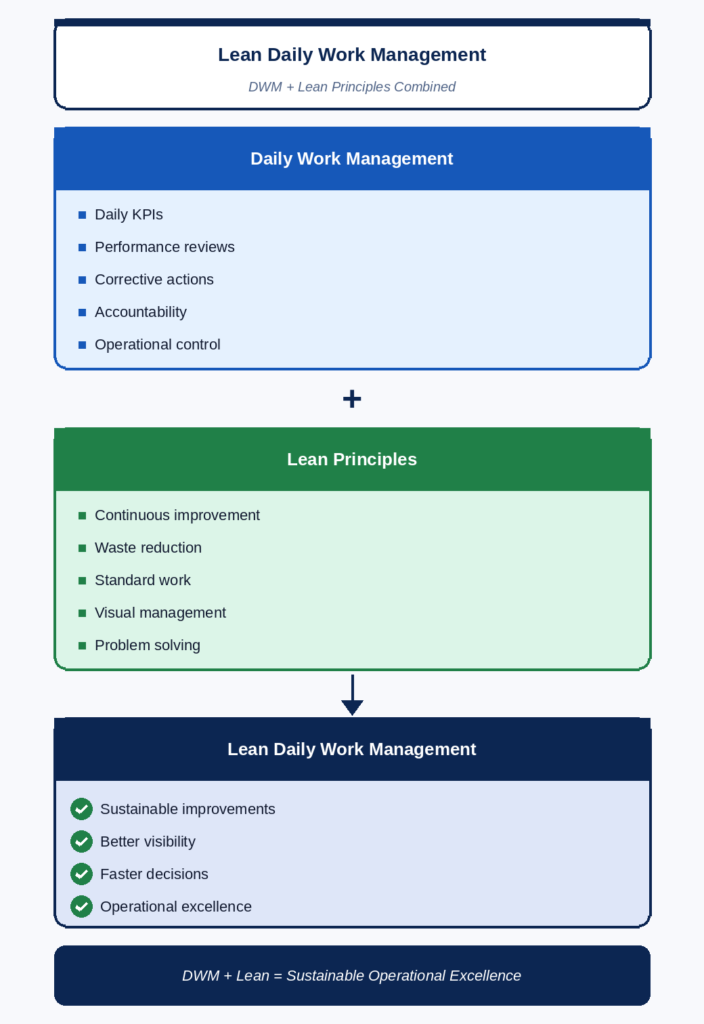
Lean Daily Work Management (LDWM) combines Lean Manufacturing principles with structured daily management routines to improve operational performance, sustain continuous improvement, and reduce waste.
Many Lean Manufacturing initiatives deliver strong early improvements but become difficult to sustain because daily management routines do not reinforce the new ways of working. One common reason is that improvement activities remain project-based instead of becoming part of everyday operations.
Lean Daily Work Management addresses this challenge by embedding Lean principles into daily management routines. It provides a structured way to review performance, identify operational issues, assign actions, and reinforce accountability every day.
For manufacturers in Egypt, this approach helps bridge the gap between continuous improvement initiatives and consistent operational execution.
Key Takeaways
- Lean Daily Work Management embeds Lean into daily operations.
- Structured routines improve visibility and accountability.
- Daily reviews help identify and resolve issues earlier.
- Successful implementation depends on leadership consistency.
- Lean Daily Work Management supports long-term operational excellence.
What Is Lean Daily Work Management?
Lean Daily Work Management applies Lean Manufacturing principles to everyday operational management. Instead of relying on periodic improvement projects, it establishes daily routines that help teams monitor performance, solve problems, and sustain improvements.
The objective is to make performance visible every day, identify operational issues quickly, assign corrective actions, and reinforce continuous improvement through consistent management routines.
Unlike standalone Lean projects, Lean Daily Work Management creates a repeatable management system that supports continuous improvement over the long term.
Why Manufacturers Adopt Lean Daily Work Management
Manufacturers typically introduce Lean Daily Work Management when existing improvement efforts fail to produce consistent operational results.
Common indicators include:
- Production issues that recur despite corrective actions
- Daily firefighting replacing structured problem-solving
- Inconsistent performance between shifts
- Limited visibility into operational KPIs (Key Performance Indicators)
- Improvement initiatives that lose momentum over time
In these situations, the challenge is often not a lack of Lean tools but the absence of structured daily management routines that reinforce consistent execution.
The Five Building Blocks of Lean Daily Work Management
Rather than relying on isolated improvement activities, Lean Daily Work Management combines several management practices into a structured daily operating system.
| Building Block | Purpose |
| Visual Management | Makes operational performance and abnormalities visible. |
| Daily Performance Reviews | Enables teams to identify and respond to issues quickly. |
| Standard Work | Reduces variation by defining consistent operating methods. |
| Action Management | Ensures agreed improvements are assigned and followed through. |
| Continuous Improvement | Encourages teams to eliminate recurring operational problems over time. |
These elements reinforce one another. When applied consistently, they create a management system that supports both operational stability and continuous improvement.
How to Implement Lean Daily Work Management
Implementing Lean Daily Work Management does not require a complete operational redesign. Most manufacturers achieve better results by introducing structured management practices incrementally.
A practical implementation roadmap includes the following steps.
1. Assess Current Management Practices
Begin by reviewing how production performance is currently monitored, how issues are escalated, and how operational decisions are made.
This assessment helps identify gaps between existing management routines and the desired future state.
2. Define Daily Operational KPIs
Select a limited number of KPIs that reflect daily operational performance.
These typically relate to:
- Safety
- Quality
- Delivery
- Productivity
- Equipment performance
The objective is to support operational decisions, not create additional reporting requirements.
3. Introduce Visual Management
Visual management boards allow teams to understand operational performance at a glance.
Information should be simple, current, and directly linked to operational priorities.
Rather than displaying every available metric, focus on the indicators that require daily management attention.
4. Establish Daily Tier Management Meetings
Daily tier meetings are short, structured reviews conducted at different levels of the organization. Their purpose is to ensure that operational performance is reviewed consistently and issues are escalated appropriately.
These meetings typically focus on:
- Previous day’s performance
- Current production status
- Key operational issues
- Action tracking and follow-up
The goal is not to discuss everything, but to focus on exceptions that require attention or intervention.
5. Build a Clear Action Management System
One of the most common reasons Lean initiatives fail is the lack of follow-up on agreed actions.
A Lean Daily Work Management system must include a structured way to:
- Assign ownership for actions
- Define clear deadlines
- Track progress consistently
- Escalate overdue items when needed
Without this layer, improvement discussions do not translate into operational change.
6. Review and Improve the System Continuously
Lean Daily Work Management is not a one-time implementation. It evolves based on how effectively it supports decision-making and operational control.
Regular reviews should focus on:
- Whether KPIs are still relevant
- Whether meetings are effective and time-efficient
- Whether actions are being completed consistently
- Whether visibility has improved across operations
This ensures the system remains practical and does not become administrative overhead.
Common Mistakes in Lean Daily Work Management
Many implementations fail not because of the concept, but because of how it is applied in practice.
Common mistakes include:
- Tracking too many KPIs, reducing focus on critical issues
- Conducting meetings without clear decisions or actions
- Treating visual boards as reporting tools rather than management tools
- Weak leadership participation in daily routines
- Lack of accountability for assigned actions
- Overcomplicating the system instead of keeping it operationally simple
Avoiding these issues is often more important than introducing advanced tools or frameworks.
Lean Daily Work Management and Industry 4.0
Industry 4.0 technologies such as real-time dashboards and automated reporting systems can significantly enhance operational visibility.
However, these tools do not replace Lean Daily Work Management. Instead, they strengthen it by improving data availability and speed of response.
Digital tools provide visibility, but Lean Daily Work Management provides the management discipline needed to act on that information.
The most effective manufacturing environments combine:
- Digital visibility (Industry 4.0 tools)
- Structured decision-making (Daily Work Management routines)
- Continuous improvement discipline (Lean principles)
When these elements are aligned, organizations can respond faster to operational issues and improve performance consistency.
Conclusion
Lean Daily Work Management provides manufacturers with a structured way to integrate Lean principles into daily operations. Instead of relying on periodic improvement initiatives, it creates a system where performance is reviewed, issues are addressed, and improvements are sustained on a daily basis.
For manufacturers in Egypt, this approach is particularly valuable in environments where operational variability, shift-based production, and efficiency pressures are common.
When implemented effectively, Lean Daily Work Management helps organizations improve visibility, strengthen accountability, and create a more stable foundation for continuous improvement.
Frequently Asked Questions
What is Lean Daily Work Management in simple terms?
It is a structured system that applies Lean principles to daily operations by using routines, visual management, and performance reviews to improve consistency and problem-solving.
How is Lean Daily Work Management different from Lean Manufacturing?
Lean Manufacturing is a broader philosophy focused on eliminating waste across the organization, while Lean Daily Work Management focuses specifically on how Lean is applied in daily operational routines.
What are the most important elements of Lean Daily Work Management?
The key elements include visual management, daily performance reviews, standard work, action tracking, and continuous improvement routines.
Can Lean Daily Work Management work without digital tools?
Yes. While digital tools can enhance visibility and speed, the foundation of Lean Daily Work Management is based on structured routines and consistent leadership practices.
How long does it take to implement Lean Daily Work Management?
Implementation time varies depending on organizational complexity, but most companies start seeing improvements within a few weeks when implemented in a focused pilot area.
Is Lean Daily Work Management part of Lean Manufacturing?
Yes. Lean Daily Work Management is a management system that helps organizations sustain Lean Manufacturing improvements through structured daily routines, visual management, accountability, and continuous improvement.