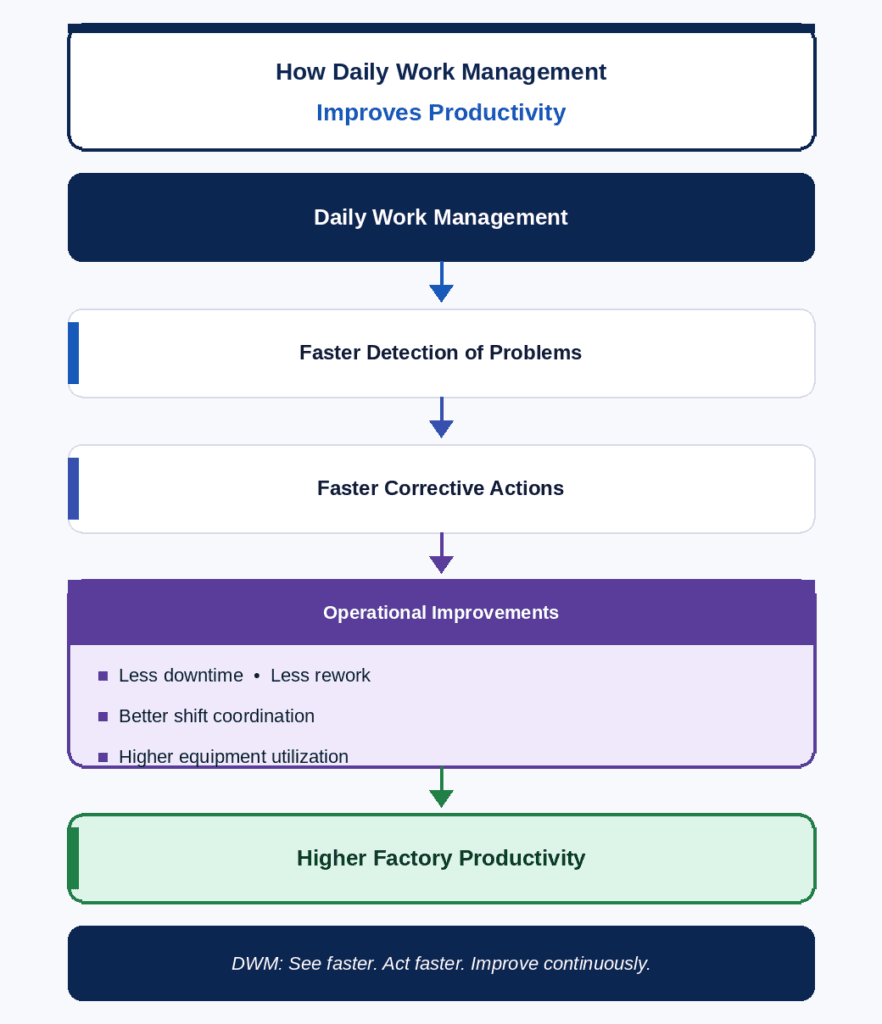
Daily Work Management (DWM) improves manufacturing productivity by helping factories identify operational problems earlier, reduce downtime, improve shift coordination, and ensure corrective actions are completed quickly. Rather than relying on weekly reports, DWM creates daily operational visibility that supports continuous productivity improvement.
In Egyptian manufacturing environments, where multi-shift operations, variable demand, and coordination gaps are common, this approach helps reduce downtime, stabilize output, and improve operational efficiency.
This article explains exactly how Daily Work Management improves productivity, where gains come from, and which operational areas are most affected.
Key Takeaways
- Productivity improves when operational issues are resolved faster, not just identified.
- Daily Work Management reduces downtime by improving response speed.
- It stabilizes shift performance and reduces variation in output.
- It improves equipment, labor, and process efficiency simultaneously.
- Most productivity losses come from delays, not lack of capacity.
How Daily Work Management Improves Productivity
Daily Work Management improves productivity by changing how manufacturing organizations respond to operational problems.
In most factories, productivity loss does not come from a single major failure. It comes from small, repeated delays and inefficiencies that accumulate throughout the day.
These include:
- Delayed machine response
- Slow communication between shifts
- Waiting time between processes
- Untracked quality issues
- Unclear operational priorities
Daily Work Management reduces these losses by creating a structured system for daily visibility and immediate action.
The result is not simply better reporting. It is faster decision-making, quicker corrective actions, and improved operational performance.
Reducing Downtime Through Faster Operational Response
Unplanned downtime is one of the largest contributors to productivity loss in manufacturing.
However, downtime is not always caused only by machine failure. In many cases, the delay in detecting, communicating, and responding to the issue increases its impact.
Daily Work Management reduces downtime by ensuring:
- Issues are identified immediately at the shop floor level
- Problems are escalated through structured routines
- Responsibility for resolution is clearly assigned
- Actions are tracked until completion
This significantly reduces the “hidden time loss” between problem occurrence and problem resolution.
Over time, this also helps factories identify recurring downtime patterns, enabling more structured long-term improvements.
Improving Shift Performance Consistency
One of the most common sources of productivity loss is variation between shifts.
Even when machines, materials, and processes remain constant, output can differ significantly depending on how each shift is managed.
Daily Work Management improves consistency by introducing structured routines such as:
- Reviewing previous shift performance at the start of each shift
- Identifying unresolved issues before production begins
- Aligning priorities across teams
- Ensuring clear communication of operational expectations
This reduces dependence on informal communication and ensures that every shift operates with the same level of clarity and focus.
The result is a more stable and predictable production flow.
Reducing Rework and Quality-Related Productivity Loss
Rework is a direct productivity drain because it consumes time, materials, and machine capacity without adding value.
In many factories, rework is not caused by a single large issue but by small deviations that are not detected early.
Daily Work Management reduces rework by:
- Making quality deviations visible earlier in the process
- Improving coordination between production and quality teams
- Tracking recurring defect patterns systematically
- Ensuring corrective actions are completed and not just recorded
This improves first-pass yield and reduces the amount of production capacity spent on non-value-added work.
Even small improvements in rework rates can have a significant impact on overall productivity.
Improving Equipment Utilization and Labor Efficiency
Productivity is strongly influenced by how effectively resources are used, not just how much output is produced.
Daily Work Management improves resource efficiency by:
- Reducing idle machine time caused by delays or miscommunication
- Improving coordination between maintenance and production teams
- Aligning workforce activity with real-time production priorities
- Minimizing waiting time between operations
This leads to higher equipment utilization and more efficient use of labor hours.
The key improvement is not increased effort, it is reduced waste of time and capacity.
Strengthening Operational Visibility
One of the most important factors affecting productivity is visibility.
Without clear visibility into what is happening on the shop floor, problems are often discovered too late to prevent losses.
Daily Work Management improves visibility by ensuring:
- Daily tracking of key production metrics
- Structured review of operational performance
- Immediate identification of deviations
- Clear communication of issues across teams
This allows managers and supervisors to act proactively rather than reactively.
Improved visibility leads directly to faster decision-making and better operational control.
Where Productivity Loss Actually Comes From
A key insight in manufacturing is that most productivity loss is not caused by major failures.
Instead, it comes from:
- Delays in responding to small issues
- Repeated minor disruptions
- Inconsistent execution across shifts
- Lack of structured follow-up
- Unclear ownership of operational problems
Individually, these issues appear minor. Collectively, they significantly reduce total output.
Daily Work Management addresses this by focusing on speed of response and consistency of execution, rather than relying only on large-scale improvements.
Daily Work Management vs Traditional Productivity Management
| Traditional Management | Daily Work Management |
| Weekly/monthly reviews | Daily performance control |
| Delayed problem detection | Real-time issue identification |
| Reactive corrections | Immediate corrective action |
| Aggregated reporting | Shop-floor visibility |
| Periodic follow-ups | Continuous action tracking |
The main difference is not tools or technology, but frequency and discipline of operational control.
Why It Matters for Egyptian Manufacturers
Egyptian manufacturing environments often operate under conditions that amplify productivity challenges, such as:
- Multi-shift production systems
- Varying workforce experience levels
- Fluctuating demand patterns
- Complex coordination between departments
In these environments, even small inefficiencies quickly accumulate into significant production losses.
Daily Work Management helps by:
- Stabilizing daily production performance
- Improving coordination across shifts
- Reducing response time to operational issues
- Increasing accountability for execution
This creates more predictable and efficient production systems.
Conclusion
Daily Work Management improves productivity by strengthening how manufacturing operations are controlled on a daily basis. It reduces downtime, improves shift consistency, increases visibility, and enhances both equipment and labor efficiency.
For Egyptian factories, its value lies in its practicality, it improves performance without requiring large-scale system changes. Instead, it focuses on improving daily execution discipline and operational responsiveness.
When applied consistently, it becomes one of the most effective mechanisms for sustained productivity improvement in manufacturing environments.
Frequently Asked Questions
How does Daily Work Management improve productivity in factories?
It improves productivity by reducing delays in identifying and resolving operational issues, which minimizes downtime and inefficiencies.
What is the biggest source of productivity loss in manufacturing?
Most productivity loss comes from small, repeated delays such as slow response to issues, inconsistent execution, and lack of follow-up.
What productivity metrics improve with Daily Work Management?
- Production output
- Downtime
- Overall Equipment Effectiveness (OEE)
- First-pass yield
- Labor utilization
- Schedule adherence
Does Daily Work Management increase output directly?
Not directly. It improves the efficiency and stability of operations, which leads to higher effective output over time.
Is DWM part of Lean Manufacturing?
It is often used as a foundational system that supports Lean Manufacturing by ensuring consistent execution and visibility.