Organizational change has become increasingly important in Nairobi’s manufacturing sector as companies face rising pressure to improve efficiency, product quality, workforce performance, and competitiveness.
As market demands evolve, manufacturers must continuously adapt their operations, processes, and organizational systems to remain effective. In many cases, organizations already recognize the need for change. The greater challenge is implementing and sustaining change within complex operational environments where production demands, workforce capability, and business objectives must remain aligned.
This article explores the importance of organizational change in Nairobi’s manufacturing sector and how it contributes to long-term operational performance and business success.
Understanding Organizational Change in Nairobi
In Nairobi’s manufacturing sector, organizational change refers to structured improvements in how companies operate, including:
- Production workflows and systems
- Workforce roles and responsibilities
- Quality control processes
- Operational efficiency practices
- Performance management systems
Unlike theoretical business environments, manufacturing organizations in Nairobi operate in highly practical, execution-driven conditions where change must be reflected directly on the shop floor.
Why Organizational Change Is Important in Nairobi’s Manufacturing Sector
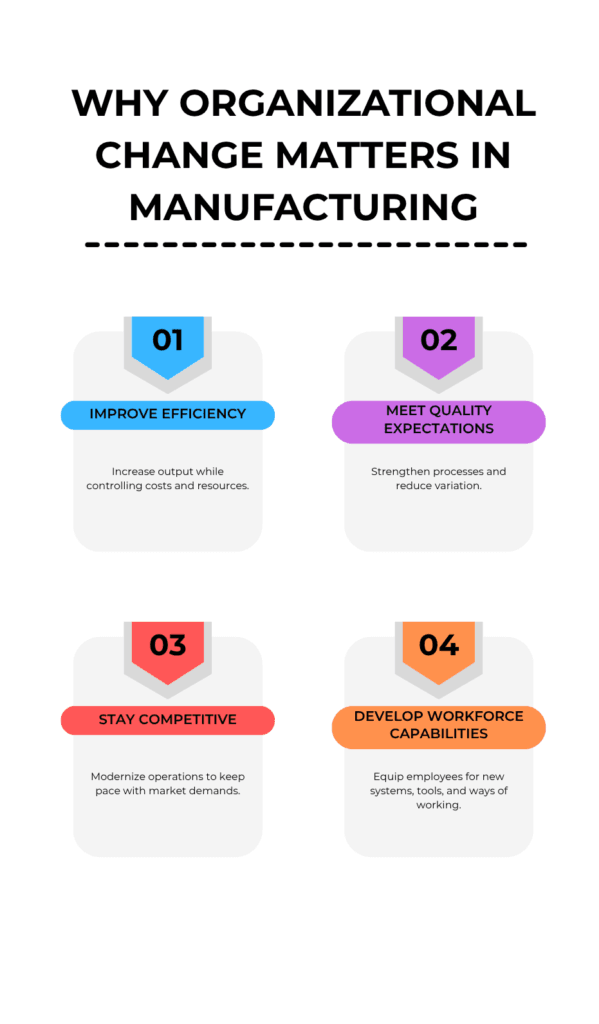
The demand for organizational change in Nairobi’s manufacturing sector is driven by real operational and market pressures.
1. Increasing Operational Efficiency Requirements
Manufacturing companies must continuously improve output while managing costs and resource constraints.
2. Quality Expectations from Customers
Higher quality standards require organizations to continuously improve processes and reduce variation.
3. Competitive Market Pressure
Local and regional competition forces manufacturers to modernize systems and improve performance.
4. Workforce and Capability Development Needs
As operations evolve, employees must adapt to new systems, tools, and expectations.
These factors make organizational change a continuous requirement rather than a one-time initiative.
How Organizational Change Impacts Manufacturing Performance
When implemented effectively, organizational change directly improves:
- Production efficiency
- Process consistency
- Product quality
- Workforce productivity
- Operational stability
However, these outcomes are only achieved when change is properly executed and sustained within daily operations.
Without structured execution, organizations may experience temporary improvements that are not maintained over time.
Challenges of Organizational Change in Nairobi’s Manufacturing Sector
Several challenges affect successful implementation of organizational change in Nairobi:
Execution Inconsistency
Even well-designed changes often fail due to lack of consistent application on the shop floor.
Leadership Misalignment
Different interpretations of change across departments can slow down execution.
Workforce Adaptation Gaps
Employees may require time, training, and support to adapt to new processes.
Limited Performance Visibility
Without clear tracking systems, it becomes difficult to measure whether change is working.
These challenges highlight why organizational change must be treated as an operational discipline, not just a strategic initiative.
What Successful Organizational Change Implementation Looks Like
Organizations that successfully implement change in Nairobi’s manufacturing sector typically demonstrate:
- Clear leadership alignment
- Structured execution planning
- Strong communication systems
- Workforce capability development
- Continuous performance tracking
These factors ensure that change is not only introduced but also sustained over time.
Leadership Alignment in Organizational Change
Leadership alignment is a critical factor in the success of organizational change in Nairobi’s manufacturing sector. When leaders across production, operations, quality, and supply chain are aligned, change is implemented more consistently across all levels of the organization.
Misalignment often results in conflicting priorities, uneven execution, and delays in adoption at the operational level.
In manufacturing environments, where coordination directly affects output and quality, aligned leadership ensures that decisions are translated into consistent action on the shop floor.
This alignment reduces execution friction and increases the likelihood that organizational change is sustained beyond the initial rollout phase.
Communication as an Execution Enabler
Clear and structured communication is essential for effective organizational change in manufacturing environments.
In Nairobi’s manufacturing sector, communication gaps often lead to confusion, resistance, and inconsistent execution across teams.
Effective communication ensures that employees understand what is changing, why it is changing, and how it affects their specific roles.
It also helps reduce uncertainty during transition periods and supports faster adoption of new processes.
When communication is consistent across departments and shifts, it strengthens coordination and improves execution reliability.
In this context, communication is not just informational; it is an operational requirement for successful change implementation.
Execution Discipline in Organizational Change
In manufacturing environments, execution discipline determines whether organizational change succeeds or fails.
Even strong strategies fail when:
- Processes are not consistently followed
- Accountability is weak
- Performance is not monitored
- Leadership follow-through is inconsistent
Execution discipline ensures that organizational change becomes part of daily operational behavior rather than a short-term initiative.
Workforce Capability and Change Adoption
Workforce capability directly influences the success of organizational change in manufacturing environments. In Nairobi’s manufacturing sector, even well-designed change initiatives can fail if employees are not adequately prepared to apply new systems and processes.
Capability gaps often result in inconsistent execution, reduced productivity, and resistance to new workflows.
Strengthening workforce capability through training, role clarity, and practical exposure ensures smoother adoption of change. When employees understand both the process and the expected outcomes, they are more likely to apply changes consistently.
Workforce capability therefore plays a central role in ensuring that organizational change is sustained in daily operations.
Measurement and Feedback in Sustaining Change
Measurement and feedback systems are essential for maintaining the effectiveness of organizational change in manufacturing environments.
In Nairobi’s manufacturing sector, lack of clear performance visibility often leads to uncertainty about whether change initiatives are delivering results.
Structured measurement systems allow organizations to track operational performance, identify deviations, and adjust execution in real time.
Feedback from operational teams also provides practical insights into implementation challenges.
When measurement is embedded into daily operations, it supports continuous improvement and ensures that organizational change remains controlled, visible, and adaptable.
This makes measurement a core driver of long-term change sustainability.
How Organizational Change Supports Long-Term Manufacturing Success
When organizational change is effectively implemented in Nairobi’s manufacturing industry, it leads to:
- Improved operational efficiency
- Higher product quality consistency
- Better workforce alignment
- Reduced process variation
- Stronger competitiveness in the market
These outcomes are only sustainable when change is treated as an ongoing operational capability, not just a one-time initiative.
How Consulting Supports Organizational Change in Nairobi’s Manufacturing Sector
Many manufacturing organizations in Nairobi recognize the importance of organizational change but face challenges in execution.
In such cases, consulting support can help organizations strengthen how organizational change is planned, implemented, and sustained across operations.
This includes:
- Aligning leadership teams across functions
- Structuring change into practical operational steps
- Improving communication across departments
- Strengthening execution discipline on the shop floor
- Ensuring change is embedded into daily routines
The value of consulting lies in helping organizations move from understanding change to consistently applying it in real operational environments.
Conclusion
Successful implementation of organizational change projects in Nairobi’s manufacturing sector depends on execution, not intent. It depends on how effectively leadership alignment, communication, workforce capability, and performance measurement systems work together within daily operations.
When these elements are disconnected, even well-designed change initiatives struggle to deliver lasting results. When they are aligned and consistently reinforced, organizational change becomes an operational capability that supports efficiency, quality improvement, and long-term competitiveness.
As manufacturers face increasing pressure to improve performance and adapt to changing market demands, the importance of organizational change will continue to grow. Manufacturers that can effectively translate change into improved operational performance are better positioned to remain competitive as business requirements continue to evolve.
Frequently Asked Questions
Why is organizational change important in Nairobi’s manufacturing sector?
Because it improves efficiency, quality, and competitiveness in a highly competitive industrial sector.
What drives the need for organizational change in manufacturing?
Operational pressure, quality expectations, and market competition.
What are the main challenges of organizational change in Nairobi?
Execution inconsistency, leadership misalignment, and workforce adaptation gaps.
How does organizational change improve manufacturing performance?
By improving efficiency, quality, and operational consistency.
What role does consulting play in organizational change?
It helps organizations structure and align change effectively within real manufacturing operations.