
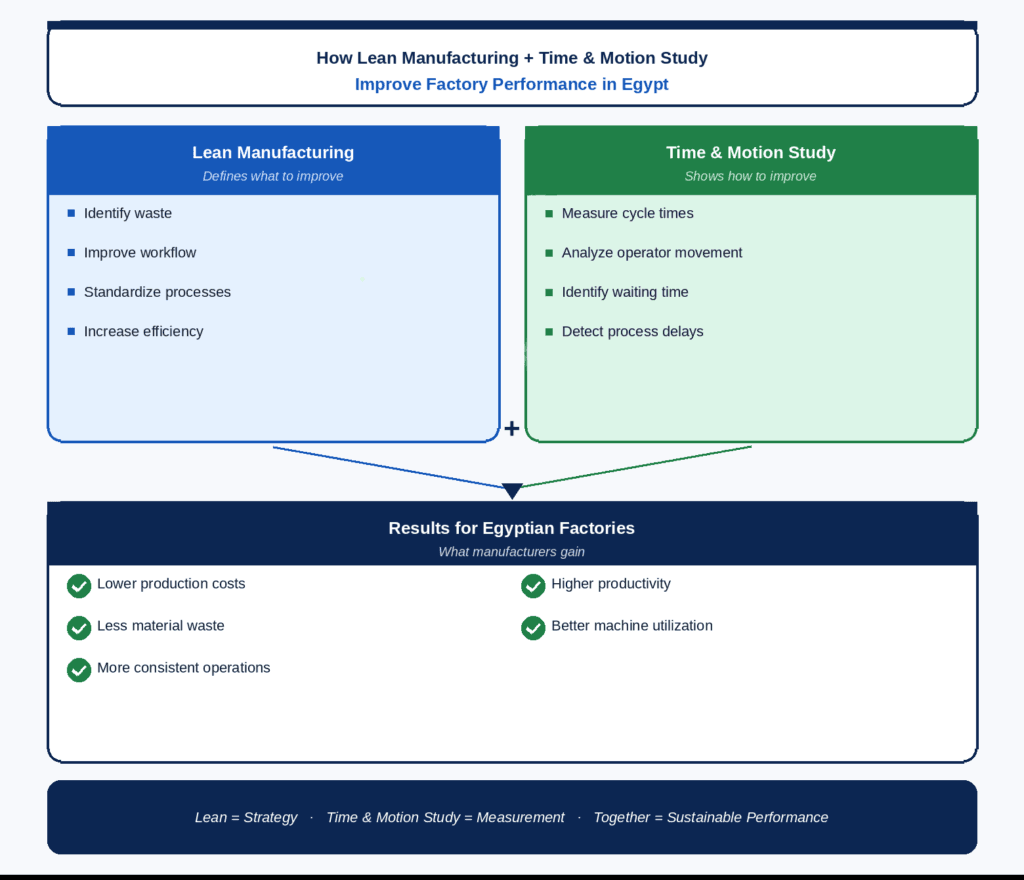
In Egypt, Lean Manufacturing is a production approach focused on reducing cost and increasing output by eliminating waste across manufacturing processes. While Lean defines what “waste” is and where efficiency should improve, Time and Motion Study (TMS) provides the practical method for identifying and measuring that waste in real production environments.
In simple terms, Lean Manufacturing tells factories what to improve, while Time and Motion Study shows exactly how to improve it.
Together, they form a complete system for increasing productivity and reducing manufacturing costs without reducing workforce size or production capacity.
How Lean Manufacturing Reduces Cost and Increases Output
At its core, Lean Manufacturing improves performance by removing activities that do not add value to the final product. These include unnecessary movement, waiting time, rework, excess inventory, and inefficient workflows.
However, in real factory conditions, these inefficiencies are not always obvious. They are often hidden within daily operations and become normalized over time.
This is where Lean alone is not enough. To reduce cost effectively, manufacturers need a way to measure where time and resources are being lost. That is the role of Time and Motion Study.
The Role of Time and Motion Study in Lean Manufacturing
Time and Motion Study is the execution engine behind Lean Manufacturing. It transforms Lean principles into measurable operational improvements.
Instead of relying on assumptions, TMS analyzes actual production activity by breaking down work into:
- Task cycle times
- Operator movements
- Waiting periods
- Material handling steps
- Machine interaction delays
This allows manufacturers to see exactly where inefficiencies occur and how much time they consume.
Once identified, these inefficiencies can be removed or reduced, directly supporting Lean goals of cost reduction and productivity improvement.
How Lean + TMS Reduce Manufacturing Costs in Practice
When Lean Manufacturing is combined with Time and Motion Study, cost reduction becomes systematic rather than theoretical.
1. Reducing Labor Cost While Increasing Output
Lean focuses on eliminating non-value-added activities, but TMS identifies exactly where those activities occur on the shop floor.
This includes unnecessary walking, searching for tools, waiting for machines, and repeated tasks caused by unclear instructions.
When these inefficiencies are removed, workers produce more output within the same working hours. This reduces labor cost per unit while increasing overall productivity.
It also reduces overtime, which is often a symptom of inefficient workflows rather than insufficient capacity.
2. Improving Material Flow and Reducing Waste
Material waste is one of the most significant cost drivers in manufacturing. Lean aims to minimize this waste, but TMS shows where it is happening in practice.
Through motion and process analysis, TMS identifies:
- Excess material handling
- Damage during transport
- Inefficient workstation layout
- Rework caused by inconsistent methods
Once these issues are corrected, material moves more efficiently through the production system, reducing scrap and improving first-pass yield.
This directly lowers production cost and improves output consistency.
3. Increasing Machine Utilization and Reducing Idle Time
Machines represent fixed-cost assets, so any idle time increases the cost per unit produced.
Lean Manufacturing aims to improve flow efficiency, while TMS identifies the exact causes of machine delays, such as:
- Operator unavailability
- Material delays
- Unbalanced production sequencing
- Poor synchronization between processes
By removing these delays, machines spend more time producing and less time waiting, which increases output without increasing capital investment.
4. Reducing Process Variation and Improving Consistency
One of the hidden sources of inefficiency in manufacturing is variation in how different operators perform the same task.
Lean Manufacturing promotes standardization, but TMS provides the data needed to define the best and most efficient method.
By analyzing multiple task executions, TMS helps establish a standard workflow that reduces variation between shifts and operators.
This improves predictability, reduces defects, and increases overall production stability.
Why Lean Manufacturing Needs Time and Motion Study
Lean Manufacturing is a powerful framework for improving efficiency, but it is difficult to implement effectively without precise measurement. In many factories, waste is identified visually or based on assumptions, which often leads to inconsistent results across production lines.
Time and Motion Study solves this problem by measuring actual production performance, including cycle times, operator movements, and delays. This makes inefficiencies visible, quantifiable, and easier to address in a structured way.
Without this level of measurement, improvement efforts may target the wrong problems or deliver only partial gains. Even small variations in process performance can significantly affect cost per unit in high-volume manufacturing environments.
By integrating Time and Motion Study into Lean Manufacturing, decision-making becomes data-driven rather than subjective. This improves the accuracy of process improvements and ensures results are repeatable, scalable, and consistent across different production areas.
Impact on Egyptian Manufacturing Industry
In Egyptian factories, where production systems often rely on manual labor, variable workflows, and tight cost structures, the combination of Lean Manufacturing and Time and Motion Study is particularly effective.
It enables manufacturers to:
- Reduce production costs without reducing workforce
- Increase output from existing resources
- Improve operational consistency
- Eliminate hidden inefficiencies in production flow
This makes it highly relevant for Egypt’s manufacturing industries.
Conclusion
Lean Manufacturing reduces cost and increases output by eliminating waste, but Time and Motion Study makes this process measurable and actionable.
When combined, Lean provides the strategy while TMS provides the execution framework. This integration allows manufacturers in Egypt to improve productivity, reduce cost per unit, and increase output without reducing production capacity.
FAQs
How does Lean Manufacturing reduce cost?
It reduces cost by eliminating waste in production processes such as waiting time, unnecessary movement, rework, and inefficiencies.
What is the role of Time and Motion Study in Lean Manufacturing?
It measures how work is performed and identifies inefficiencies that Lean principles aim to eliminate.
Does Lean Manufacturing increase output?
Yes. By removing waste and improving flow, Lean Manufacturing increases productivity and output from existing resources.
Why is Time and Motion Study important for Lean implementation?
Because it provides the data needed to identify inefficiencies accurately rather than relying on assumptions.
Can Lean Manufacturing work without Time and Motion Study?
Yes, but results are usually less precise and harder to sustain because improvements are not data-driven.