Egypt’s manufacturing sector is under constant pressure to increase output, reduce operational waste, and improve efficiency without significantly increasing labor or capital costs. One of the most effective ways to achieve this is through a Time and Motion Study (TMS).
A Time and Motion Study improves labor productivity by analyzing how work is performed, measuring task durations, and identifying unnecessary movements or inefficiencies in production processes. Instead of relying on assumptions or increasing workforce size, TMS focuses on optimizing existing operations using structured, data-driven analysis.
In practical terms, it helps manufacturers answer a critical question:
How can we produce more output with the same workforce and resources?
In Egypt’s competitive manufacturing environment, this approach plays a key role in improving operational performance and production efficiency.
Key Takeaways
- Time and Motion Study (TMS) improves labor productivity by analyzing how work is performed and eliminating inefficiencies.
- It helps reduce non-value-added activities such as unnecessary movement, waiting, and rework.
- TMS enables standardization of work methods, improving consistency across operators and shifts.
- It supports better use of time, workforce capacity, and production resources.
- Productivity improvements are achieved through process optimization, not increased labor effort.
Why Labor Productivity Matters in Egyptian Manufacturing
Labor productivity is one of the most important performance indicators in manufacturing. It measures how efficiently human effort is converted into output.
In Egypt, manufacturers often operate in environments where:
- Production demand fluctuates
- Labor-intensive processes dominate
- Cost pressure is increasing
- Delivery timelines are becoming tighter
- Operational inefficiencies accumulate over time
Even small inefficiencies, such as extra walking, waiting time, or repeated handling, can significantly reduce output when repeated across shifts and production cycles.
Common productivity challenges include:
- Operators spending time searching for tools or materials
- Uneven workload distribution across stations
- Waiting time due to machine or material delays
- Inconsistent methods between workers
- Excess movement within workstation layouts
These issues often remain unnoticed because they become part of daily routine. Time and Motion Study helps uncover these inefficiencies by breaking work into measurable elements.
What Is Time and Motion Study (TMS)?
A Time and Motion Study (TMS) is an industrial engineering method used to analyze work performance by combining two techniques:
Time Study
Measures how long each task takes under normal working conditions to establish standard production times.
Motion Study
Examines the physical movements involved in completing a task to identify unnecessary or inefficient actions.
When combined, they provide a complete view of how work is performed on the shop floor.
The objective of TMS is not to increase worker speed, but to improve process efficiency by designing better methods of work.
Instead of asking:
“How fast are workers performing?”
TMS asks:
“Is there a better way to perform this work?”
This distinction is what makes TMS a powerful tool for improving labor productivity sustainably.
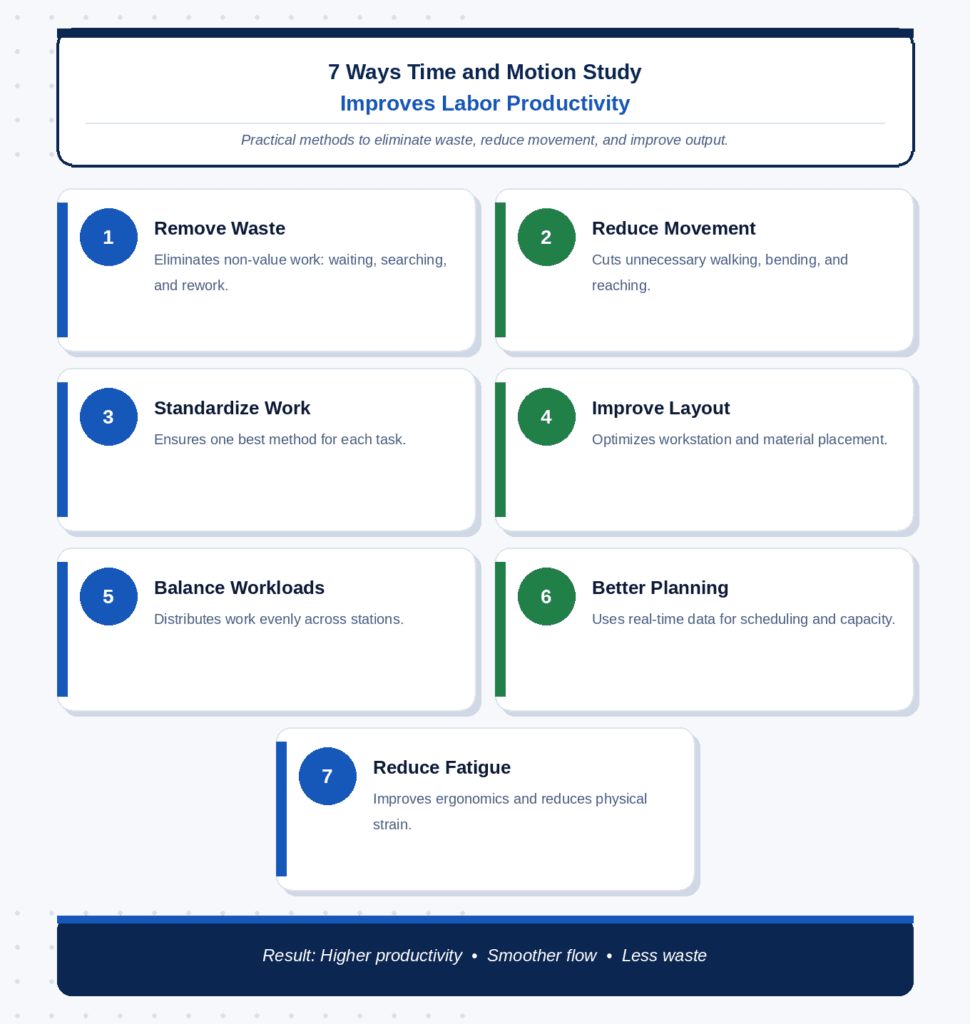
7 Ways Time and Motion Study Improves Labor Productivity
1. Eliminates Non-Value-Added Activities
One of the biggest sources of productivity loss in manufacturing is time spent on activities that do not directly contribute to output.
These include:
- Walking to retrieve materials
- Searching for tools or equipment
- Waiting for machines to complete cycles
- Unnecessary handling of components
- Duplicate or repeated inspections
While each activity may seem minor, their cumulative effect across hundreds of cycles leads to significant productivity loss.
By identifying and eliminating these activities, TMS increases the proportion of time spent on productive work.
2. Reduces Unnecessary Operator Movement
Movement that does not add value directly reduces efficiency and increases fatigue.
A Time and Motion Study analyzes how operators interact with their workstation and identifies inefficient movements such as:
- Excessive walking between stations
- Reaching or bending repeatedly
- Poor tool placement
- Inefficient material access points
Even small improvements, such as repositioning tools or materials within arm’s reach, can significantly reduce wasted time when repeated across production cycles.
3. Standardizes Work Methods
In many manufacturing environments, different operators perform the same task in slightly different ways. While outcomes may be similar, variations in method often lead to differences in cycle time and productivity.
TMS helps identify the most efficient method of performing a task and establishes it as a standard work method.
Standardization improves:
- Consistency in output
- Predictability of cycle times
- Training efficiency for new workers
- Stability across shifts
This creates a more controlled and measurable production environment.
4. Improves Workstation Layouts
Workstation design has a direct impact on productivity. Poor layout decisions often result in unnecessary motion, delays, and inefficiency.
A Time and Motion Study highlights layout-related issues such as:
- Poor placement of tools and materials
- Excessive distance between related tasks
- Inefficient flow of components
- Congested or poorly organized workspaces
By optimizing layout design, manufacturers can reduce movement waste and improve workflow efficiency without changing the process itself.
5. Balances Workload Across Operations
Uneven workload distribution is a common cause of production delays and bottlenecks.
When one workstation takes significantly longer than others, it slows down the entire production line.
TMS helps identify these imbalances by measuring cycle times across different tasks. This allows manufacturers to:
- Redistribute tasks more evenly
- Reduce idle time at faster stations
- Improve overall production flow
- Increase throughput without additional labor
Balanced workloads lead to smoother and more predictable production output.
6. Improves Production Planning Accuracy
Accurate production planning depends on knowing how long tasks actually take, not how long they are assumed to take.
Time and Motion Study provides realistic time standards based on observation, which improves:
- Production scheduling
- Capacity planning
- Workforce allocation
- Delivery forecasting
This reduces the risk of underestimating production time or overloading production lines.
7. Reduces Operator Fatigue and Improves Efficiency
Excessive movement, poor workstation design, and inefficient methods not only reduce productivity but also increase physical fatigue.
TMS helps reduce unnecessary effort by improving ergonomics and simplifying tasks.
When operators experience less physical strain:
- Productivity becomes more consistent
- Error rates decrease
- Work quality improves
- Overall efficiency increases
This creates a more sustainable production environment where productivity improvements are maintained over time.
Common Productivity Challenges Time and Motion Study Helps Solve
In manufacturing environments, productivity losses are often not caused by a single major issue, but by multiple small inefficiencies that accumulate over time. A Time and Motion Study helps identify and address these issues in a structured and measurable way.
Some of the most common challenges include:
1. Inconsistent Work Methods
When different operators perform the same task using different approaches, it leads to variations in cycle time and output. This inconsistency makes production planning less reliable and reduces overall efficiency.
2. Excessive Waiting Time
Waiting occurs when operators depend on machines, materials, or upstream processes. Even short delays can significantly reduce productive working time when repeated across shifts.
3. Poor Material Availability
Delays caused by missing or poorly positioned materials force operators to stop work or move away from their stations, reducing active production time.
4. Inefficient Workstation Design
Poor layout decisions often result in unnecessary walking, reaching, bending, or searching for tools and components.
5. Unbalanced Production Flow
When one stage of production is slower than others, it creates bottlenecks that reduce overall output, even if other stations are operating efficiently.
By addressing these challenges through structured observation and measurement, TMS helps manufacturers create more stable and efficient production systems.
Why Data-Driven Process Improvement Matters
One of the key strengths of Time and Motion Study is that it replaces assumptions with measurable data.
In many manufacturing environments, decisions about productivity improvements are based on experience or observation alone. While experience is valuable, it can sometimes overlook hidden inefficiencies that are not immediately visible.
TMS introduces a structured, evidence-based approach by:
- Measuring actual task times instead of estimated durations
- Observing real operator behavior on the shop floor
- Identifying inefficiencies through repeatable analysis
- Establishing objective performance standards
This approach aligns with modern industrial engineering principles, where improvement decisions are based on verified data rather than perception.
Data-driven analysis ensures that productivity improvements are not only effective but also sustainable over time.
Conclusion
Improving labor productivity does not always require significant capital investment. In many cases, carefully analyzing existing work methods can reveal opportunities to improve operational efficiency, reduce waste, and establish more consistent production standards.
For manufacturers in Egypt, TMS remains one of the most practical industrial engineering techniques for supporting productivity improvement and Lean manufacturing initiatives. When conducted using structured methodologies and supported by accurate data, these studies help organizations make informed decisions that contribute to long-term operational excellence.
Frequently Asked Questions
What is a Time and Motion Study in manufacturing?
A Time and Motion Study analyzes how work is performed by measuring task durations and evaluating worker movements. The goal is to establish efficient, standardized work methods that improve productivity while reducing unnecessary effort.
How does a Time and Motion Study improve labor productivity?
By identifying non-value-added activities such as waiting, excessive movement, and inefficient workflows, manufacturers can redesign processes to make better use of labor and equipment.
Is a Time and Motion Study different from a work study?
A work study is a broader discipline that includes both Method Study and Time Study. Time and Motion Studies are important components of work study used to improve operational efficiency.
How does a Time and Motion Study support Lean manufacturing?
Time and Motion Studies provide objective data that helps identify waste, standardize work, and improve process flow, making them an important tool within Lean Manufacturing initiatives.