
Manufacturing companies in Egypt are increasingly adopting structured quality improvement systems to remain competitive in both local and global markets. One of the most effective approaches is working with Six Sigma consultants for manufacturing quality improvement, a methodology focused on reducing defects, improving process efficiency, and strengthening Operational Excellence.
As industries expand across industrial zones, the demand for Six Sigma consulting services continues to grow across Egypt’s manufacturing industries, especially in sectors where quality consistency and cost efficiency are critical.
What Is a Six Sigma Consultant?
A Six Sigma consultant is a process improvement specialist who helps organizations identify inefficiencies, reduce variation, and eliminate defects using data-driven methods.
Unlike traditional advisory roles, Six Sigma consultants rely on statistical analysis and structured frameworks to improve performance in measurable ways.
In manufacturing environments, their role typically includes:
- Reducing production defects and rework
- Improving process control and stability
- Enhancing quality management systems
- Increasing productivity and efficiency
- Training internal teams on continuous improvement tools
Their focus is not only short-term fixes but long-term Operational Excellence.
Why Six Sigma Matters in Egyptian Manufacturing
The concept of Six Sigma is becoming essential in Egyptian manufacturing as companies face increasing pressure from global supply chains, export requirements, and rising production costs.
Many factories struggle with:
- High defect rates in production lines
- Inefficient workflows and bottlenecks
- Inconsistent product quality
- Limited process standardization
- High operational waste
Six Sigma addresses these issues through a structured and measurable improvement approach.
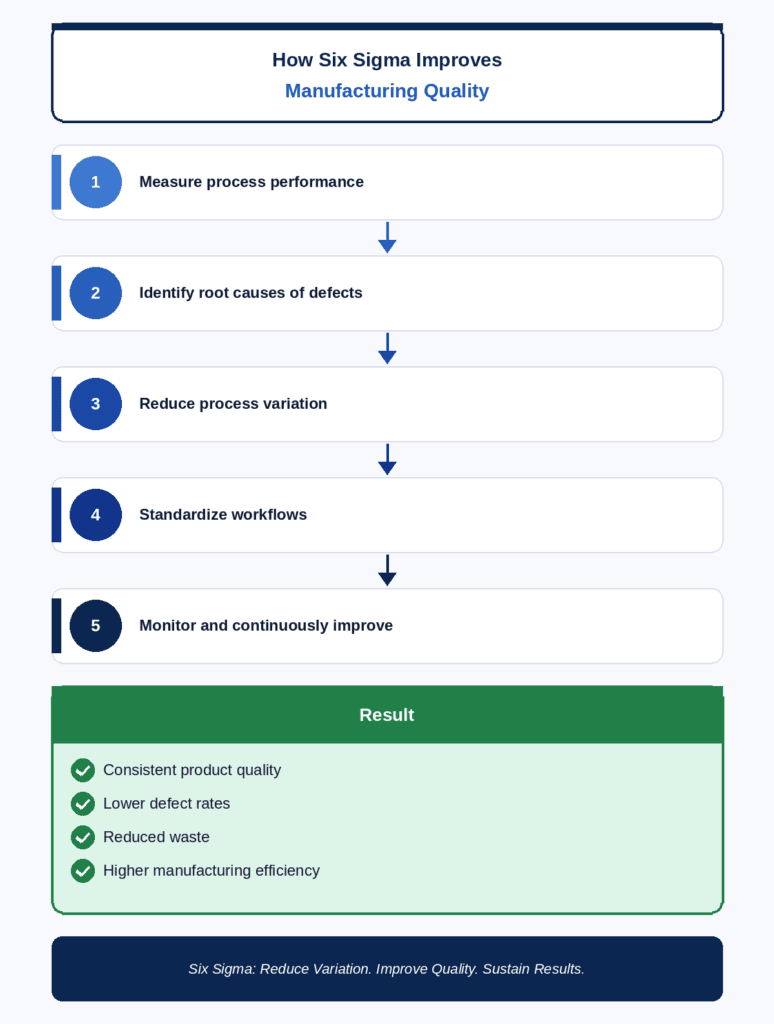
How Six Sigma Improves Manufacturing Quality and Reduces Defects
At its core, Six Sigma improves manufacturing quality by systematically reducing process variation. In manufacturing environments, variation is one of the primary causes of defects, inconsistencies, and production inefficiencies.
When process variation is high, output quality becomes unpredictable; resulting in defective products, rework, and increased operational costs. By contrast, when variation is reduced through structured Six Sigma methods, production becomes stable, repeatable, and controlled.
The Six Sigma quality improvement approach is especially valuable in manufacturing because it transforms quality from a reactive function into a proactive, data-driven system.
Six Sigma achieves this improvement through measurement, root-cause analysis, and controlled process optimization.
1. Reduced Defects Through Root Cause Elimination
One of the most important outcomes of Six Sigma is defect reduction in manufacturing processes.
Instead of treating defects as isolated issues, Six Sigma focuses on identifying and eliminating their root causes using structured tools such as:
- Pareto Analysis (to identify major defect drivers)
- Fishbone Diagrams (to map potential causes)
- Statistical Process Control (to detect variation trends)
- Process Capability Analysis (to measure performance gaps)
In Egypt’s manufacturing sector, this approach helps industries reduce recurring production errors such as:
- Material inconsistencies
- Machine calibration issues
- Human operational errors
- Supplier quality variations
By eliminating these root causes, companies achieve long-term defect reduction rather than temporary fixes.
2. Better Process Control and Stability
Another key benefit of Six Sigma is improved process control in manufacturing systems.
Stable processes are predictable processes. Six Sigma ensures stability by:
- Defining Standard Operating Procedures (SOPs)
- Monitoring critical quality parameters in real time
- Using control charts to track performance trends
- Setting acceptable upper and lower control limits
When processes are tightly controlled, manufacturers experience fewer unexpected disruptions, less variation between production batches, and improved consistency across output lines.
This is particularly important in industries where even small deviations can lead to major quality failures.
3. Higher Productivity Through Reduced Rework
Improving quality is directly linked to increasing productivity in manufacturing operations.
When defect rates decrease:
- Less time is spent on rework
- Fewer production stoppages occur
- Machine utilization improves
- Labor efficiency increases
Six Sigma eliminates inefficiencies that slow down production flow. As a result, factories can produce more units in less time without increasing operational costs.
This is a key reason why Six Sigma consulting services are widely adopted in Egypt’s competitive manufacturing environments where output speed and consistency must be balanced.
4. Cost Reduction Through Waste Elimination
Another major advantage of Six Sigma is its ability to significantly reduce manufacturing costs by eliminating waste.
Common sources of waste include:
- Scrap materials due to defects
- Reprocessing and rework costs
- Machine downtime caused by process instability
- Excess inventory due to production inefficiencies
By improving process accuracy and stability, Six Sigma reduces these hidden costs.
With Lean Six Sigma, this effect is even stronger, as waste reduction is combined with defect reduction, creating a highly efficient production system focused on maximum value with minimum resource loss.
5. Improved Customer Satisfaction Through Consistent Quality
Customer satisfaction in manufacturing is strongly influenced by product consistency and reliability.
When Six Sigma is implemented effectively, customers benefit from:
- Fewer defective products
- More consistent product performance
- Improved durability and reliability
- Fewer complaints and returns
In export-driven industries, this is especially important because international buyers expect strict adherence to quality standards.
Consistent quality builds trust, strengthens brand reputation, and increases long-term customer retention.
6. Data-Driven Continuous Improvement Culture
Beyond immediate improvements, Six Sigma introduces a continuous improvement culture within manufacturing organizations.
Instead of relying on intuition, decisions are based on:
- Real production data
- Statistical evidence
- Measurable Key Performance Indicators (KPIs)
- Performance benchmarks
This shift allows organizations to continuously refine processes, detect inefficiencies early, and maintain long-term competitiveness.
Over time, this creates a manufacturing system where quality improvement becomes an ongoing discipline rather than a one-time initiative.
Lean Six Sigma Consulting in Egypt
Many organizations in Egypt now prefer Lean Six Sigma consulting, which combines:
- Lean principles (eliminating waste)
- Six Sigma methodology (reducing defects and variation)
This combination is especially effective in manufacturing environments where both speed and quality matter.
Benefits include:
- Faster production cycles
- Reduced operational waste
- Improved workflow efficiency
- Better resource utilization
- Stronger quality assurance systems
Conclusion
In Egypt, the role of Six Sigma consultants for manufacturing quality improvement is becoming increasingly important as businesses strive to reduce defects, improve efficiency, and achieve operational excellence.
By implementing structured methodologies such as DMAIC and integrating Lean principles, manufacturers can significantly enhance productivity, reduce costs, and improve product quality.
Companies that invest in Lean Six Sigma consulting in Egypt are better positioned to compete in both local and international markets.
FAQs
What does a Six Sigma consultant do in manufacturing?
A Six Sigma consultant improves manufacturing processes by reducing defects, improving quality, and increasing efficiency using data-driven methods.
How does Six Sigma improve manufacturing quality in Egypt?
It reduces process variation, improves control systems, and eliminates defects, resulting in more consistent production quality.
What is DMAIC in Six Sigma?
DMAIC stands for Define, Measure, Analyze, Improve, and Control; a structured framework for process improvement.
What is the difference between Lean and Six Sigma?
Lean focuses on waste reduction, while Six Sigma focuses on reducing defects and variation. Together they improve efficiency and quality.