
Rising operational costs continue to challenge businesses across Kenya. Organizations are under increasing pressure to improve efficiency while maintaining quality and customer satisfaction.
Many businesses initially focus on cutting budgets when costs begin to rise. While this may provide short-term savings, it rarely addresses the underlying issues that drive inefficiency. Sustainable cost reduction typically comes from improving processes, eliminating waste, and making better use of available resources.
This is where Lean Six Sigma has become a valuable framework for organizations seeking measurable improvements in performance. By combining waste elimination with data-driven process improvement, Lean Six Sigma helps businesses identify inefficiencies, reduce defects, improve productivity, and build more reliable operations.
As competition increases and customer expectations continue to evolve, many organizations are turning to Lean Six Sigma consultants in Kenya to uncover hidden costs and create a foundation for long-term Operational Excellence.
Why Operational Costs Remain High in Many Kenyan Businesses
In many organizations, excessive costs are not caused by a single major issue. Instead, they often result from numerous small inefficiencies that accumulate over time.
Common challenges include:
- Manual approval processes that slow decision-making
- Duplicate data entry across departments
- Excessive paperwork and administrative tasks
- Inconsistent quality standards
- Frequent rework and corrections
- Poor visibility into operational performance
- Inventory inaccuracies
- Long turnaround times for routine activities
Because these inefficiencies develop gradually, they often become accepted as part of normal operations. However, their impact on profitability can be significant.
For example, a manufacturing company may experience rising production costs due to recurring defects and excessive scrap. A logistics provider may struggle with route inefficiencies, delivery delays, and fragmented reporting systems. Service-based organizations often lose productivity through manual workflows and inconsistent processes that create unnecessary delays.
Without a structured approach to improvement, these hidden costs can continue to affect growth, customer satisfaction, and overall business performance.
What Is Lean Six Sigma?
Lean Six Sigma is a proven methodology used worldwide to improve business performance through waste reduction, process optimization, and quality improvement.
The methodology combines two complementary approaches:
Lean focuses on eliminating activities that do not add value to customers and reducing operational waste.
Six Sigma focuses on reducing process variation and defects through measurement, analysis, and data-driven problem-solving.
Together, these approaches help organizations improve efficiency, consistency, and profitability while delivering better outcomes for customers.
Common Lean Six Sigma tools include:
- DMAIC (Define, Measure, Analyze, Improve, Control)
- Value Stream Mapping (VSM)
- Root Cause Analysis
- Statistical Process Control (SPC)
- Kaizen
- Process Capability Analysis
These tools enable organizations to identify bottlenecks, understand the root causes of operational issues, and implement improvements that deliver measurable results.
How Lean Six Sigma Helps Reduce Costs
One of the primary benefits of Lean Six Sigma is its ability to identify and eliminate unnecessary costs without compromising quality or customer experience.
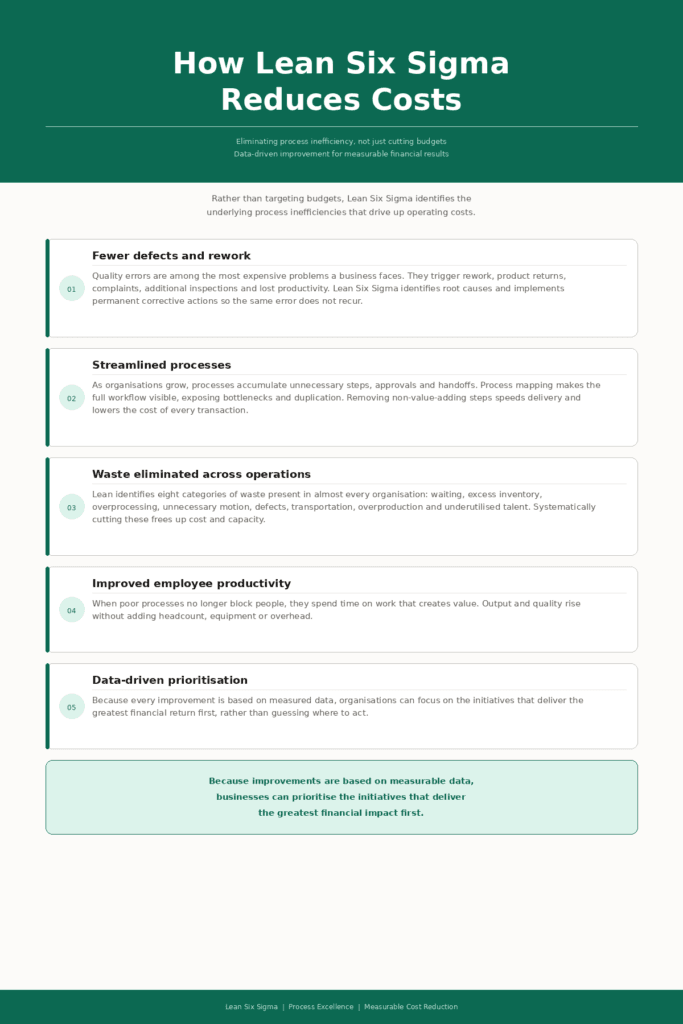
Rather than focusing solely on budget reductions, Lean Six Sigma targets the underlying process inefficiencies that increase operating expenses.
Organizations often achieve cost savings by:
- Reducing defects and rework
- Improving employee productivity
- Eliminating process bottlenecks
- Optimizing inventory levels
- Reducing waiting times
- Improving resource utilization
- Increasing process consistency
Because improvements are based on measurable data, businesses can prioritize initiatives that deliver the greatest financial impact.
Reducing Defects and Rework
Quality-related issues are among the most expensive operational problems businesses face.
When errors occur, organizations incur additional costs through:
- Rework
- Product returns
- Customer complaints
- Additional inspections
- Service delays
- Lost productivity
Many Kenyan firms have successfully adopted Lean Six Sigma to reduce defects by identifying the root causes of quality issues and implementing permanent corrective actions.
For manufacturers, this can result in lower scrap rates and improved production output. For service organizations, it often leads to fewer customer issues, faster resolution times, and more consistent service delivery.
Reducing defects not only lowers costs but also strengthens customer trust and brand reputation.
Streamlining Business Processes
As organizations grow, processes often become more complex.
Additional approvals, reporting requirements, and administrative tasks can create inefficiencies that slow operations and increase costs.
Through Lean Six Sigma process optimization in Kenya, organizations can gain a clearer understanding of how work moves through the business. Process mapping exercises help identify bottlenecks, duplicated effort, and activities that do not contribute value.
By simplifying workflows and removing unnecessary steps, businesses can improve efficiency while maintaining quality and compliance standards.
Eliminating Waste Across Operations
Waste exists in almost every organization, regardless of industry.
Lean methodology identifies several common categories of waste, including:
- Waiting time
- Excess inventory
- Overprocessing
- Unnecessary movement
- Defects
- Transportation inefficiencies
- Underutilized employee skills
Effective waste reduction consulting using Six Sigma helps organizations systematically identify and eliminate these sources of inefficiency.
The result is often lower operating costs, faster processes, and improved utilization of people, equipment, and resources.
The Role of a Lean Six Sigma Consultant in Kenyan Industries
Many organizations recognize operational challenges but struggle to determine where improvements should begin. This is where Lean Six Sigma consultants with experience in Kenyan industries can provide significant value.
A consultant brings an objective perspective, proven methodologies, and practical experience in solving complex operational challenges.
Typical consulting activities include:
- Conducting operational assessments
- Analyzing process performance data
- Identifying root causes of inefficiencies
- Designing improvement roadmaps
- Facilitating improvement workshops
- Supporting change management initiatives
- Building internal process improvement capabilities
Working with Lean Six Sigma process experts for Kenyan markets can help organizations accelerate results while minimizing implementation risks.
How Lean Six Sigma Improves Quality and Performance
While cost reduction is often a primary objective, Lean Six Sigma delivers benefits that extend well beyond financial savings.
By improving process design and strengthening operational controls, organizations can achieve:
- More consistent service delivery
- Reduced process variation
- Faster turnaround times
- Improved compliance
- Better customer experiences
- Increased employee productivity
- Stronger operational resilience
This is one reason why Lean Six Sigma quality management continues to gain traction across both private and public sector organizations in Kenya.
It enables businesses to proactively prevent issues through better process control and continuous monitoring, rather than reacting to problems after they occur.
Signs Your Organization May Need Lean Six Sigma Support
Many businesses delay improvement initiatives until operational challenges become severe. However, early intervention often delivers greater value. Common warning signs include:
- Rising operating costs
- Frequent customer complaints
- Missed deadlines
- Excessive manual work
- Recurring quality issues
- Low productivity levels
- High employee frustration
- Slow decision-making processes
When multiple challenges exist simultaneously, a structured process improvement initiative can often generate significant performance gains.
This is why many organizations in Kenya invest in Lean Six Sigma consulting services as part of their broader Operational Excellence and business transformation strategies.
The Importance of Data-Driven Process Improvement
A key principle of Lean Six Sigma is making decisions based on facts rather than assumptions.
Many organizations believe they understand their biggest challenges, but data often reveals a different story.
Through data driven process improvement consulting, businesses can accurately measure performance, identify root causes, and prioritize initiatives that offer the highest return on investment.
This evidence-based approach reduces guesswork and ensures improvement efforts are focused on areas that will deliver meaningful business outcomes.
Building a Culture of Continuous Improvement
The most successful organizations do not treat process improvement as a one-time project. Instead, they create systems that continuously identify opportunities for optimization and performance enhancement.
A strong continuous improvement framework that Kenyan firms can implement typically includes:
- Clearly defined performance metrics
- Process ownership and accountability
- Employee engagement and participation
- Structured problem-solving methods
- Ongoing training and development
- Leadership support and commitment
When continuous improvement becomes part of everyday operations, organizations are better positioned to adapt to changing market conditions and customer needs.
Lean Six Sigma and Long-Term Business Growth
As businesses expand, operational complexity often increases.
Without standardized processes and effective performance management systems, growth can introduce new inefficiencies that affect profitability and customer experience.
This is why many organizations invest in Lean Six Sigma consulting services for Kenyan enterprises.
By improving efficiency, strengthening quality controls, and developing internal improvement capabilities, businesses can create scalable operations that support sustainable growth.
Organizations pursuing broader transformation initiatives also benefit from Lean Six Sigma improvement consulting in Kenya, which helps align operational improvements with strategic business objectives.
Ultimately, Lean Six Sigma consulting for long term growth in Kenya is not simply about reducing costs. It is about building a more agile, resilient, and competitive organization that can thrive in a rapidly evolving business environment.
Conclusion
For Kenyan businesses facing rising costs and increasing customer expectations, Lean Six Sigma offers a practical and proven path to improved performance.
By eliminating waste, reducing defects, optimizing processes, and using data to drive decision-making, organizations can achieve meaningful cost savings while improving quality and customer satisfaction.
Whether the goal is reducing operational expenses, streamlining workflows, improving quality management, or supporting broader business transformation initiatives, Lean Six Sigma provides a structured framework for achieving sustainable results.
Partnering with experienced providers of Lean Six Sigma consultant services in Kenya can help organizations identify high-impact opportunities, develop internal capabilities, and build the foundation for long-term Operational Excellence and growth.
Frequently Asked Questions
How do Lean Six Sigma consulting services improve operations in Kenya?
Lean Six Sigma consulting services improve operations by identifying inefficiencies, reducing waste, streamlining workflows, and improving process performance through data-driven analysis. Businesses often benefit from lower costs, higher productivity, and improved customer outcomes.
What is the role of a Lean Six Sigma consultant in Kenyan industries?
A Lean Six Sigma consultant helps organizations assess operational performance, identify improvement opportunities, analyze root causes, and implement solutions that improve efficiency, quality, and profitability.
Are Lean Six Sigma consulting services suitable for growing businesses?
Yes. Lean Six Sigma helps growing organizations establish scalable processes, improve productivity, maintain quality standards, and reduce operational costs as they expand.
How effective is Lean Six Sigma for reducing defects?
Lean Six Sigma is highly effective because it focuses on identifying and eliminating the root causes of defects. This helps organizations reduce rework, improve consistency, and strengthen overall quality performance.
Why is Lean Six Sigma important for long-term growth?
Lean Six Sigma supports long-term growth by creating efficient processes, improving operational resilience, strengthening quality management, and fostering a culture of continuous improvement that helps organizations remain competitive.