
Market dynamics across Egypt require organizations to achieve higher operational performance, maximize asset utilization, and eliminate process waste. To maintain sustainable growth, leadership teams are looking beyond traditional expansion tactics. Instead, they focus on internal process optimization, strategic alignment, and daily execution discipline. Partnering with professional productivity consultants offers Egyptian enterprises the structured framework required to transform everyday operations into long-term commercial success.
The Strategic Need for Productivity Consultants in Egypt
Modern Egyptian enterprises operate in an economic environment where efficiency directly influences competitive advantage. Expanding workforce headcount or capital equipment without refining underlying processes creates operational friction. Business productivity consultants in Egypt provide the external objectivity and technical methodology required to identify invisible bottlenecks, reduce cycle times, and streamline value streams.
By implementing structured frameworks such as Lean management, Total Productive Maintenance (TPM), and Value Stream Mapping (VSM), operational leaders can convert resource constraints into sustainable performance gains.
Addressing Structural Inefficiencies
Organizational growth often reveals underlying operational issues. Common challenges include:
- Unbalanced workflows leading to uneven line speeds and process delays.
- Inconsistent Daily Work Management (DWM) practices across operating shifts.
- High operational waste across inventory, transport, and processing steps.
- Misalignment between executive growth strategy and front-line execution.
By systematically evaluating operations, corporate productivity consultants in Egypt replace reactive problem solving with structured, data-driven management systems.
Core Pillars How Productivity Consultants Drive Sustainable Growth
When business leadership collaborates with productivity improvement consultants in Egypt, the objective is not temporary cost cutting. The primary goal is building scalable capacity that supports top line expansion while protecting bottom line profitability.
1. Value Stream Optimization and Waste Elimination
A foundational step in driving business growth is analyzing how value flows to the end customer. Operational productivity consultants in Egypt conduct detailed Value Stream Mapping (VSM) exercises to capture every step in the operational process.
This analysis categorizes activities into value added, non-value added but necessary, and pure waste. Eliminating process waste (such as unnecessary material movement, waiting times, and unnecessary motion) allows businesses to increase output using existing capacity.
Key Operational Insight: Process growth occurs when organizations increase throughput velocity without proportionally increasing operational overhead. Eliminating non-value added steps unlocks hidden capacity instantly.
2. Standardizing Daily Work Management
Strategic vision achieves results only when executed consistently on the shop floor or office floor every day. Productivity consultants help build structured Daily Work Management (DWM) systems that convert strategic goals into actionable daily metrics.
A robust daily management framework establishes:
- Clear daily Key Performance Indicators (KPIs) tracked at every level.
- Visual management boards for instant visibility into operational health.
- Structured daily review meetings to address performance variances quickly.
- Defined escalation pathways so operational issues are resolved systematically.
3. Capability Building and Workforce Performance Optimization
Process design requires engaged teams to succeed. Employee performance optimization consulting focuses on building internal capabilities so that workforce teams drive continuous improvement independently.
Through structured training, shift-level coaching, and standardized work instruction, consultants empower supervisors and operators to identify operational waste, practice root-cause problem solving, and sustain performance improvements over time. 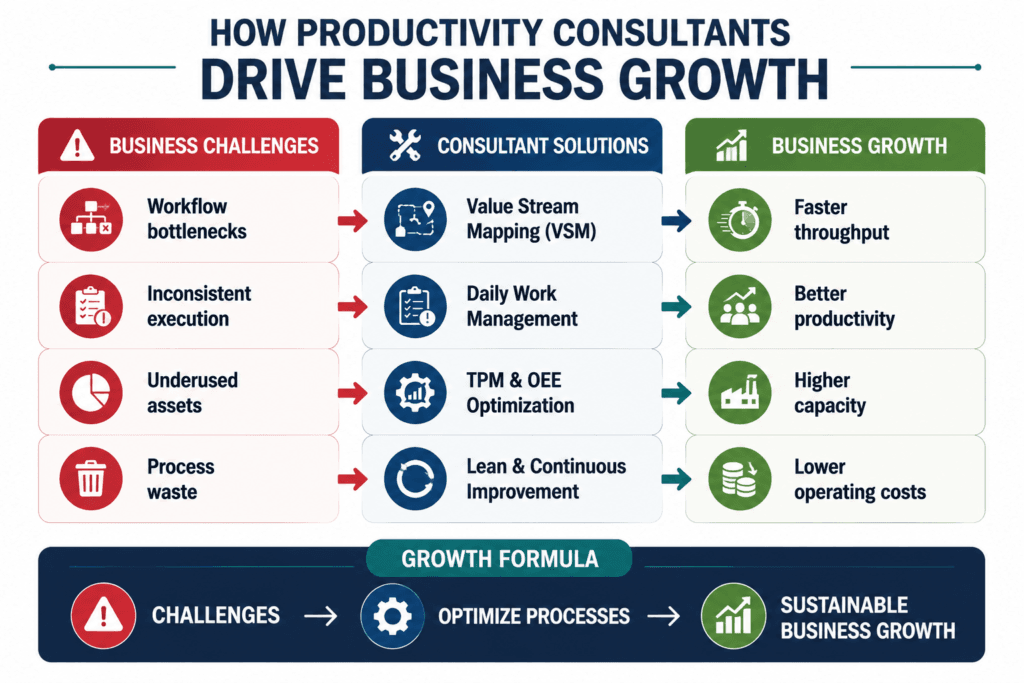
Overcoming Internal Barriers to Scale and Efficiency
When businesses scale across Egypt, internal operational friction often multiplies. Growth without optimized systems typically increases lead times, causes quality variations, and inflates overhead costs. Business productivity consultants in Egypt assist organizations in identifying and breaking through these operational ceilings.
Bridging the Execution Gap Between Leadership and Operations
A common structural failure in growing enterprises is the disconnect between executive decision-making and operational execution. Leadership establishes strategic targets, but frontline supervisors lack the standardized tools to achieve them consistently.
Productivity advisors implement structured governance systems that align strategic objectives with shift-level targets. By introducing visual standard work, standardized shift handovers, and structured problem-solving mechanisms, every level of the workforce aligns with overarching corporate objectives.
Maximizing Resource and Asset Utilization
Increasing production capacity does not always require capital expenditure on new machinery or facility expansion. Operational productivity consultants in Egypt analyze asset performance using structured techniques like Overall Equipment Effectiveness (OEE) and Total Productive Maintenance (TPM).
By analyzing unplanned downtime, speed losses, and micro-stoppages, consultants help enterprises optimize existing assets. Unlocking hidden machine and labor capacity enables organizations to handle higher volume without incurring unnecessary fixed capital costs.
Integrating Modern Productivity Frameworks for Scalability
Leading business efficiency consulting services combine classic Lean management principles with modern, data-informed technologies to ensure sustainable business transformation.
| Transformation Area | Traditional Approach | Consultant-Led Framework | Business Growth Impact |
| Workflow Design | Uncoordinated batch processing | Value Stream Mapping and Flow Management | Shorter lead times and improved throughput |
| Workplace Organization | Informal cleanup routines | Structured 5S and Visual Controls | Reduced search time and safer working conditions |
| Performance Tracking | Historical end-of-month reporting | Real-time Daily Work Management | Rapid issue resolution and lower downtime |
| Process Control | Subjective quality checks | Statistical process control and standard work | Consistent quality and minimal rework |
Tactical Roadmap: How Consultants Facilitate Business Growth in Egypt
The engagement model used by experienced productivity consultants in Egypt follows a disciplined, step-by-step methodology designed to achieve measurable operational results:
Step 1: Comprehensive Diagnostic Scan
Consultants observe actual operational conditions on-site, analyze historical performance data, and conduct Time and Motion studies to identify process bottlenecks and capability gaps.
Step 2: Custom Solution Architecture
Recognizing that every enterprise operates under unique conditions, consultants design tailored process productivity enhancement solutions rather than applying pre-packaged templates.
Step 3: On-Site Implementation and Execution
Working alongside internal teams, consultants roll out workplace productivity improvement strategies, establish visual management boards, and optimize physical floor layouts.
Step 4: Governance and Sustenance Integration
To ensure long-term gains, governance structures, audit systems, and management review cadences are established. This step embeds continuous improvement directly into organizational culture.
The Long-Term Commercial Impact of Productivity Transformation
Partnering with professional corporate productivity consultants in Egypt creates a cultural shift toward Operational Excellence. Instead of relying on periodic management interventions to address operational issues, companies establish a self-sustaining environment of continuous improvement.
When process workflows are streamlined, waste is eliminated, and daily management routines are embedded, businesses experience:
- Sustainable cost structures that remain resilient against market fluctuations.
- Higher operational agility to adapt quickly to changing customer demands.
- Enhanced brand reputation driven by consistent quality and reliable delivery timelines.
- Higher return on capital invested across equipment, labor, and facilities.
Ultimately, systematic productivity improvement transitions an enterprise from reactive operational survival into scalable, market-leading expansion.
Frequently Asked Questions (FAQs)
How do productivity consultants help Egypt’s businesses?
Productivity consultants help Egypt businesses by diagnosing operational bottlenecks, eliminating workflow waste, and implementing structured frameworks like Lean management and Daily Work Management. They optimize resource utilization, streamline value streams, and build employee capabilities to drive higher throughput and sustainable bottom-line growth.
Why should companies hire productivity consultants in Egypt?
Companies hire productivity consultants in Egypt to gain objective expert analysis, access proven international methodologies, and accelerate performance transformation. Consultants assist organizations in improving operational efficiency, lowering production costs, standardizing quality, and scaling operations without unnecessary capital expenditure.
What services do productivity consultants offer in Egypt?
Productivity consultants in Egypt offer services including Value Stream Mapping (VSM), Lean management implementation, workplace organization (5S), manpower productivity studies, Total Productive Maintenance (TPM), supply chain optimization, and Daily Work Management systems.
When do businesses need productivity consultants in Egypt?
Businesses need productivity consultants in Egypt when experiencing operational bottlenecks, rising production costs, inconsistent delivery schedules, high product defect rates, or rapid business expansion that strain existing operational capabilities.