
Growth is a goal for nearly every business, but sustainable growth requires more than increased sales, new customers, or market expansion.
As organizations grow, operational complexity often grows with them. Processes that worked well for a small team may struggle to support higher volumes, larger workforces, and increased customer expectations. Without the right systems in place, growth can introduce inefficiencies, quality issues, and rising operational costs that limit long-term success.
This is why many organizations are investing in Lean Six Sigma as part of their growth strategy.
Rather than focusing solely on cost reduction, Lean Six Sigma helps businesses create scalable processes, improve operational performance, and maintain quality as they expand. By combining process optimization with data-driven decision-making, organizations can build the operational foundations needed to support sustainable growth.
Today, many businesses are engaging Lean Six Sigma consulting services in Kenya to strengthen Operational Excellence, improve customer experiences, and create systems that can scale alongside business objectives.
Why Growth Often Creates Operational Challenges
Growth is generally viewed as a positive sign, but it can expose weaknesses that were previously hidden within an organization.
As demand increases, businesses often experience challenges such as:
- Rising operational costs
- Delayed project delivery
- Inconsistent service quality
- Communication breakdowns between teams
- Resource constraints
- Increased customer complaints
- Limited visibility into performance metrics
- Process bottlenecks
These issues frequently emerge because processes were designed for a smaller organization and have not evolved to support expansion.
For example, a manufacturer may struggle to maintain product quality as production volumes increase. A logistics provider may experience delays as order volumes grow beyond the capacity of existing workflows. A financial services firm may find that manual approval processes become a barrier to timely customer service.
Without structured process improvement, growth can unintentionally create inefficiencies that reduce profitability and customer satisfaction.
How Lean Six Sigma Supports Business Growth
Lean Six Sigma helps organizations build efficient, scalable operations that can support growth without sacrificing quality or performance.
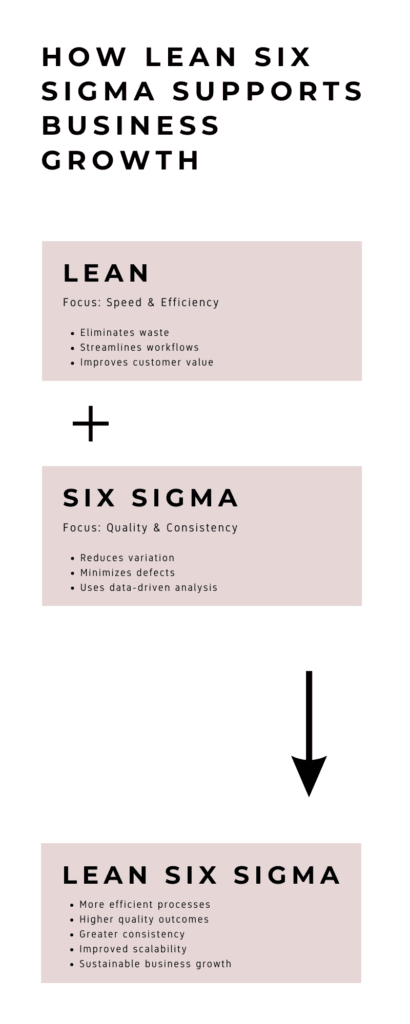
The methodology combines two complementary approaches:
Lean focuses on eliminating waste, improving workflow efficiency, and maximizing customer value.
Six Sigma focuses on reducing process variation, improving consistency, and minimizing defects through data-driven analysis.
Together, these approaches help organizations create processes that are more predictable, efficient, and capable of handling increased demand.
Unlike short-term improvement initiatives, Lean Six Sigma establishes systems and capabilities that support long-term business objectives.
The Connection Between Operational Excellence and Growth
Many organizations focus heavily on revenue growth while overlooking operational performance.
However, growth becomes increasingly difficult to sustain when:
- Costs rise faster than revenue
- Productivity declines
- Quality becomes inconsistent
- Customer complaints increase
- Employees spend more time managing problems than creating value
This is where Operational Excellence becomes a competitive advantage.
Organizations that invest in process improvement often benefit from:
- Improved efficiency
- Better resource utilization
- Stronger quality management
- Increased employee productivity
- Faster decision-making
- Enhanced customer experiences
- Greater organizational agility
These capabilities create a stronger foundation for expansion and help businesses scale more effectively.
Why Businesses Engage Lean Six Sigma Consultants
As organizations grow, internal teams are often focused on managing daily operations and executing strategic initiatives.
This can make it difficult to dedicate sufficient time and expertise to process improvement efforts.
A Lean Six Sigma consultant provides an objective perspective, proven methodologies, and practical experience that help organizations identify improvement opportunities and accelerate results.
The role of a Lean Six Sigma consultant in Kenya industries often includes:
- Process assessments
- Operational diagnostics
- Performance analysis
- Root cause identification
- Improvement roadmap development
- Change management support
- Continuous improvement capability building
By leveraging structured methodologies, consultants help organizations prioritize high-impact initiatives and avoid common implementation challenges.
How Lean Six Sigma Consulting Services Improve Operations in Kenya
Organizations frequently ask how Lean Six Sigma consulting services improve operations in Kenya.
The answer lies in the methodology’s ability to align operational performance with strategic business goals.
Rather than focusing on isolated improvements, Lean Six Sigma addresses the underlying processes that influence efficiency, quality, customer satisfaction, and profitability.
Process Optimization
Many business processes evolve organically over time.
As organizations expand, additional approvals, reporting requirements, and manual activities can create unnecessary complexity.
Through Lean Six Sigma process optimization in Kenya, businesses can identify bottlenecks, simplify workflows, and improve operational efficiency.
Common tools include:
- Value Stream Mapping (VSM)
- DMAIC (Define, Measure, Analyze, Improve, Control)
- Process Flow Analysis
- Root Cause Analysis
These methods help organizations improve performance while reducing waste and operational costs.
Quality Improvement
Growth often places pressure on quality standards.
Without strong quality controls, increased demand can result in more defects, customer complaints, and rework.
Organizations implementing Lean Six Sigma quality management initiatives in Kenya focus on reducing variation and strengthening process consistency. The benefits of this include:
- Fewer customer complaints
- Reduced rework
- Improved compliance
- Greater customer satisfaction
- More reliable service delivery
Data-Driven Decision-Making
Successful growth requires informed decision-making.
Through data driven process improvement consulting, organizations gain greater visibility into operational performance and can make decisions based on measurable facts rather than assumptions.
This enables leadership teams to prioritize investments, allocate resources effectively, and focus on initiatives that generate meaningful business value.
Common Growth Barriers Lean Six Sigma Helps Address
Many organizations encounter similar operational challenges as they expand.
Rising Operational Costs
Growth often introduces additional complexity, which can increase operating expenses.
Through waste reduction consulting using Six Sigma, organizations can identify activities that consume resources without creating customer value.
Common examples include:
- Duplicate work
- Excess approvals
- Inventory inefficiencies
- Waiting time
- Manual reporting processes
- Rework and corrections
Eliminating these inefficiencies helps improve profitability while supporting growth objectives.
Quality and Consistency Challenges
As organizations expand across teams, departments, or locations, maintaining consistent quality can become increasingly difficult.
Lean Six Sigma focuses on reducing process variation and creating standardized processes that support predictable outcomes.
This enables organizations to scale while maintaining customer trust and operational reliability.
Limited Scalability
Many businesses eventually outgrow the processes that supported them during earlier stages of growth.
Lean Six Sigma helps redesign workflows and operating models so they can support future expansion without requiring constant intervention or crisis management.
Why Continuous Improvement Matters for Growth
Sustainable growth requires more than a single improvement project.
Customer expectations change, technologies evolve, and market conditions shift over time.
Kenyan organizations that maintain strong performance typically embrace a continuous improvement framework to identify opportunities, solve problems, and adapt to changing conditions.
Key elements often include:
- Performance metrics and dashboards
- Process ownership
- Structured problem-solving methods
- Employee engagement
- Ongoing training and development
- Leadership accountability
When continuous improvement becomes part of organizational culture, businesses become more resilient, adaptable, and capable of sustaining growth.
Lean Six Sigma Consulting Services for Kenyan Enterprises
As organizations scale, Operational Excellence becomes increasingly important.
This is why Kenyan enterprises seeking to improve efficiency, strengthen quality, and support strategic growth objectives invest in Lean Six Sigma consulting services.
Experienced consultants help organizations:
- Improve operational performance
- Reduce inefficiencies
- Strengthen quality management systems
- Improve customer experiences
- Increase organizational agility
- Build scalable processes
Many organizations also work with Kenya Lean Six Sigma process experts when undertaking broader transformation initiatives that require cross-functional collaboration and measurable business outcomes.
Lean Six Sigma and Long-Term Growth
Sustainable growth depends on an organization’s ability to continuously improve and adapt. This is where Lean Six Sigma improvement consulting in Kenya provides lasting value.
Rather than focusing only on immediate operational challenges, Lean Six Sigma helps organizations establish:
- Standardized processes
- Performance management systems
- Continuous improvement capabilities
- Stronger operational governance
- Better decision-making frameworks
As a result, businesses are better equipped to respond to changing customer expectations, market dynamics, and future growth opportunities.
This is one reason many organizations view Lean Six Sigma consulting for long term growth in Kenya as a strategic investment rather than simply an operational initiative.
Conclusion
Growth creates opportunity, but it also introduces new operational challenges.
Without efficient processes, effective quality controls, and strong performance management systems, expansion can increase complexity and reduce profitability.
Lean Six Sigma provides a structured framework for overcoming these challenges. By improving process efficiency, reducing waste, strengthening quality, and enabling data-driven decision-making, organizations can create the operational foundations needed for sustainable growth.
Whether the objective is improving productivity, enhancing customer satisfaction, supporting digital transformation, or scaling operations, Lean Six Sigma helps businesses build more efficient, resilient, and growth-ready organizations.
For companies focused on long-term success, partnering with experienced Lean Six Sigma consultants in Kenya can provide the expertise, structure, and guidance needed to achieve measurable business outcomes.
Frequently Asked Questions
How do Lean Six Sigma consulting services improve operations in Kenya?
Lean Six Sigma consulting services improve operations by reducing inefficiencies, streamlining workflows, improving quality, and supporting data-driven decision-making that enhances business performance.
What is the role of a Lean Six Sigma consultant in Kenya’s manufacturing industry?
A Lean Six Sigma consultant helps organizations identify process gaps, analyze operational performance, implement improvement initiatives, and establish sustainable Operational Excellence practices.
Are Lean Six Sigma consulting services suitable for growing businesses?
Yes. Lean Six Sigma helps growing organizations create scalable processes, improve productivity, maintain quality standards, and support sustainable expansion.
How does Lean Six Sigma support business growth?
Lean Six Sigma supports growth by improving efficiency, reducing waste, strengthening quality management, and helping organizations develop scalable systems that can support increasing demand.
Why is Lean Six Sigma important for long-term growth?
Lean Six Sigma helps organizations establish efficient processes, continuous improvement capabilities, and operational resilience that support sustainable growth and long-term competitiveness.