Kenya’s manufacturing sector is operating in an increasingly demanding business environment where companies must produce more with fewer resources while maintaining consistent quality and controlling operational costs. Rising energy prices, supply chain disruptions, increasing customer expectations, and regional competition have made productivity a strategic priority rather than simply a performance improvement initiative.
For many manufacturers, the greatest barrier to growth is not a lack of demand but inefficiencies within the factory itself. Frequent equipment downtime, inconsistent production planning, excessive material handling, quality defects, and underutilized resources can significantly reduce output and profitability without being immediately visible in financial reports.
This is where productivity consultants add value. Rather than offering general business advice, they work directly with manufacturers to identify operational constraints, improve production processes, and implement systems that deliver measurable improvements in efficiency, quality, and overall factory performance.
This article explains what productivity consulting involves, the challenges it addresses, the methods commonly used in Kenyan manufacturing environments, and how structured productivity improvement helps manufacturers achieve sustainable growth.
What Is Manufacturing Productivity Consulting?
Manufacturing productivity consulting is the systematic process of improving factory performance by increasing output while making better use of available resources such as labor, equipment, materials, energy, and production time.
Unlike short-term troubleshooting, productivity consulting focuses on identifying the root causes of operational inefficiencies and implementing sustainable improvements. The objective is not simply to increase production volume but to create reliable, repeatable processes that consistently deliver better results.
Typical performance indicators include:
- Output per labor hour
- Machine uptime
- Production cycle time
- Cost per unit
- Overall Equipment Effectiveness (OEE)
- Defect and rework rates
- Schedule adherence
These metrics provide manufacturers with a clearer understanding of where productivity is being lost and where improvements will have the greatest operational and financial impact.
Common Productivity Challenges in Kenyan Manufacturing
Many factories experience productivity losses that develop gradually over time. Individual issues may appear minor, but together they can significantly reduce production capacity and increase operating costs.
Some of the most common challenges include:
- Frequent unplanned machine stoppages
- Production bottlenecks
- Inefficient factory layouts
- Excessive movement of materials
- Poor shift-to-shift consistency
- Limited production visibility
- High defect and rework rates
- Inconsistent production scheduling
For example, a production line may appear fully utilized while operators regularly wait for materials or downstream processes to catch up. Similarly, several short machine stoppages throughout the day may collectively result in more lost production time than a single major equipment breakdown.
These inefficiencies often remain hidden because they are accepted as part of normal operations. Productivity consultants help manufacturers identify these constraints objectively and prioritize improvements that produce measurable business results.
How Productivity Consultants Improve Factory Performance
Effective productivity improvement begins with understanding how work is actually performed on the factory floor rather than relying solely on production reports.
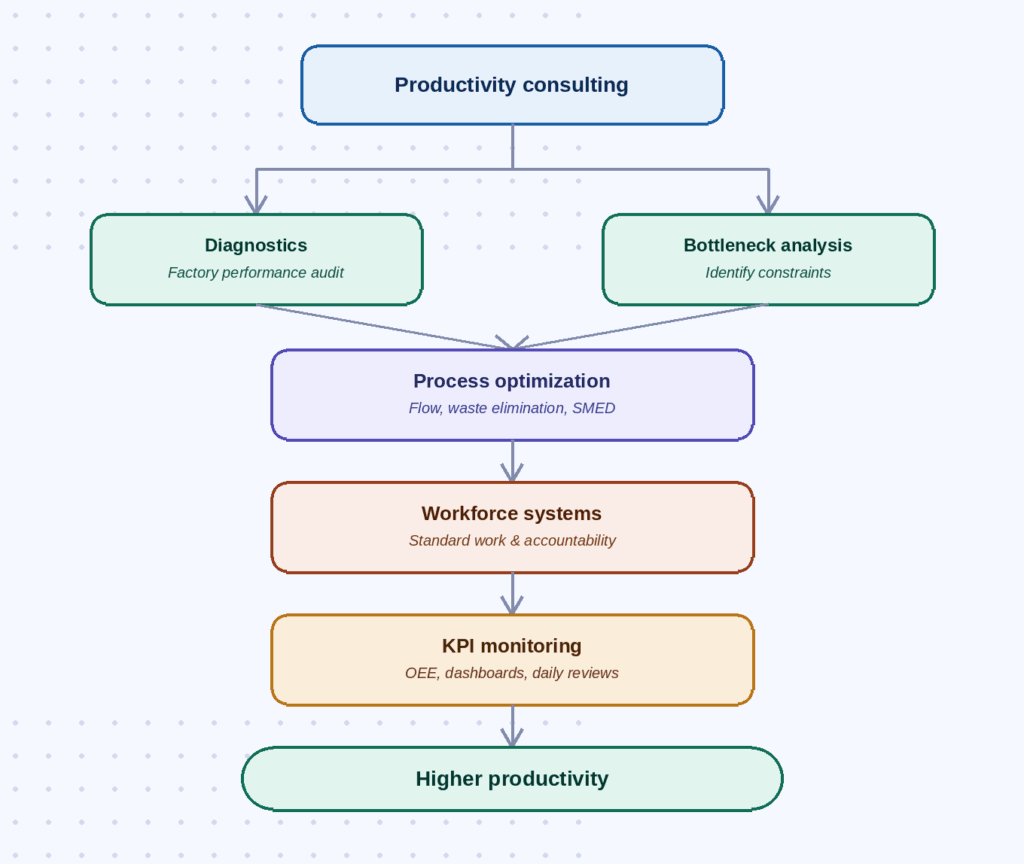
Operational Assessment
Consultants conduct detailed assessments of production operations to establish baseline performance. This typically includes observing production flow, measuring equipment utilization, reviewing downtime records, analyzing labor productivity, and identifying recurring operational issues.
The goal is to understand where production capacity is being lost and why.
Bottleneck Analysis
Every manufacturing system has at least one constraint that limits overall output.
In many factories, increasing production does not require expanding capacity across the entire operation. Instead, improving the performance of a single machine, workstation, or production process can significantly increase throughput.
By identifying and addressing these bottlenecks, manufacturers often achieve substantial gains without major capital investment.
Process Optimization
Once constraints have been identified, consultants redesign workflows to remove unnecessary activities that increase production time without adding customer value.
Improvements may include:
- Simplifying production procedures
- Reducing waiting time between operations
- Improving material flow
- Standardizing work methods
- Balancing production lines
These changes reduce waste while improving consistency across shifts.
Workforce Productivity
People remain one of the most important drivers of manufacturing performance.
Productivity consultants work with supervisors and operators to establish standardized work practices, clarify responsibilities, introduce meaningful performance indicators, and improve communication between production teams.
Rather than increasing employee workload, the objective is to eliminate activities that prevent employees from working efficiently.
Performance Management Systems
Sustainable productivity improvements require continuous measurement.
Consultants frequently introduce factory management systems such as:
- Daily production meetings
- Shift performance dashboards
- Standard operating procedures (SOPs)
- Visual production boards
- Key Performance Indicator (KPI) tracking
These systems enable managers to identify issues quickly, respond consistently, and maintain improvements over time.
Productivity Improvement Methods Used in Manufacturing
Productivity consultants typically combine several proven industrial improvement methodologies depending on the needs of the factory.
Lean Manufacturing
Lean manufacturing focuses on eliminating activities that consume time, labor, or materials without creating value for customers.
Common forms of waste include waiting time, unnecessary movement, excess inventory, overproduction, defects, and inefficient transportation.
By reducing these forms of waste, manufacturers improve production flow while lowering operating costs.
Kaizen (Continuous Improvement)
Kaizen encourages ongoing, incremental improvements rather than occasional large-scale projects.
Operators, supervisors, and managers are encouraged to identify practical opportunities to improve efficiency as part of everyday operations, creating a culture of continuous improvement.
Six Sigma
Six Sigma focuses on reducing process variation and improving quality consistency through data-driven analysis.
It is particularly valuable for manufacturers experiencing recurring quality issues or excessive product rework.
Value Stream Mapping (VSM)
Value Stream Mapping provides a visual representation of the entire production process from raw materials to finished products.
This helps manufacturers identify delays, bottlenecks, and non-value-adding activities that may not be visible when individual departments are assessed independently.
Time and Motion Studies
Time and motion studies measure how work is performed and identify opportunities to improve task efficiency, workstation design, and labor utilization.
Rather than encouraging employees to work faster, these studies focus on designing better ways of performing work safely and consistently.
The Productivity Consulting Process
Although every factory has unique operational challenges, most consulting engagements follow a structured approach.
1. Diagnostic Assessment
Current performance is measured using production data, direct observations, equipment performance, labor efficiency, and process analysis.
2. Improvement Strategy
Based on assessment findings, consultants prioritize opportunities according to operational impact, implementation complexity, and expected return on investment.
3. Implementation
Recommended improvements are introduced through process redesign, employee training, standardized procedures, and performance management systems.
Implementation is carried out alongside factory personnel to encourage ownership and long-term adoption.
4. Monitoring and Continuous Improvement
Performance is monitored using operational KPIs to verify that improvements are sustained.
Regular reviews also help identify new opportunities for continuous improvement as production requirements evolve.
Benefits of Productivity Consulting for Kenyan Manufacturers
Manufacturers that implement structured productivity improvement programs often achieve benefits that extend beyond higher production output.
These may include:
- Improved machine utilization
- Lower production costs
- Reduced operational waste
- Higher product quality
- Greater production consistency
- Better delivery performance
- Improved workforce engagement
- Increased profitability without significant capital expenditure
Perhaps the greatest advantage is that productivity improvements often unlock existing capacity within the factory. Instead of investing immediately in additional equipment or facilities, manufacturers can increase output by making better use of the resources they already have.
Conclusion
As competition continues to increase across domestic, regional, and export markets, manufacturing productivity has become a key determinant of business performance.
Productivity consultants help manufacturers move beyond reactive problem-solving by applying structured diagnostic techniques, proven improvement methodologies, and practical implementation support that deliver measurable operational results.
Whether the objective is reducing downtime, improving production flow, lowering operating costs, or increasing output, productivity consulting provides manufacturers with a practical framework for building more efficient, competitive, and resilient operations.
Frequently Asked Questions
What do productivity consultants do in manufacturing?
They assess factory operations, identify operational constraints, optimize production processes, and implement systems that improve efficiency, quality, and overall manufacturing performance.
How can manufacturers improve productivity?
Manufacturers can improve productivity by reducing downtime, optimizing workflows, improving equipment utilization, standardizing work processes, and monitoring performance using meaningful operational KPIs.
What is the first step in productivity consulting?
The process typically begins with a comprehensive operational assessment to establish baseline performance and identify the primary factors limiting production efficiency.
Why is productivity consulting important for manufacturers in Kenya?
It enables manufacturers to improve output, reduce costs, strengthen competitiveness, and achieve sustainable operational improvements without relying solely on additional capital investment.