
Manufacturers across Kenya are under increasing pressure to reduce costs while maintaining quality and delivery timelines. Rising labor costs, operational inefficiencies, and global competition make this challenge even more complex. Yet, many businesses overlook one of the most practical and proven tools for cost reduction—time and motion study.
A well-executed time and motion study in Kenya goes beyond stopwatch observations. It provides deep insights into how work is performed, where time is lost, and how processes can be redesigned for maximum efficiency. At Faber Infinite Consulting, we have seen firsthand how structured time and motion analysis can transform shop floors, reduce waste, and significantly improve profitability.
What is a Time and Motion Study?
A time and motion study is a systematic approach used to analyze work processes by breaking them into smaller elements, measuring the time taken for each, and identifying unnecessary movements or delays.
Key Components:
- Time Study: Measures the time required to complete a task under standard conditions
- Motion Study: Examines physical movements to eliminate inefficiencies
- Work Standardization: Establishes best practices for consistent output
When combined with lean manufacturing consulting in Kenya, this approach becomes a powerful driver of continuous improvement and cost reduction.
Why Time and Motion Study Matters in Kenya’s Manufacturing Sector
Kenya’s manufacturing industry contributes significantly to GDP, yet many factories operate below optimal efficiency levels due to:
- Manual processes with high variability
- Lack of standardized work methods
- Inefficient plant layouts
- Hidden downtime and idle labor
A lean time and motion study in Kenya directly addresses these gaps by introducing data-driven decision-making.
How Time and Motion Study Reduces Manufacturing Costs
-
Eliminating Non-Value-Added Activities
One of the biggest cost drivers in manufacturing is wasted effort. Time and motion studies help identify:
- Unnecessary walking or handling
- Waiting time between processes
- Redundant approvals or steps
By eliminating these, companies can achieve immediate productivity improvement without additional investment.
-
Optimizing Labor Productivity
Labor is often the largest cost component. A structured time and motion study manufacturing Kenya enables:
- Accurate manpower planning
- Balanced workloads across operators
- Reduction in overtime costs
Example Insight:
In one of our engagements, a packaging unit reduced operator idle time by 18% simply by redistributing tasks based on time study data.
-
Improving Process Efficiency
Through data-driven time and motion analysis in Kenya, manufacturers can:
- Identify bottlenecks
- Reduce cycle times
- Improve throughput
This leads to higher output with the same resources—directly impacting the bottom line.
-
Supporting Lean Manufacturing Implementation
Time and motion study is a foundational tool in lean transformation. It supports:
- Standard Work creation
- Line balancing
- Kaizen initiatives
When integrated with lean manufacturing consulting in Kenya, it accelerates overall operational excellence.
-
Reducing Operational Costs
By improving efficiency across processes, companies can reduce:
- Labor costs
- Energy consumption
- Machine idle time
- Rework and defects
This makes cost reduction sustainable rather than temporary.
Application Beyond Manufacturing
While widely used in factories, time and motion study service industry Kenya is also gaining traction in:
- Healthcare (reducing patient wait times)
- Retail (optimizing checkout processes)
- Logistics (improving delivery efficiency)
The principles remain the same—measure, analyze, improve.
How to Measure Work Efficiency Using Time Study in Kenya
A structured approach typically involves:
Step 1: Define the Process
Select the task or operation to be studied
Step 2: Break into Elements
Divide the task into smaller measurable units
Step 3: Record Time
Use tools or digital systems for accurate measurement
Step 4: Analyze Data
Identify inefficiencies and variation
Step 5: Implement Improvements
Standardize best practices
Step 6: Monitor Continuously
Ensure sustained continuous improvement
Why Choose Faber Infinite Consulting?
As experienced time and motion study consultants, Faber Infinite Consulting brings:
- Deep industry expertise across 40+ sectors
- Proven methodologies aligned with global standards
- Data-driven insights tailored to Kenyan industries
- Practical implementation support, not just recommendations
Our approach ensures measurable outcomes in productivity improvement, cost reduction, and long-term operational efficiency.
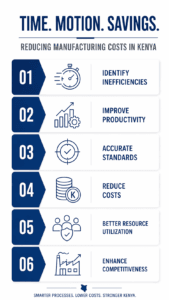
Conclusion: Turning Time into Profit
Time is one of the most underutilized resources in manufacturing. Every second of inefficiency translates into hidden costs. A well-executed time and motion study in Kenya transforms this challenge into an opportunity.
By identifying inefficiencies, optimizing labor, and standardizing processes, businesses can achieve sustainable growth without heavy capital investment.
Actionable Takeaways:
- Start with a pilot time and motion study in one critical process
- Focus on eliminating non-value-added activities
- Use data—not assumptions—for decision-making
- Integrate findings with lean manufacturing practices
- Partner with experienced consultants for faster results
FAQs
-
How time and motion study improves productivity in Kenya?
It identifies inefficiencies, eliminates wasted effort, and standardizes best practices, leading to higher output with the same resources.
-
What industries benefit from time and motion study in Kenya?
Manufacturing, logistics, healthcare, retail, and service sectors can all benefit from improved efficiency and cost savings.
-
How long does a time and motion study take?
Depending on complexity, it can take from a few days to several weeks, including analysis and implementation.
-
What tools are used in time and motion studies?
Stopwatches, digital tracking systems, video analysis, and specialized industrial engineering software are commonly used.