
Many businesses today are putting in more effort but not seeing proportional results. Whether it’s manufacturing, logistics, or service operations, inefficiencies often hide in plain sight—unmeasured, unmanaged, and unresolved.
This is where time and motion study in Kenya plays a critical role.
At Faber Infinite Consulting, our on-ground experience shows that when businesses shift from assumption-based decisions to data-driven time and motion analysis in Kenya, the results are not incremental—they are transformational.
This guide breaks down the practical application of time and motion studies, supported by real implementation insights and measurable outcomes.
What is Time and Motion Study?
A time and motion study is a structured approach to:
- Measuring the time required for tasks
- Analyzing worker movements
- Identifying inefficiencies
- Designing optimized workflows
It forms the backbone of lean time and motion study in Kenya, helping organizations achieve productivity improvement, cost reduction, and sustainable continuous improvement.
Why Time and Motion Study is Critical for Kenyan Businesses
-
Increasing Pressure on Productivity
With rising operational costs, businesses must deliver more output without increasing resources.
-
Hidden Inefficiencies in Daily Operations
Unnecessary movement, waiting time, and poor layout design often go unnoticed.
-
Demand for Lean and Scalable Systems
Organizations are shifting toward lean manufacturing consulting in Kenya to stay competitive.
How Time and Motion Study Improves Productivity in Kenya
Eliminates Waste
Identifies non-value-adding activities like:
- Excess walking
- Waiting time
- Redundant processes
Improves Labor Productivity
Aligns workforce with actual workload, enabling labor productivity improvement using time and motion study in Kenya.
Enhances Process Flow
Reduces delays and improves material movement—critical for improving logistics productivity through time and motion study in Kenya.
Standardizes Work
Creates consistent, repeatable processes for better output quality.
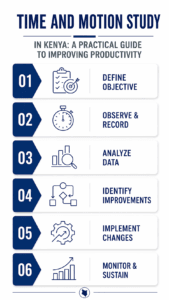
Step-by-Step Approach to Time and Motion Study
-
Process Selection
Focus on high-impact areas like bottlenecks or labor-intensive processes.
-
Time Study
Measure cycle times using stopwatch, video analysis, or digital tools.
-
Motion Study
Break down movements into value-adding and non-value-adding.
-
Data Analysis
Apply lean tools such as:
- Line balancing
- Work content analysis
- Cycle time optimization
-
Implementation
Introduce:
- Layout improvements
- SOPs
- Workforce training
-
Sustenance
Ensure long-term results using:
- Daily Work Management (DWM)
- Continuous audits
Real Case Insights (From Faber Infinite Consulting Experience)
Case Study 1: Pack House Flow & Productivity Optimization
Challenges Identified:
- No hourly productivity monitoring
- Imbalance between sorting and grading activities
- Excess movement for material handling
- Delays in moving finished goods
Approach Taken:
- Conducted detailed time and motion study across operations
- Balanced manpower between sorting and grading
- Redesigned layout for smoother flow
- Reduced unnecessary movement through process redesign
Results Achieved:
- Productivity improved by 50%
- Work content reduced by 40%
- Labor cost reduced by 50%
- Productivity per person per hour increased by 25.4%
- Movement time reduced from 14 minutes to less than 1 minute
- Transportation distance reduced from 11 meters to 5 meters
Key Insight:
Small improvements in layout and manpower balancing can create massive gains in flow efficiency and productivity.
Case Study 2: Assembly Line Productivity Improvement
Challenges Identified:
- Inability to meet increased demand
- Lack of standard operating procedures
- Imbalanced operations causing inefficiencies
- Operator fatigue due to poor workstation design
Approach Taken:
- Conducted time and motion study to define standard times
- Identified and eliminated non-value-adding activities
- Applied lean tools like:
- Line balancing
- 5S
- SMED
- Kanban systems
- Redesigned workstations for better ergonomics
Results Achieved:
- Output increased from 2 units per shift to 3 units per shift
- Work content reduced by 40%
- Labor cost reduced by 50%
- Overall productivity improved by 50%
Key Insight:
Combining time study with lean tools delivers measurable improvements in throughput and cost efficiency.
Applications Across Industries in Kenya
Manufacturing
- Line balancing
- Cycle time reduction
- Waste elimination
Service Industry
- Reduced waiting time
- Faster service delivery
- Better staff utilization
Logistics
- Improved material flow
- Reduced handling time
- Optimized routing
This highlights the growing importance of time and motion study service industry Kenya alongside manufacturing.
Global Standards & Methodologies (Authoritativeness)
Time and motion studies align with globally recognized frameworks:
- International Labour Organization (ILO) – Work Study Standards
- Lean Manufacturing Principles – Waste elimination (Muda, Mura, Muri)
- Six Sigma Methodology – Data-driven process improvement
These frameworks ensure accuracy, credibility, and consistency in implementation.
Common Challenges & Practical Solutions
Resistance to Change
Solution: Involve employees in improvement initiatives.
Inaccurate Data Collection
Solution: Use digital tools and cross-verification.
Lack of Expertise
Solution: Work with experienced time and motion consultants Kenya.
Why Faber Infinite Consulting?
Faber Infinite brings:
- Deep cross-industry experience
- Proven results in productivity improvement
- Strong expertise in lean manufacturing consulting Kenya
- Practical, implementation-driven approach
We don’t just analyze—we deliver measurable outcomes.
Conclusion: From Observation to Optimization
A well-executed time and motion study in Kenya transforms operations by turning hidden inefficiencies into visible opportunities.
Actionable Takeaways:
- Start with a high-impact process
- Measure everything—don’t assume
- Focus on eliminating waste, not just reducing cost
- Standardize best practices
- Sustain improvements through daily management systems
In today’s competitive environment, efficiency is not optional—it’s strategic.
FAQs
-
How time and motion study improves productivity in Kenya?
By identifying inefficiencies, eliminating waste, and optimizing workflows using data-driven insights.
-
How to measure work efficiency using time study in Kenya?
By comparing standard time vs actual time and analyzing productivity per person per hour.
-
What industries benefit most from time and motion study in Kenya?
Manufacturing, logistics, and service industries with high labor dependency.
-
Is time and motion study suitable for small businesses?
Yes, even small improvements can significantly impact productivity and cost.
-
How long does a time and motion study take?
Typically ranges from a few days to several weeks depending on process complexity.