Sustaining 5S Lean manufacturing requires embedding structured discipline into daily operations through leadership commitment, measurable KPIs, structured audits, visual management systems, and continuous training. In Kenyan manufacturing plants, long-term success depends on treating 5S as a permanent operational system rather than a short-term improvement initiative.
Key Takeaways
- 5S sustainment depends on behavior, not tools or initial setup
- Leadership consistency directly determines long-term success
- KPIs and audits convert discipline into measurable performance
- Visual management reduces dependence on supervision
- Without sustainment systems, efficiency gains gradually decline
Why Sustaining 5S Matters in Manufacturing Plants
In many Kenyan manufacturing environments, 5S Lean manufacturing delivers immediate improvements such as better organization, reduced workplace clutter, and improved workflow efficiency. However, these gains are often not sustained over time because the system is not reinforced after implementation.
When sustainment is weak, factories gradually experience:
- Declining workplace organization standards
- Inconsistent tool placement and storage practices
- Reduced adherence to standard operating procedures
- Increased time wastage in daily operations
- Gradual return of pre-implementation inefficiencies
This happens because workplace behavior naturally drifts back to familiar habits when structured reinforcement is absent. Sustainment ensures that 5S becomes part of operational discipline rather than a temporary improvement exercise.
Leadership Role in Sustaining 5S Culture in Kenya
Leadership is one of the strongest determinants of whether 5S remains effective over time. In manufacturing environments, employees tend to follow what leadership consistently prioritizes.
Effective leadership in sustaining 5S Lean manufacturing includes both strategic oversight and daily operational involvement.
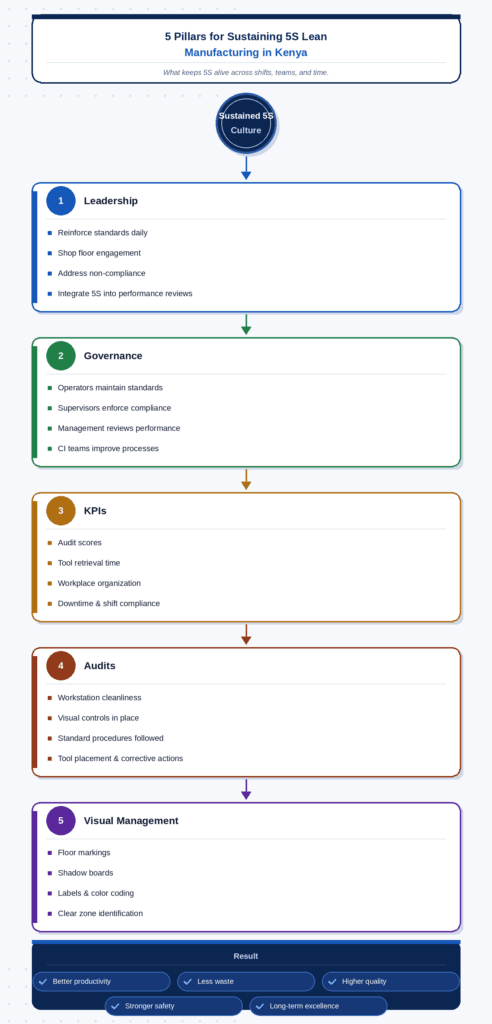
Key leadership responsibilities include:
- Reinforcing 5S standards during daily operations
- Conducting regular shop floor engagement and reviews
- Addressing non-compliance immediately and consistently
- Integrating 5S expectations into performance management
- Ensuring alignment across departments and shifts
When leadership attention weakens, 5S compliance typically declines shortly afterward, making leadership consistency essential for long-term stability.
Governance Structure for 5S Sustainment
A structured governance model ensures that responsibility for 5S is distributed across all operational levels, preventing dependency on a single role or department.
In a mature system, responsibilities are clearly defined as follows:
- Operators: Maintain daily workplace organization and cleanliness
- Supervisors: Enforce compliance and monitor shift-level discipline
- Management: Review performance trends and ensure accountability systems function
- Continuous improvement teams: Refine processes and eliminate recurring inefficiencies
This layered structure ensures that 5S sustainment is embedded into daily operations rather than treated as an isolated initiative.
KPIs as a Driver of 5S Performance Sustainability
Key performance indicators (KPIs) are essential because they transform 5S from a visual discipline system into a measurable operational framework.
Instead of assuming compliance, organizations track performance using structured metrics.
Common 5S KPIs include:
- 5S audit compliance scores
- Workstation organization accuracy
- Tool retrieval time efficiency
- Frequency of workplace deviations
- Downtime linked to poor organization
- Shift-level compliance consistency
These indicators allow manufacturing teams to identify performance gaps early and take corrective action before inefficiencies become systemic.
KPI tracking also ensures that sustainment is based on data rather than perception.
Role of Audits in Maintaining 5S Discipline in Kenya
Audits are a core mechanism for sustaining 5S in manufacturing because they provide structured evaluation of workplace standards over time.
Unlike informal checks, audits follow consistent criteria that assess operational discipline across multiple dimensions.
Typical audit focus areas include:
- Cleanliness and order of workstations
- Accuracy of labeling and visual controls
- Adherence to standardized workflows
- Proper tool placement and availability
- Consistency across shifts and departments
More importantly, audits create accountability by making compliance visible and measurable.
When combined with corrective action tracking, audits become a continuous improvement system rather than just an evaluation tool.
Visual Management as a Self-Sustaining System
Visual management plays a critical role in reducing reliance on supervision and memory by making standards visible within the workplace.
In well-structured manufacturing environments, visual systems act as continuous behavioral guides.
Common visual management tools include:
- Floor markings that define movement and storage zones
- Shadow boards that highlight missing tools immediately
- Labeled storage areas for structured organization
- Color-coded zones for functional clarity across departments
These systems ensure that deviations from standards are immediately visible, enabling faster correction and reducing the need for constant supervision.
Over time, visual management becomes a self-reinforcing discipline system within the factory.
Why 5S Systems Fail Over Time
Even well-implemented 5S systems fail when sustainment mechanisms are weak or inconsistent.
The most common reasons include:
- Reduced leadership engagement after initial implementation
- Inconsistent or infrequent audit cycles
- Lack of structured KPI tracking systems
- Insufficient training for new employees
- Production pressure overriding discipline standards
These factors lead to gradual erosion of workplace discipline, often without immediate visibility, making long-term decline harder to detect.
Maturity Stages of 5S in Manufacturing Plants
Sustaining 5S can be understood as a progression through maturity stages that reflect how deeply it is embedded within operations.
Stage 1: Implementation
- Focus is on training and physical workplace changes
- Compliance is supervision-driven
Stage 2: Stabilization
- Audits are introduced and compliance improves
- Processes become more consistent across teams
Stage 3: Integration
- 5S becomes part of daily workflows
- KPIs begin to reflect workplace discipline
Stage 4: Cultural Maturity
- Employees self-correct without supervision
- 5S becomes part of organizational behavior
At this stage, 5S is no longer seen as an initiative; it becomes the default way work is done.
Strategic Value of Sustained 5S Systems
When properly sustained, 5S delivers long-term operational advantages that extend beyond workplace organization.
These include:
- Improved production consistency through reduced variability
- Lower operational waste due to improved efficiency
- Enhanced equipment reliability through better upkeep
- Stronger workforce discipline and accountability
- Improved quality consistency across production cycles
Sustained 5S systems create a more predictable and stable manufacturing environment, which is essential for competitiveness in industrial operations.
Frequently Asked Questions
Why does 5S fail in manufacturing plants?
5S fails mainly due to weak sustainment systems, lack of leadership involvement, inconsistent audits, and absence of measurable KPIs.
How do you sustain 5S long-term?
Through leadership reinforcement, structured audits, KPI tracking, visual management, and continuous employee training.
What is the most important part of 5S?
Sustain is the most critical stage because it ensures long-term discipline and operational stability.
What role do KPIs play in 5S?
KPIs convert 5S discipline into measurable performance outcomes, making compliance trackable and enforceable.
Is 5S a system or a culture?
It begins as a system but becomes a culture when consistently reinforced across daily operations.