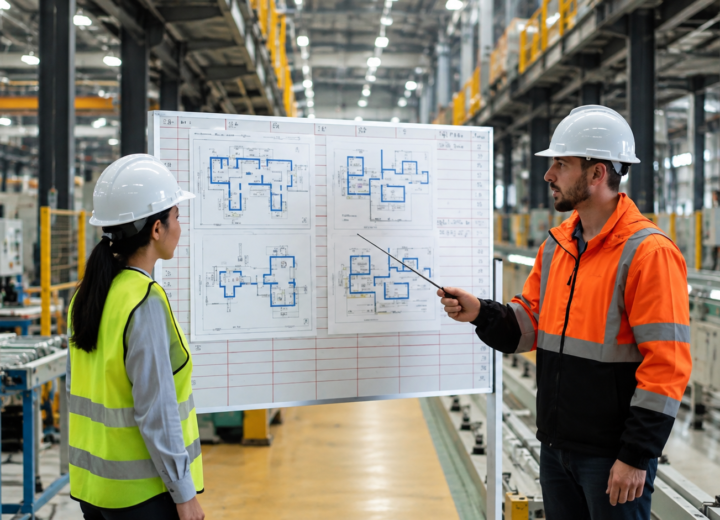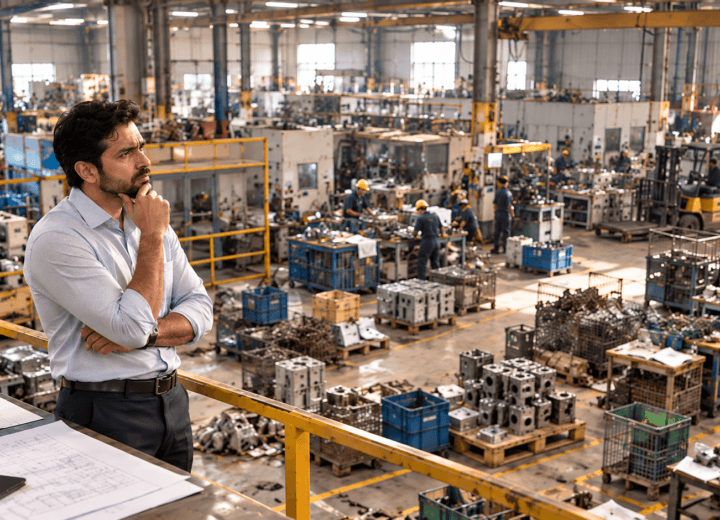
A factory rarely becomes inefficient overnight. More often, performance gradually deteriorates around decisions that once appeared practical: a machine positioned where space was available, inventory stored where it could fit, additional manpower added to manage rising workloads, or a process designed around yesterday’s production requirements.
Over time, these decisions become part of the way the factory operates. Teams adapt to them, workarounds become routine, and inefficiencies begin to look normal. Productivity targets may still be pursued, but the organisation spends increasing amounts of time managing movement, waiting, excess inventory, rework, bottlenecks and capacity constraints.
The difficulty is that many of these problems are treated as execution issues when their origins lie much deeper.
When Inefficiency Becomes Part of the System?
Consider a manufacturing plant where material travels across multiple areas before reaching the next process. Operators may spend significant time moving materials, supervisors may coordinate frequent internal transfers, and production planners may maintain additional inventory to protect against delays.
The immediate response is often to improve discipline: increase monitoring, push productivity targets, add manpower or ask teams to work faster. These interventions can provide short-term relief, but they do not necessarily change the underlying system.
The factory may still have the same physical layout, the same process sequence and the same constraints that created the problem in the first place.
This is where the distinction between improving performance and redesigning the conditions that determine performance becomes important.
The Decisions Made Before Production Begins
Factory performance is influenced long before the first production order reaches the shop floor. Decisions around plant layout, process design, equipment selection, capacity planning, manpower deployment, material flow, inventory positioning and supply chain design can shape operational outcomes for years.
A poorly considered layout can increase handling distance every day. An equipment decision can create a capacity bottleneck that becomes expensive to resolve later. Excessive work-in-progress can tie up working capital while masking problems in production flow. An imbalance between process capacities can leave some resources underutilised while others remain overloaded.
None of these issues necessarily indicate poor effort from employees. They can simply be consequences of a system that was not designed around the way value actually flows through the factory.
The financial impact can therefore extend well beyond shop-floor productivity. Inefficient flow consumes time, capacity and working capital. It can increase operating costs, extend throughput time, reduce responsiveness and ultimately affect profitability and customer service.
But There Is a More Fundamental Question Worth Asking:
Are we trying to improve the performance of the existing factory, or are we making the decisions necessary to create a factory that performs differently?
The distinction matters.
Continuous improvement is essential, but repeatedly optimising an inefficient arrangement has limits. If material movement is fundamentally excessive, faster material handling will not eliminate the underlying waste. If capacity is structurally unbalanced, pushing individual teams harder will not create sustainable throughput. If inventory is being used to compensate for unreliable flow, reducing inventory without addressing the cause can simply expose another problem.
The opportunity lies in looking at the factory as an interconnected operating system rather than as a collection of individual departments.
From Isolated Improvements to Operational Excellence
Operational Excellence provides a framework for making that shift. Instead of examining productivity, cost, quality or capacity independently, it considers how processes, people, equipment, layout, information and material flow interact to determine overall performance.
This perspective changes the nature of improvement discussions. The question is no longer simply how to make an existing process faster. It becomes how the organisation can create a flow that requires less movement, less waiting, less inventory and less corrective effort while making better use of available capacity.
For leaders, this also changes where improvement priorities should sit. Some of the highest-impact decisions may involve capital planning, factory expansion, layout redesign, production-system changes or future capacity requirements rather than another short-term productivity initiative.
Designing Performance, Not Just Managing It
Long-term factory performance is ultimately shaped by the quality of the decisions that create the operating environment.
A factory can compensate for a poor decision for months or even years through additional manpower, inventory, supervision and effort. But compensation is not the same as optimisation.
For CEOs and manufacturing leaders, the strategic question is therefore not only how efficiently the factory is operating today, but whether the decisions being made today are creating a stronger operating system for tomorrow.
The most sustainable improvements often begin before the problem becomes visible on the shop floor. They begin by designing flow, capacity, productivity and efficiency into the way the factory is structured so that operational performance is not dependent on constant firefighting, but supported by the system itself.