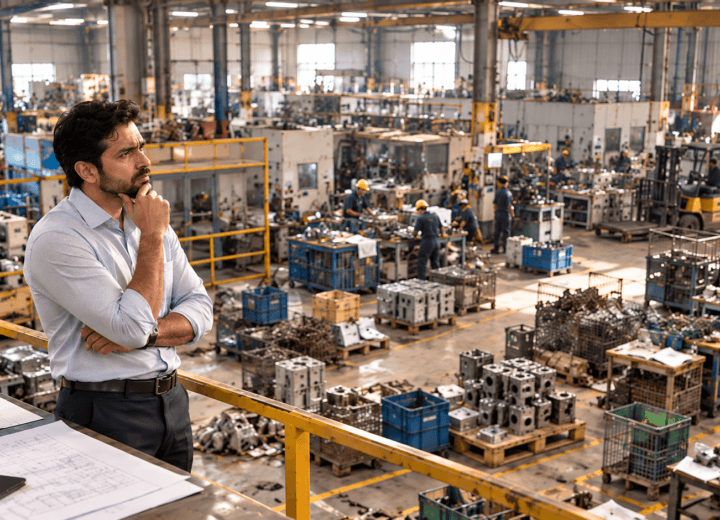
The biggest opportunities to improve profitability are not always found in pricing, sales, or cost-cutting. In many organisations, they are hidden within the everyday activities of the operation itself.
When organisations discuss profitability, the conversation typically moves toward revenue growth, pricing, procurement costs, or financial efficiency. These are important levers, but they represent only part of the equation. A significant portion of profitability can be determined much earlier — on the shop floor, across processes, and within the daily movement of people, materials, information, and equipment.
The challenge is that operational losses rarely appear as a single, identifiable expense. They are distributed across waiting time, machine downtime, excess movement, rework, unnecessary inventory, inefficient changeovers, and underutilised capacity. Individually, each loss may appear too small to demand immediate attention. Collectively, however, they can represent a substantial financial opportunity.
When Inefficiency Becomes “Normal”
One of the most difficult aspects of operational improvement is recognising losses that have become part of the normal way of working.
Consider a production line where an operator spends several minutes every hour waiting for material. The delay may not stop the entire operation, and therefore it may not be treated as a serious problem. However, when the same delay is repeated across multiple operators, shifts, and working days, the accumulated loss can represent hundreds or thousands of hours of productive capacity every year.
The same principle applies to quality losses. A small amount of rework may appear manageable when viewed on a single production order. But repeated rework consumes additional labour, machine time, materials, inspection effort, and energy. It also reduces the capacity available for productive work.
This is how operational losses become embedded in the system: they are small enough to be tolerated individually but significant enough to affect profitability collectively.
The Hidden Cost of Poor Flow
Many profit leaks are fundamentally problems of flow.
When materials do not move smoothly between processes, work-in-progress begins to accumulate. When processes are poorly balanced, one operation becomes a bottleneck while another remains underutilised. When changeovers take longer than necessary, available production time is lost. When information does not reach the right person at the right time, decisions are delayed and work waits.
These losses are often interconnected rather than independent.
A bottleneck can create waiting. Waiting can create excess inventory. Excess inventory can increase material handling and movement. Poor flow can increase the likelihood of damage and defects. Defects then create rework, further consuming the capacity that was already constrained.
Looking at each issue separately can therefore lead to fragmented solutions. The greater opportunity lies in understanding how the entire process behaves as a system.
From Cost Reduction to Loss Elimination
When profitability comes under pressure, organisations often respond by looking for ways to reduce expenditure. While cost control has its place, reducing spending does not necessarily address the underlying operational problem.
A more sustainable question is: Where are resources being consumed without creating corresponding value?
This shifts the focus from simply spending less to losing less.
Eliminating unnecessary movement can release productive time. Reducing changeover time can increase available capacity without adding equipment. Improving first-time-right quality can reduce the resources consumed by rework. Better inventory control can release working capital while improving flow. Addressing recurring downtime can increase the output generated from existing assets.
The value comes not merely from reducing a line item in the cost statement, but from improving how the operation converts its available resources into customer value.
Making the Invisible Financially Visible
Identifying these opportunities requires more than observing that a process is inefficient. The operational loss needs to be translated into measurable business impact.
How many hours are lost to waiting each month? How much capacity is unavailable because of downtime? What percentage of labour hours is spent on rework? How much working capital is tied up in excess inventory? How much output could be generated if the existing bottleneck were removed?
These questions connect operational performance with financial performance.
Once an organisation can quantify the time, capacity, material, and working capital associated with operational losses, improvement opportunities become easier to prioritise. What previously appeared to be a minor process inefficiency can suddenly become a significant business case for action.
The Profit Already Inside the Operation
Operational Excellence is not simply about making processes faster. It is about understanding where resources are being consumed without creating value and systematically removing the causes of those losses.
The objective is not to make people work harder or to continuously add resources. It is to make the existing system work better.
For many organisations, the next significant improvement in profitability may not require a new factory, additional manpower, or a major investment. It may begin by uncovering the capacity, time, and resources already being lost within everyday operations.
Conclusion
Profitability is not determined only by what an organisation earns; it is also shaped by what the operation quietly loses. Waiting, rework, downtime, excess inventory, and inefficient movement may appear to be routine operational issues, but their cumulative impact can significantly affect the bottom line.
The opportunity is to stop treating these losses as the cost of doing business and start treating them as opportunities for improvement.