Lean Six Sigma consulting in Kenya helps businesses improve operational efficiency, reduce waste, and achieve measurable cost savings through proven methodologies.
Why Efficiency Is Now a Business Priority in Kenya
Across industries in Kenya, businesses are under increasing pressure to do more with less. Rising operational costs, supply chain inefficiencies, and quality challenges are no longer isolated issues—they directly impact profitability.
This is why lean six sigma consulting Kenya is gaining momentum. Companies are actively working with six sigma consultants Kenya to streamline operations, reduce waste, and improve performance without heavy capital investment.
The shift is clear: efficiency is no longer optional—it is a competitive requirement.
What is Lean Six Sigma and Why It Matters in Kenya
Lean Six Sigma combines lean manufacturing principles with Six Sigma’s data-driven approach to quality improvement.
- Lean focuses on eliminating waste
- Six Sigma focuses on reducing variation
Together, they drive operational efficiency, continuous improvement, and measurable cost reduction.
For Kenyan businesses, this approach is especially relevant. Many operational inefficiencies—whether in production, logistics, or service delivery—remain hidden within existing systems. Six sigma consulting services Kenya help uncover and eliminate these inefficiencies systematically.
Why Businesses Need Lean Six Sigma Consulting in Kenya
Organizations often assume that cost reduction requires automation or large investments. In reality, most inefficiencies already exist within current processes.
By engaging lean six sigma consulting Kenya specialists, businesses can:
- Identify process bottlenecks
- Reduce unnecessary movement and delays
- Improve consistency in output
- Optimize resource utilization
The result is not incremental improvement—but a structured transformation in how operations perform.
How Kenyan Companies Achieved Cost Savings Using Six Sigma
One of the strongest proofs of impact comes from real implementations.
A manufacturing company adopted lean six sigma consulting Kenya to address high defect rates and inconsistent production output. With guidance from an experienced six sigma consultant Kenya, the company applied the DMAIC methodology to identify and eliminate root causes.
Instead of investing in new machinery, the focus was on process discipline and standardization.
The outcomes were significant:
- Defect rates reduced by more than 50%
- Production efficiency improved by over 20%
- Operational costs reduced by nearly 18%
This example reflects a broader trend—how Kenyan companies achieved cost savings using six sigma is primarily through process optimization, not capital expenditure.
Lean Six Sigma for Supply Chain Optimization in Kenya
In Kenya, supply chain inefficiencies are a major contributor to operational costs. Delays, poor planning, and excess inventory create unnecessary financial pressure.
Through lean six sigma for supply chain optimization in Kenya, businesses are improving:
- Inventory management
- Demand forecasting
- Transportation efficiency
In one case, a logistics operation reduced delivery lead times by 25% simply by redesigning workflows and eliminating non-value-added activities.
This highlights a key strength of lean six sigma consulting Kenya—it improves performance using existing resources.
The DMAIC Framework: How Lean Six Sigma Works in Practice
Every Lean Six Sigma engagement at Faber Infinite Consulting is anchored in the DMAIC methodology — a structured, data-led roadmap that ensures changes stick.
| Phase | Full Name | What Happens | Key Tools |
| D | Define | Scope the problem, map customer CTQs, build project charter | Project charter |
| M | Measure | Baseline current performance; quantify the gap | Process maps, Data collection |
| A | Analyse | Root-cause analysis using fishbone, Pareto | Fishbone, Pareto |
| I | Improve | Pilot solutions, redesign processes, validate gains | SMED, Kaizen |
| C | Control | Sustain gains with control charts, SOPs & training | Control plan, visual management |
Why DMAIC matters in Kenya: Many improvement initiatives fail because they jump to solutions without understanding root causes. DMAIC enforces rigour , changes are piloted, validated with data, and only then scaled across the organisation.
Digital Lean Six Sigma Implementation in Kenya
As businesses evolve, Lean Six Sigma is becoming more integrated with digital technologies.
Digital lean six sigma implementation in Kenya includes:
- Real-time performance tracking
- Data analytics for decision-making
- Integration with ERP and operational systems
This enhances visibility and enables faster, more accurate improvements—moving organizations from reactive to proactive operations.
Lean Six Sigma Case Studies from Kenya: Key Learnings
Insights from lean six sigma case studies from Kenya reveal consistent patterns:
- Most inefficiencies are process-related
- Small improvements create large cumulative impact
- Data-driven decisions outperform assumptions
- Sustainable results require continuous monitoring
These learnings reinforce that Lean Six Sigma is not a one-time initiative—it is a long-term capability.
How to Measure Six Sigma Project Success in Kenya
Success in Lean Six Sigma is always measurable.
Organizations track:
- Reduction in defects
- Improvement in cycle time
- Cost savings achieved
- Process capability improvements
- Customer satisfaction levels
Understanding how to measure six sigma project success in Kenya ensures that improvements are not just implemented—but sustained.
Why Choose the Right Six Sigma Consultants in Kenya
The success of Lean Six Sigma depends heavily on execution. Experienced lean six sigma consulting Kenya professionals bring:
- Practical implementation expertise
- Industry-specific knowledge
- Structured methodologies aligned with business goals
Faber Infinite Consulting focuses on delivering measurable outcomes, ensuring that improvements translate into real business impact—not just theoretical gains.
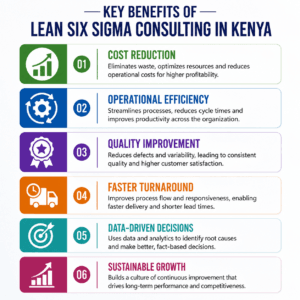
| Benefit | What It Means for Your Business | Typical Result |
| Cost Reduction | Eliminate rework, scrap, overproduction & excess inventory | 15 to 40% reduction in operational costs |
| Quality Improvement | Fewer defects reaching customers; stronger brand reputation | 50 to 80% defect reduction |
| Faster Throughput | Shorter lead times, quicker order fulfilment | 20 to 50% cycle time reduction |
| Staff Engagement | Employees solve problems at the source (Kaizen culture) | Higher retention, lower error rates |
| Supply Chain Optimisation | Better supplier quality, leaner inventory levels | 10 to 30% inventory cost savings |
| Regulatory Readiness | Documented processes align with ISO, KEBS, and export standards | Faster certification timelines |
Turning Efficiency into Competitive Advantage
Kenyan businesses are entering a phase where operational excellence defines success. Cost pressures, market competition, and customer expectations demand smarter, more efficient systems.
Lean six sigma consulting Kenya provides a clear, structured path to achieve this:
- Reduce waste
- Improve quality
- Increase efficiency
- Deliver measurable cost savings
Organizations that adopt this approach early are not just improving processes—they are building long-term competitive strength.
FAQs
- What industries benefit from six sigma consulting services Kenya?
Manufacturing, logistics, healthcare, and service industries benefit significantly due to their process-driven operations.
- How Kenyan companies achieved cost savings using six sigma?
By reducing defects, eliminating waste, and optimizing workflows—typically achieving 15–30% cost reduction.
- How long does a Lean Six Sigma project take in Kenya?
Most projects using the DMAIC methodology take 3 to 6 months depending on complexity.
- What is digital lean six sigma implementation in Kenya?
It involves integrating Lean Six Sigma with data analytics, ERP systems, and real-time monitoring tools.
- How to measure six sigma project success in Kenya?
Through metrics such as cost savings, defect reduction, cycle time improvement, and customer satisfaction.
Contact us