The importance of organizational change in Egypt’s manufacturing industry is increasing as manufacturers face growing pressure to improve productivity, strengthen operational performance, and compete in evolving markets.
Organizational change enables manufacturers to align leadership, employees, processes, and management systems around common improvement objectives. This article explains why organizational change is important for Egyptian manufacturers, how it supports Operational Excellence, and the practices that help organizations sustain long-term improvement.
What Is Organizational Change in Manufacturing?
Organizational change in manufacturing is the structured process of aligning people, leadership, processes, and management systems to improve performance, support continuous improvement, and create sustainable operational capabilities.
Unlike isolated improvement projects, organizational change focuses on developing the behaviors, systems, and capabilities required for long-term transformation.
Key Takeaways
- Organizational change helps manufacturers align people, processes, and leadership toward shared improvement goals.
- Sustainable manufacturing transformation requires more than technology or process changes.
- Lean Manufacturing initiatives are more successful when supported by organizational capability and culture.
- Daily operations management creates visibility, accountability, and continuous improvement routines.
- Egyptian manufacturers can strengthen competitiveness by building stronger change capabilities.
Why Is Organizational Change Important for Egypt’s Manufacturing Industry?
Organizational change is important for Egypt’s manufacturing industry because it helps organizations respond to operational challenges while building the internal capabilities needed for sustainable improvement.
Manufacturers today face increasing expectations related to:
- Production efficiency
- Product quality
- Cost control
- Supply chain reliability
- Workforce capability
- Customer requirements
Addressing these challenges requires more than improving individual processes. Organizations need the ability to identify problems, implement improvements, and maintain better ways of working over time.
For Egyptian manufacturers, this capability is particularly important as industries continue to focus on strengthening competitiveness, improving operational performance, and developing more resilient production systems.
A manufacturing organization may invest in advanced machinery, production technologies, or improvement tools. However, without aligned leadership, employee involvement, and effective management systems, these investments may not achieve their full potential.
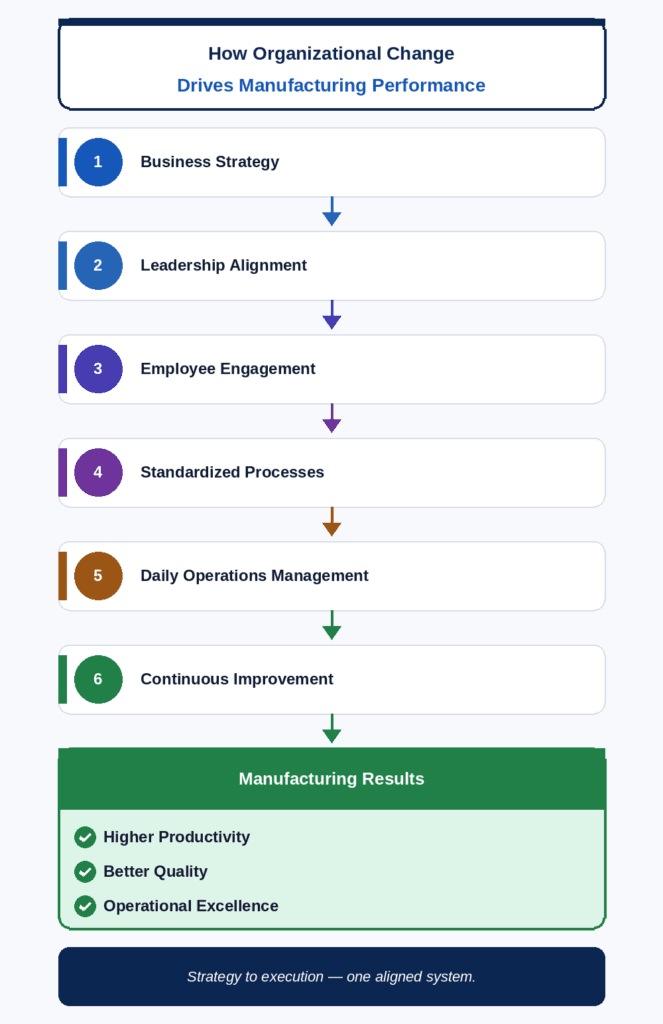
Organizational change creates the connection between strategic objectives and daily execution.
It enables organizations to:
- Establish clearer improvement priorities
- Improve collaboration between departments
- Develop stronger problem-solving capabilities
- Create consistent operating practices
- Increase employee ownership of improvement activities
How Does Organizational Change Support Manufacturing Transformation?
Organizational change supports manufacturing transformation by ensuring that improvements are embedded into everyday operations rather than treated as temporary initiatives.
Successful transformation requires alignment between several organizational elements:
| Organizational Element | Role in Manufacturing Transformation |
| People | Building skills, ownership, and improvement behaviors |
| Leadership | Setting direction and reinforcing improvement priorities |
| Processes | Creating consistent and efficient ways of working |
| Management Systems | Measuring performance and supporting accountability |
| Culture | Encouraging continuous improvement and problem-solving |
When these elements work together, organizations are better equipped to sustain improvements and respond to future challenges.
The Role of Leadership in Manufacturing Change
Leadership plays a critical role in determining whether organizational change succeeds.
Manufacturing leaders influence transformation by:
- Establishing clear objectives
- Communicating the purpose behind change
- Supporting improvement activities
- Removing barriers to implementation
- Reinforcing new behaviors
A common challenge in manufacturing environments is the gap between strategic goals and operational execution.
Leadership may define improvement priorities, but supervisors and frontline employees determine how effectively those priorities become daily practices.
Strong organizational change requires leaders to actively connect business objectives with operational activities.
How Does Organizational Change Support Operational Excellence?
Organizational change supports Operational Excellence by creating the behaviors, systems, and management practices required to achieve consistent performance improvement.
Operational Excellence is not achieved only through reducing waste or improving processes. It depends on creating an organization capable of identifying problems, solving them effectively, and continuously improving performance.
Organizations pursuing Operational Excellence typically focus on:
Continuous Improvement Culture
A continuous improvement culture encourages employees to identify inefficiencies, suggest improvements, and participate in solving operational challenges.
Employees who work closest to production processes often have valuable knowledge about:
- Process issues
- Quality concerns
- Workflow limitations
- Improvement opportunities
Creating systems that capture this knowledge strengthens organizational capability.
Standardized Ways of Working
Standardization creates consistency by defining the best-known methods for performing tasks.
Effective standardization helps organizations:
- Reduce process variation
- Improve training effectiveness
- Identify abnormal conditions
- Create a foundation for further improvement
Data-Based Decision Making
Manufacturing transformation requires reliable information.
Performance data enables teams to:
- Identify recurring problems
- Prioritize improvement opportunities
- Measure progress
- Make informed decisions
This reduces dependence on assumptions and supports more structured problem-solving.
How Does Organizational Change Support Lean Manufacturing?
Organizational change is essential for making Lean Manufacturing sustainable because Lean depends not only on tools and techniques but also on changes in employee behaviors, leadership practices, and management systems.
Many organizations begin Lean initiatives by introducing methods such as:
- Waste identification
- Standardized work
- Problem-solving approaches
- Process improvement activities
- Visual management
However, these methods deliver limited results when they are implemented without the organizational capabilities required to sustain them.
Lean Manufacturing requires a shift from a reactive operating model to a proactive improvement mindset. Employees need to identify problems, understand root causes, and participate in improving processes rather than simply responding to issues after they occur.
Organizational change supports this shift by developing:
- Employee involvement in improvement activities
- Leadership behaviors that encourage problem-solving
- Management routines that reinforce Lean principles
- A culture where improvement becomes part of daily work
For example, standardized work is not only a document or procedure. It represents an agreement on the best current way to perform a task and creates a foundation for identifying future improvements.
Without organizational alignment, Lean tools may be implemented temporarily but fail to become part of the organization’s operating system.
How Does Daily Operations Management Support Manufacturing Transformation?
Daily operations management supports manufacturing transformation by creating structured routines for monitoring performance, identifying problems, and maintaining accountability.
Instead of relying on occasional improvement projects, daily operations management creates a continuous connection between strategic objectives and everyday activities.
Effective daily operations management typically includes:
- Regular performance reviews
- Visual performance tracking
- Issue escalation processes
- Cross-functional communication
- Structured problem-solving routines
| Traditional Management | Daily Operations Management |
| Reacts after problems occur | Identifies issues early |
| Relies heavily on individual experience | Uses structured performance information |
| Improvement happens periodically | Improvement becomes a daily activity |
| Problems may remain hidden | Issues are made visible |
| Responsibility may stay at management level | Encourages ownership across teams |
For Egyptian manufacturing organizations, strengthening daily operations management can help create greater alignment between leadership priorities and shop-floor execution.
It enables teams to understand:
- What performance is expected
- Where problems exist
- Who owns improvement actions
- How progress will be measured
This makes organizational change more practical because employees can see how new behaviors connect directly to operational outcomes.
What Are the Common Challenges of Organizational Change in Manufacturing?
Organizational change can create significant improvements, but manufacturers often face challenges when introducing new ways of working.
1. Resistance to Changing Established Practices
Manufacturing environments often depend on established processes and routines. While these practices provide stability, they can make employees hesitant to adopt unfamiliar approaches.
This challenge can be addressed through:
- Clear communication about the purpose of change
- Employee involvement in improvement activities
- Practical training and support
- Visible leadership commitment
People are more likely to support change when they understand why it is needed and how it improves daily work.
2. Limited Leadership Alignment
A common barrier occurs when leadership priorities are not translated effectively into operational actions.
For example, senior leaders may focus on productivity improvement, while frontline teams may focus mainly on resolving immediate production issues.
Reducing this gap requires:
- Clear objectives
- Consistent communication
- Leadership involvement in improvement activities
- Alignment between strategy and daily management routines
3. Difficulty Sustaining Improvements
Many organizations achieve initial improvements but struggle to maintain results over time.
This often happens when improvement activities depend on individual effort rather than becoming part of organizational systems.
Sustainable improvement requires:
- Performance monitoring
- Regular follow-up
- Standardized processes
- Leadership reinforcement
- Employee engagement
Organizational change helps transform improvement from a temporary initiative into an ongoing capability.
How Can Manufacturers Successfully Manage Organizational Change?
Manufacturers can improve the success of transformation efforts by following a structured approach.
1. Understand the Current State
Before implementing changes, organizations should understand existing performance levels, operational challenges, and improvement opportunities.
This assessment creates a realistic foundation for defining priorities.
2. Align Change With Business Objectives
Change initiatives should directly support organizational goals such as:
- Improving productivity
- Enhancing quality
- Increasing operational efficiency
- Strengthening customer value
Employees are more engaged when they understand how their work contributes to broader business outcomes.
3. Develop People Alongside Processes
Manufacturing transformation requires capable people who can support and sustain improvements.
Organizations should focus on developing:
- Leadership capability
- Problem-solving skills
- Improvement mindset
- Collaboration across functions
Technology and processes create opportunities, but people determine whether improvements become sustainable.
4. Build Management Systems That Sustain Improvement
Effective management systems help organizations maintain progress through:
- Regular performance reviews
- Clear accountability
- Data-based decision-making
- Continuous improvement routines
These systems ensure that improvement remains part of normal operations.
Best Practices for Sustainable Manufacturing Transformation
Successful organizational change is built through consistent practices rather than one-time initiatives.
Key practices include:
Create Leadership Ownership
Leaders should actively participate in transformation efforts and demonstrate commitment through their decisions and behaviors.
Engage Employees
Employees should be involved in identifying improvement opportunities because they often understand operational challenges most closely.
Focus on Capability Building
Organizations should develop the skills and behaviors required for long-term improvement.
Measure and Reinforce Progress
Performance measurement helps organizations understand whether changes are producing the desired results and where further improvement is required.
Conclusion
Organizational change is a critical foundation for improving Egypt’s manufacturing industry because sustainable performance depends on more than technology, equipment, or isolated improvement projects.
Manufacturers that successfully transform their operations align people, leadership, processes, and management systems around continuous improvement. By connecting organizational change with Lean Manufacturing, Operational Excellence, and daily operations management, organizations can create stronger capabilities for long-term performance improvement.
As manufacturing environments continue to evolve, organizations that develop the ability to adapt and improve will be better positioned to strengthen competitiveness, increase productivity, and achieve sustainable growth.
Frequently Asked Questions
Why is organizational change important in manufacturing?
Organizational change is important in manufacturing because it helps businesses align people, processes, leadership, and management systems to improve performance. It enables organizations to sustain improvements, develop problem-solving capabilities, and create a culture of continuous improvement.
How does organizational change support Lean Manufacturing?
Organizational change supports Lean Manufacturing by creating the behaviors, leadership practices, and management systems required to sustain Lean principles. While Lean tools improve processes, organizational change ensures those improvements become part of everyday operations.
What role does leadership play in manufacturing transformation?
Leadership plays a key role by setting priorities, communicating expectations, supporting improvement activities, and reinforcing new ways of working. Strong leadership alignment helps ensure transformation efforts are successfully implemented across the organization.
How can manufacturers sustain operational improvements?
Manufacturers can sustain improvements by using structured management systems, monitoring performance, developing employee capabilities, standardizing effective practices, and creating routines that support continuous improvement.
What is the relationship between organizational change and Operational Excellence?
By helping organizations build the capabilities needed for consistent improvement. It connects people, processes, and leadership practices to create sustainable operational performance.