The industrial and corporate ecosystem in Egypt is navigating a profound transformation. From numerous bustling industrial hubs to Egypt’s flagship economic zone, macroeconomic changes are introducing immense market opportunities alongside rigorous regional competition.
In this high-stakes commercial environment, relying on legacy operational habits is no longer a sustainable plan. To protect profit margins and capture international export markets, leadership teams must explicitly focus on how to improve efficiency and productivity across every single tier of their organization.
True growth cannot be purchased through hasty capital investments or by simply demanding longer hours from a workforce. Lasting success requires a structured operational framework supported by a culture of continuous improvement. Egyptian enterprises must implement proven operational frameworks that systematically identify hidden waste, align human behavior, and build a culture of permanent, continuous improvement.
The Core Challenges Facing Workforce Yield in Egypt
Before an organization can cultivate sustainable growth, it must accurately diagnose the systemic friction that quietly erodes daily output. Many companies across Egypt suffer from a massive disconnect between boardroom expectations and actual floor execution.
Overlooking the Human Element in Transformation
A frequent pitfall in corporate transformation is treating productivity as a purely mechanical equation. Leaders often assume that introducing new machinery or stricter schedules will automatically optimize output. In reality, true progress depends entirely on how effectively teams adopt and sustain new workflows. Without transparent communication and hands-on training, workforce engagement drops, leading to passive resistance and operational stagnation.
How to Improve Workforce Productivity in Egypt
To reverse this friction and discover how to improve workforce productivity in Egypt, businesses must look closely at the daily routines of their personnel. Low workforce yield is rarely caused by a lack of worker motivation or effort. Instead, it is almost always the result of poor process design and sub-optimal workplace organization.
When operators spend their days hunting for missing tools, waiting for material deliveries from a disorganized warehouse, or navigating poorly planned factory layouts, their time is being stolen by non-value-added activities (Muda). By systematically restructuring the workplace to support the operator, organizations directly unlock higher workforce yields, reduce physical fatigue, and maximize output without inflating payroll costs.
Elevating Operational and Manufacturing Efficiency in Egypt
While productivity measures the quantity of output over a given period, efficiency determines the quality of resource deployment. High productivity holds little value if it is achieved using excessive raw materials, high defect rates, or uncoordinated machine usage. Therefore, establishing a dedicated strategy for operational efficiency improvement in Egypt is critical for long-term survival.
Maximizing Manufacturing Efficiency in Egypt
Within the primary industrial hubs of Egypt, manufacturing efficiency is heavily dependent on how smoothly equipment and materials flow through the shop floor. Inefficiencies often hide in plain sight. Long machine setup times, uncoordinated changeovers between product batches, and micro-stoppages accumulate into massive hourly losses, often keeping factory utilization hovering around 60% of true capacity.
To improve operational efficiency in Egypt, management must transition away from unverified office assumptions and anchor metrics in real floor data. By optimizing machine utilization, reducing equipment idle time, and standardizing tool setups, factories can dramatically lower operational costs while maintaining identical or higher output volumes.
Process Standardization for Operational Efficiency in Egypt
The baseline of any efficiency initiative is standardization. Without standard work instructions, every operator handles a machine or executes a process differently. This lack of uniformity causes unpredictable cycle times and volatile quality levels.
Implementing robust process standardization for operational efficiency in Egypt ensures that the absolute best, lowest-waste method of running an operation is captured, documented, and taught to every single shift team. Standardization stabilizes the entire operation, making it highly predictable and vastly easier to optimize.
Navigating the Shift to Operational Excellence
To understand where efficiency is lost, it is helpful to contrast traditional management habits with modern Operational Excellence frameworks.
| Operational Focus | Traditional Management Style | Operational Excellence Framework |
| Problem Solving | Reactive firefighting after errors occur | Real-time variance tracking at the source |
| Process Definition | Fluid, unverified office assumptions | Standardized work based on observed reality |
| Asset Utilization | Overloading capacity to mask hidden waste | Optimizing cycle times and balancing lines |
| Workplace Design | Cluttered layouts with excessive movement | Organized workspaces focused on smooth flow |
By transitioning away from reactive management, companies in Egypt can unlock true operational efficiency, ensuring that every hour of labor and every machine cycle contributes directly to value creation.
Proven Productivity Improvement Strategies for Egyptian Businesses
To build an agile, resilient enterprise, corporate leaders must transition from crisis management to proactive process ownership. This requires deploying structured productivity improvement strategies for Egyptian businesses that treat efficiency as an ongoing operational science.
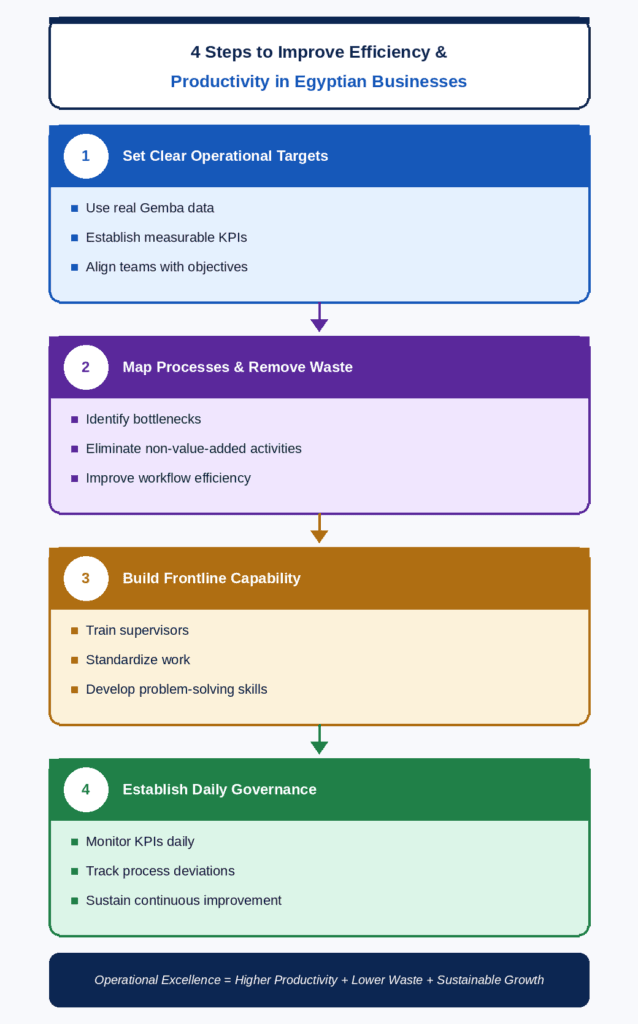
Successful productivity improvement requires a structured operational framework rather than isolated improvement initiatives. Organizations should begin by defining clear, realistic operational targets aligned with business objectives, followed by mapping processes to identify and eliminate non-value-added activities. Building frontline capability through Gemba-based coaching helps sustain standardized work practices, while daily governance and real-time performance monitoring ensure variances are addressed quickly and operational gains are maintained over the long term.
Step 1: Anchoring Operations in Observed Reality
Productivity planning often fails because it relies on idealized office assumptions rather than real data. To truly improve efficiency and productivity, management must spend time at the Gemba, the actual place where value is created. By measuring precise cycle times and observing physical workflows, operations establish an accurate baseline. This allows for realistic pricing, balanced production lines, and attainable performance targets.
Step 2: Implementation of Lean Manufacturing Principles
Deploying Lean Manufacturing methodologies is one of the most effective ways to drive productivity improvement in Egypt. Lean is not about downsizing resources; it is about maximizing value by aggressively targeting waste reduction. This involves mapping value streams to eliminate unnecessary material handling, reducing setup times on critical machinery, and smoothing out production bottlenecks that cause costly idleness.
Step 3: Building Frontline Capability
Middle managers and floor supervisors are the critical bridge between executive strategy and floor execution. A core pillar of comprehensive productivity improvement in Egypt’s manufacturing sector involves transforming these supervisors from traditional taskmasters into proactive problem solvers. When frontline leaders are equipped with tools like Root Cause Analysis (RCA) to spot process deviations and address them immediately, waste is eliminated before it impacts the bottom line.
Step 4: Establishing Daily Governance
Sustainable productivity improvements depend on consistent daily management rather than periodic reviews. Visual performance boards, standardized daily meetings, and real-time KPI tracking enable supervisors to identify process deviations as they occur and implement corrective actions before they escalate. By embedding daily governance into routine operations, organizations can sustain operational gains, reinforce accountability, and foster a culture of continuous improvement.
For organizations seeking to accelerate these improvements, specialized productivity consulting for Egyptian industrial zones can provide the objective, data-driven perspective needed to uncover hidden capacity within existing operations.
Connecting Process Optimization to Long-Term Growth
Ultimately, the journey to improve operational efficiency in Egypt is not a temporary corporate project; it is a permanent shift in how an organization thinks, acts, and evolves.
By committing to rigorous process optimization and focusing heavily on workforce capability building, Egyptian businesses can insulate themselves from external market volatility and changing raw material costs. When waste is systematically stripped out of workflows and teams are empowered with standardized, data-driven processes, improving productivity and efficiency stops being a distant goal and becomes the daily operational baseline.
Frequently Asked Questions (FAQs)
What is the primary difference between productivity and efficiency in manufacturing?
Productivity measures the total volume of goods produced relative to the resources used, whereas efficiency measures how effectively those resources are deployed without creating waste, defects, or unnecessary operational costs. High productivity with low efficiency results in expensive rework and wasted material.
How can a company improve efficiency and productivity in Egypt without massive capital spend?
Massive capital expenditure is often an incorrect diagnosis for poor utilization of existing assets. By analyzing physical movement, eliminating non-value-added waste via Lean methodologies, reducing machine setup times, and balancing production lines, operations can uncover significant hidden capacity using current resources.
Why is process improvement critical for industrial zones in Egypt?
With Egypt rapidly expanding its manufacturing and export footprints across regional markets, companies in major industrial zones must match global benchmarks for cost, quality, and delivery speed. Disciplined process improvement ensures local firms remain highly competitive on the international stage.
What is the role of continuous improvement in maintaining manufacturing efficiency in Egypt?
Continuous improvement ensures that operational gains do not fade over time. By establishing daily governance, visual dashboards, and structured daily reviews (Daily Work Management), teams can spot performance variances instantly and prevent processes from slipping back into inefficient, legacy habits.