Operating a business in Egypt’s booming industrial environment, introduces distinct operational challenges. Macroeconomic adjustments, localized skill gaps, and fluctuating material input costs mean that organizations cannot afford to tolerate hidden waste. To stay competitive regionally and protect bottom-line margins, companies are shifting away from short-term cost-cutting and adopting structured Lean Manufacturing principles.
When applied strategically, Lean management serves as a fundamental system for operational efficiency in Egypt. It transitions facilities from reactive firefighting to a streamlined, predictive model of execution, driving long-term productivity improvement across Egypt’s manufacturing sector without requiring large capital expenditures.
Why Traditional Operations Waste Capacity in Egypt
Before introducing advanced tools, it is crucial to understand where hidden inefficiencies reside. In many Egyptian industrial zones, low baseline asset utilization stems from fundamental process friction:
- High Process Variability: A heavy reliance on manual operations across different shifts creates irregular output rates and volatile quality standards.
- Long Material Transport Loops: Outdated, siloed layouts mean work-in-progress (WIP) items travel excessively long distances across the factory floor before completion.
- Extended Downtimes: Unstructured machine changeovers and a lack of preventative upkeep lead to frequent micro-stoppages.
To combat these friction points, enterprises must aggressively target waste reduction (Muda). Lean thinking classifies waste into specific categories, such as unnecessary motion, overprocessing, excessive inventory, and waiting times. By isolating and eliminating these non-value-adding steps, you automatically unlock latent capacity within your existing layout.
High-Impact Lean Methods for Egyptian Enterprises
1. Value Stream Mapping (VSM)
You cannot optimize an operational flow until you visualize it end-to-end. Value Stream Mapping is a core diagnostic tool used to map the physical movement of materials alongside the corresponding flow of information.
By tracking exactly how long a product spends in a value-adding state versus an idle state, management can locate structural bottlenecks. VSM provides the data required to design an optimized future-state workflow.
2. Lean Facility Design© and Layout Optimization
Many manufacturing facilities operate in layouts organized by machine type (e.g., all cutting machines grouped in one corner and assembly in another). This creates massive material handling costs and chaotic floor traffic.
Transitioning to integrated work cells via structured layout optimization allows products to flow smoothly from start to finish within a minimized physical radius. Grouping equipment based on the natural sequence of operations eliminates unnecessary forklift travel and reduces product cycle times.
Real-World Insight: Redesigning a factory floor using industrial engineering layout principles can significantly reduce material travel distances. In practical applications across the packaging and fabrication sectors, optimizing the physical flow has reclaimed up to 12% to 15% of underutilized floor space, allowing companies to add new production lines within their existing footprint.
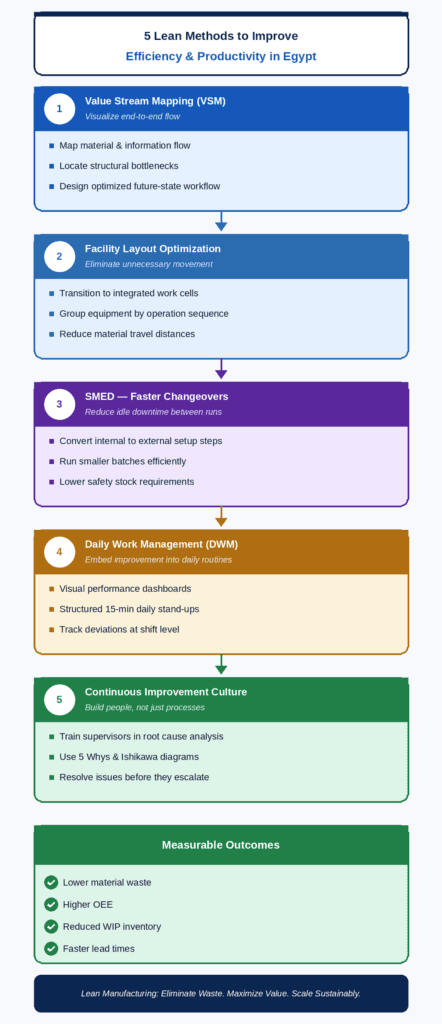
3. SMED (Single-Minute Exchange of Die) for Faster Changeovers
In certain industries, changing production lines from one product type to another often causes hours of idle downtime.
Implementing the SMED methodology streamlines this process by converting internal setup steps (tasks done while the machine is stopped) into external steps (tasks prepared while the machine is still running). Reducing changeover times enables factories to run smaller product batches smoothly, lowering warehouse safety stock requirements while maintaining high delivery reliability.
Building a Culture of Continuous Improvement
Tools alone do not sustain high-performance operations; people do. A common reason Lean initiatives stall is treating the transformation as an administrative project delegated solely to an external team, rather than embedding it into daily management routines.
Empowering the Frontline via Daily Work Management (DWM)
To ensure process improvements remain stable over time, organizations must implement Daily Work Management frameworks directly on the shop floor:
- Visual Performance Dashboards: Shift metrics, quality yields, and tool change targets must be visible at a glance right next to the work zones.
- Structured Tiered Meetings: Brief, 15-minute daily operational stand-ups allow operators and floor supervisors to review yesterday’s variations, align on today’s production quotas, and address immediate roadblocks collaboratively.
Transforming Supervisors into Problem Solvers
True Operational Excellence requires training middle managers and floor leaders to actively identify and resolve process deviations. By providing teams with practical Root Cause Analysis (RCA) techniques, such as the “5 Whys” and Ishikawa diagrams, companies create a proactive culture where minor operational issues are resolved before they impact customer delivery timelines.
Measurable Outcomes of Lean Transformations
When built upon structured execution, Lean principles deliver clear, measurable financial and operational advantages:
| Operational Metric | Traditional Manufacturing State | Post-Lean Optimized State |
| Material Wastage | High scrap rates due to unstandardized setups and shift variations. | Drastic reductions in raw material waste through stabilized processes. |
| Overall Equipment Effectiveness (OEE) | Equipment frequently idle due to uncoordinated batch changes. | Higher machine availability and maximized asset output per hour. |
| Work-in-Progress (WIP) Inventory | High volume of semi-finished items clogging walkways and blocking cash flow. | Balanced production lines with streamlined, pull-based material movement. |
| Lead Times | Extended delivery dates caused by internal operational bottlenecks. | Compressed end-to-end cycle times, leading to faster order fulfillment. |
For businesses operating across key regional logistics nodes, utilizing targeted productivity consulting for Egyptian industrial zones ensures these Lean methodologies are customized to fit local labor environments and supply chain constraints.
The Foundation for Future Scaling
Lean management is not an individual, one-off initiative; it is a fundamental prerequisite for long-term corporate growth. Attempting to automate an unstable, unstandardized workflow only serves to accelerate operational inefficiencies.
By first executing thorough process optimization, stabilizing cycle times, and eliminating non-value-added activities, Egyptian enterprises build the disciplined foundation required to successfully adopt advanced industrial systems and scale sustainably.
Frequently Asked Questions (FAQs)
Does implementing Lean Manufacturing methods mean reducing our workforce size?
No. Lean Manufacturing focuses on maximizing value by eliminating process waste, not headcount. The core goal is to remove non-value-added tasks, such as waiting for materials or searching for tools, so the existing workforce can focus entirely on high-yield, value-adding execution.
Can Lean Manufacturing be implemented without investing in new equipment?
Yes. Most Lean improvements focus on optimizing existing processes rather than purchasing new machinery. Techniques such as Value Stream Mapping (VSM), SMED, workplace organization, and layout optimization help manufacturers reduce waste, improve workflow, and increase productivity using their current resources. Capital investments may support future improvements, but they are not a prerequisite for starting a Lean transformation.
How long does it typically take to see measurable results from a Lean process improvement initiative?
While a comprehensive cultural transformation takes time, targeted operational improvements yield rapid results. Initial baseline optimizations, such as quick changeover adjustments (SMED) or layout adjustments, often deliver measurable increases in shift output and waste reduction within 60 to 90 days.
Why do some Lean implementation attempts fail in Egyptian factories?
Lean implementations generally fail when they are treated as top-down mandates or temporary cleanup projects. Success requires active leadership commitment, training middle management to take real ownership of daily metrics, and ensuring that performance goals are tracked visually on the floor rather than just discussed in executive meetings.