
Operational Excellence consulting in Kenya is increasingly focused on system redesign rather than performance coaching alone. Because most operational problems in Kenyan companies are not caused by a lack of effort, talent, or even strategy.
They are caused by something more structural: misaligned, outdated operating systems that no longer match the scale of the business.
As organizations grow, complexity increases faster than internal systems evolve. Processes that worked for a small team become inefficient as the business expands. Decision-making slows, communication breaks down, and execution becomes inconsistent.
At its core, Operational Excellence ensures that how work gets done is as strong as what the business is trying to achieve. It creates scalable systems, clear accountability, and repeatable performance that supports long-term growth.
The Hidden Problem: Why Growth Creates Inefficiency
Most companies assume inefficiency is a performance problem.
In reality, it is usually a scaling problem hidden inside outdated systems and processes.
When a business grows without redesigning its internal operations, three things typically happen:
- Work becomes fragmented across too many touchpoints
- Decision-making slows due to unclear authority
- Execution becomes dependent on individuals rather than systems
Over time, this creates what is known as operational drag, a condition where every additional unit of growth increases inefficiency instead of improving productivity.
This is why business process improvement in Kenya is not simply about optimization. It is about redesigning how work flows across the organization.
Diagnostic Lens: Where Operational Inefficiency Actually Lives
In operational excellence consulting in Kenya, one of the biggest mistakes is treating operational inefficiency as a surface-level problem.
Delays, missed deadlines, rising costs, customer complaints, and execution failures are rarely the root issue. They are usually symptoms of deeper weaknesses within the operating model.
Before any meaningful business process improvement can occur, leaders must identify where inefficiency is being created.
In Operational Excellence consulting, inefficiencies typically emerge from three interconnected layers: processes, systems, and organizational structure. Improving one layer while ignoring the others often produces only temporary results.
1. Process Layer (How Work Gets Done)
In operational excellence consulting in Kenya, the process layer contains the visible workflows employees follow every day.
This includes:
- Approval processes
- Task sequences
- Reporting procedures
- Service delivery workflows
- Operational handoffs
Common indicators of process inefficiency include:
- Excessive approval requirements
- Duplicate tasks
- Unclear process ownership
- Frequent rework
- Bottlenecks that slow execution
While process issues are the most visible, they are often symptoms of deeper systems or structural weaknesses.
2. System Layer (How Work Connects Across the Organization)
In operational excellence consulting in Kenya, the system layer determines how information, technology, and communication support operational execution.
It includes:
- Business software and platforms
- Data management systems
- Communication channels
- Departmental coordination mechanisms
- Performance tracking tools
When systems are poorly integrated:
- Teams duplicate effort
- Data becomes inconsistent
- Decision-making slows
- Reporting loses accuracy
- Operational costs increase
Many organizations attempt to improve performance by adding more tools, when the real challenge is often the lack of integration between existing systems.
3. Structural Layer (How Decisions Are Made)
In operational excellence consulting in Kenya, the structural layer defines how authority, accountability, and decision-making operate throughout the organization.
It includes:
- Organizational design
- Reporting relationships
- Decision rights
- Accountability frameworks
- Leadership governance structures
Structural weaknesses often create the most significant operational constraints because they affect every department.
Common signs include:
- Decisions being escalated unnecessarily
- Slow execution despite capable teams
- Confusion over ownership and accountability
- Cross-functional conflicts
- Overdependence on senior leadership
When organizational structure is misaligned with business growth, operational complexity increases faster than execution capacity.
Why This Diagnostic Framework Matters
Operational excellence consulting in Kenya often finds organizations focus exclusively on fixing workflows because process problems are the easiest to see.
However, sustainable Operational Excellence requires identifying whether inefficiency originates from the process layer, the system layer, the structural layer, or a combination of all three.
This diagnostic approach helps organizations move beyond symptom management and address the root causes of operational friction, creating systems that support efficiency, accountability, and scalable growth.
The Real Meaning of Operational Excellence
Operational excellence consulting in Kenya proves that Operational Excellence is not simply process improvement.
It is the design of an operating system where inefficiency is minimized, or eliminated, by design.
Most Operational Excellence consulting engagements in Kenya follow a fundamental shift in thinking:
From:
“How do we fix this issue?”
To:
“Why does the system allow this issue to exist in the first place?”
This shift separates temporary improvements from genuine organizational transformation.
Instead of solving recurring problems one at a time, Operational Excellence addresses the underlying conditions that create those problems.
What Operational Excellence Actually Changes
Operational excellence consulting in Kenya shows that, when properly implemented, Operational Excellence improves four core dimensions of a business.
Flow of Work
Work moves smoothly through the organization without unnecessary delays, bottlenecks, or handoffs.
Decision Speed
Authority and accountability are clearly defined, reducing unnecessary escalation and approval cycles.
Cost Structure
Waste is removed at the system level rather than only at the task level, creating sustainable efficiency gains.
Execution Reliability
Outcomes become predictable, measurable, and repeatable rather than dependent on individual effort.
This is why Operational Excellence is closely linked with business transformation consulting in Kenya, particularly for organizations experiencing rapid growth.
Business Process Improvement in Kenya
At a practical level, business process improvement in Kenya is often misunderstood as simply making workflows faster.
However, real process improvement involves:
- Removing activities that do not create value
- Redesigning how departments interact
- Reducing dependency on manual coordination
- Standardizing repeatable tasks
- Improving visibility across workflows
- Creating consistent operating procedures
Example of Hidden Inefficiency
A simple purchase approval process may involve:
- Multiple email chains
- Manual verification steps
- Repeated confirmations across departments
- Unclear approval ownership
Individually, these activities may appear harmless. At scale, however, they create significant delays, higher costs, and reduced organizational agility.
Surface Thinking vs. System Thinking
| Dimension | Surface Thinking | System Thinking |
| Focus | Individual tasks | Entire workflow structure |
| Problem Solving | Fix symptoms | Fix root causes |
| Improvements | Short-term | Structural |
| Outcome | Temporary efficiency | Scalable performance |
| Risk | Problems reappear | Problems are prevented |
Organizations that adopt system thinking create sustainable improvements that continue to generate value as they grow.
Why Efficiency Problems Persist
One of the most important insights in operational consulting is this:
Inefficiency is often designed into the system, not created by individuals.
This means even highly capable employees will struggle inside poorly designed operating environments.
Common structural causes include:
- Unclear decision authority
- Fragmented workflows
- Lack of standardization
- Weak performance visibility
- Poor communication channels
- Misaligned accountability structures
This is why many management consulting firms in Kenya prioritize operating model redesign over individual performance interventions.
Improving people without improving systems rarely produces lasting results.
High-Impact Areas of Operational Excellence Consulting
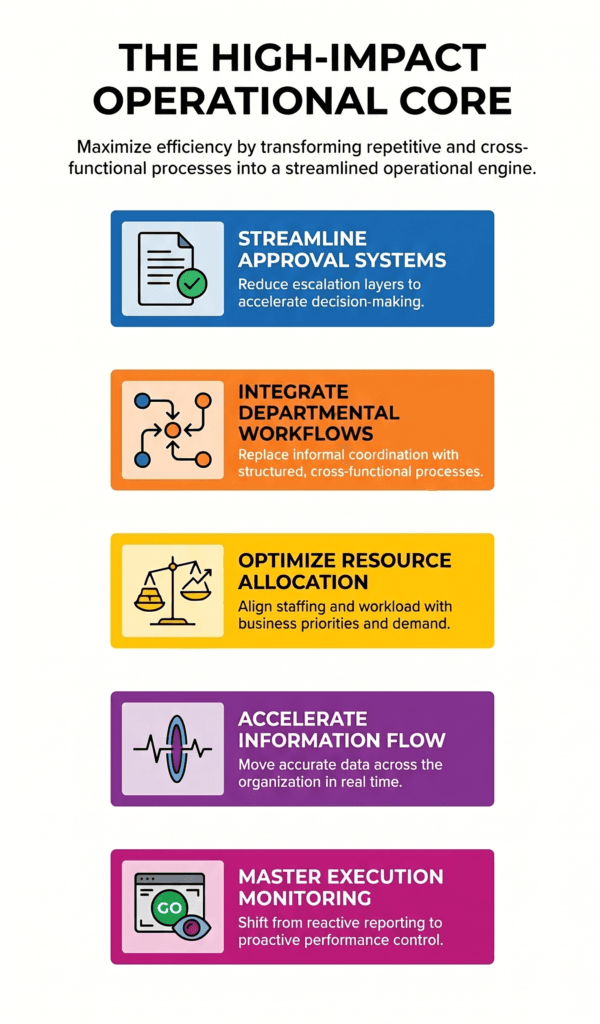
Operational Excellence delivers the greatest impact in areas where work is repetitive, cross-functional, and time-sensitive.
Approval Systems
Reduce unnecessary escalation layers and accelerate decision-making.
Workflow Integration
Connect departments through structured processes rather than informal coordination.
Resource Allocation
Align workload, staffing, and capacity with business priorities and operational demand.
Information Flow
Ensure accurate data moves across the organization in real time rather than through delayed reporting cycles.
Execution Monitoring
Shift from reactive reporting to proactive operational control and performance management systems.
Operational Excellence Consulting: Before vs. After
| Area | Before | After |
| Workflow Design | Fragmented | Structured |
| Decision Speed | Slow | Fast and clearly defined |
| Cost Efficiency | Unpredictable | Controlled and measurable |
| Accountability | Diffused | Clear ownership |
| Scalability | Breaks under growth | System-supported growth |
When Companies Need Operational Excellence Consulting
Organizations typically require Operational Excellence consulting in Kenya when:
- Growth increases internal complexity
- Operational costs rise without a clear explanation
- Execution becomes inconsistent
- Teams rely heavily on specific individuals
- Decision-making slows significantly
- Departments operate in silos
- Scaling creates inefficiency instead of improvement
These are indicators of system breakdown rather than effort failure.
The earlier these issues are addressed, the easier it becomes to create sustainable growth.
Conclusion
Operational Excellence consulting in Kenya is fundamentally about redesigning how work flows so efficiency is built directly into the operating system.
Through structured business process improvement in Kenya, organizations can reduce operational friction, eliminate waste at its source, improve decision-making, and build scalable systems that support long-term growth.
In today’s competitive business environment, Operational Excellence is not simply an improvement initiative, it is a strategic and structural requirement for sustainable business success.
Frequently Asked Questions (FAQs)
What is Operational Excellence in business?
Operational excellence is the design of systems, processes, and structures that reduce inefficiency, improve execution, and create consistent business performance.
Why do business processes fail?
Business processes often fail because organizations continue to grow while relying on systems that were designed for a much smaller scale of operation.
What is business process improvement?
Business process improvement is the systematic redesign of workflows to increase efficiency, reduce waste, and improve organizational performance.
How is Operational Excellence different from process improvement?
Process improvement focuses on optimizing workflows, while Operational Excellence focuses on improving the broader systems, structures, and operating model that support those workflows.
When should companies adopt Operational Excellence?
Companies should adopt Operational Excellence when growth leads to operational inefficiencies, rising costs, delayed decisions, inconsistent execution, or reduced organizational performance.
Contact us