
In Kenyan manufacturing companies, many transformation efforts fail not because the strategy is wrong, but because execution on the ground is inconsistent or incomplete.
Implementation is the stage where leadership decisions, operational systems, and workforce behavior must align. Without that alignment, even well-designed change programs lose impact.
This article explains how organizational change is implemented in Kenyan manufacturing environments and what determines whether execution succeeds or stalls.
What Implementing Organizational Change Means for Manufacturing
Implementation refers to the process of translating change plans into daily operational practice.
In manufacturing environments, this includes:
- Updating production workflows
- Introducing new operating standards
- Adjusting roles and responsibilities
- Training teams on new processes
- Aligning performance expectations
- Embedding new ways of working into operations
Unlike planning, implementation is not theoretical. It is visible on the shop floor, in daily output, and in workforce behavior.
Implementing Organizational Change: From Planning to Execution
In many organizations, the biggest gap is between planning and execution.
A plan may define:
- New operating models
- Efficiency improvements
- Quality targets
- Productivity goals
But implementation determines whether these targets are actually achieved.
Manufacturing organizations in Kenya often face execution challenges when:
- Roles are not clearly defined
- Leadership alignment is weak
- Communication is inconsistent
- Operational readiness is underestimated
Closing this gap is central to successful organizational change.
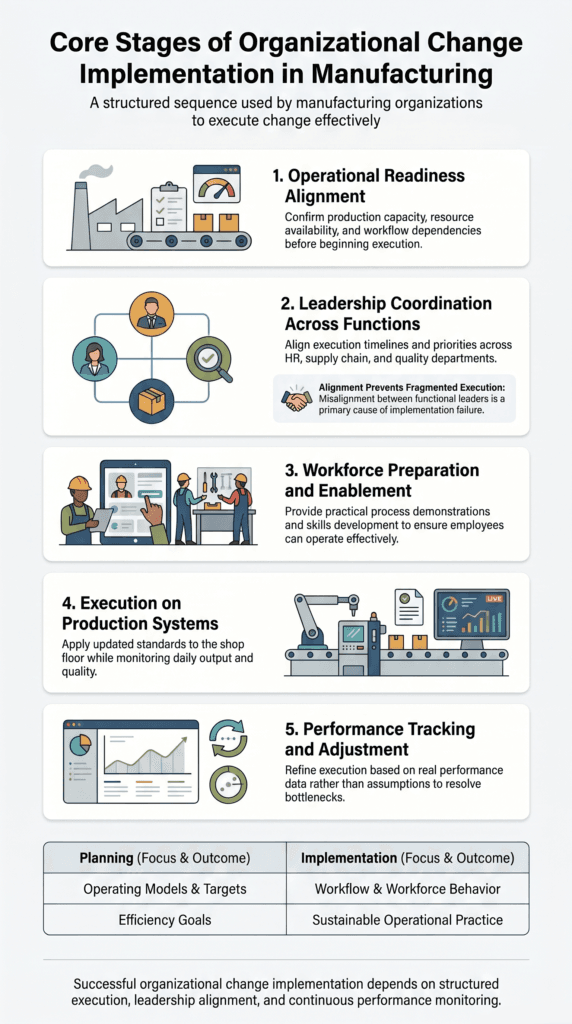
Core Stages of Organizational Change Implementation in Manufacturing
Organizational change implementation typically follows a structured sequence.
Operational Readiness Alignment
Before execution begins, organizations must confirm readiness across operations.
This includes:
- Assessing production capacity
- Reviewing workflow dependencies
- Identifying impacted departments
- Confirming resource availability
Without operational readiness, implementation slows down quickly.
Leadership Coordination Across Functions
Manufacturing change requires coordination between multiple functions such as operations, HR, supply chain, and quality.
This means leadership teams must ensure:
- Consistent priorities across departments
- Clear decision-making authority
- Aligned execution timelines
- Shared accountability for outcomes
Misalignment at this stage often leads to fragmented execution.
Workforce Preparation and Enablement
Employees must be prepared to operate in new ways.
This involves:
- Role clarity
- Skills development
- Supervisor training
- Practical demonstrations of new processes
Workforce readiness is one of the strongest predictors of implementation success.
Execution on Production Systems
This is where change becomes operational.
It includes:
- Applying new processes in real production environments
- Enforcing updated standards
- Monitoring daily output and quality
- Supporting frontline teams during transition
Execution discipline determines whether change holds or fades.
Performance Tracking and Adjustment
Implementation is not a one-time project.
Manufacturers must continuously monitor:
- Productivity levels
- Quality performance
- Process adherence
- Operational bottlenecks
Any adjustments to follow are made based on actual performance data, not assumptions.
Role of Leadership in Implementation Success
Leadership determines whether organizational change is sustained or lost during execution.
In manufacturing environments, effective leaders focus on:
Setting Execution Priorities
Clear priorities ensure teams know what matters most during transition.
Removing Operational Barriers
Leaders must address issues that slow down execution, such as resource gaps or process conflicts.
Ensuring Accountability
Consistent follow-through ensures new processes are applied across all teams.
Supporting Frontline Supervisors
Supervisors play a key role in translating strategy into daily work.
Without strong leadership involvement, implementation loses momentum.
Why Communication Controls Execution Quality
Communication directly influences how well change is implemented.
Effective communication ensures:
- Clarity of expectations
- Reduced uncertainty in teams
- Faster adoption of new processes
- Better coordination across shifts and departments
In manufacturing environments, communication must be continuous and operationally grounded.
How Workforce Contributes to Implementing Organizational Change
Employees are not passive recipients of change. They are active participants in execution.
Their responsibilities include:
- Applying new work standards
- Following updated production processes
- Reporting issues during transition
- Contributing improvement feedback
When employees understand expectations clearly, implementation becomes more stable and predictable.
Common Challenges in Implementing Organizational Change
Even well-designed programs face challenges during implementation.
Inconsistent Leadership Messaging
Different interpretations of change slow down execution.
Weak Operational Readiness
Systems or teams may not be fully prepared for new processes.
Capability Gaps
Employees may lack the skills needed to operate new systems effectively.
Lack of Follow-Through
Some organizations fail to sustain discipline after initial rollout.
These challenges are often execution-related, not strategy-related.
How Kenyan Manufacturers Can Strengthen Implementation
Manufacturing organizations can improve execution outcomes by focusing on:
- Structured implementation planning
- Leadership alignment across functions
- Workforce capability development
- Consistent communication systems
- Real-time performance tracking
- Strong frontline supervision support
Organizations that treat implementation as a disciplined operational system achieve more stable and sustainable results.
How This Connects to Organizational Change Success
Effective implementation is what turns organizational change into measurable business results.
Without strong execution:
- Strategies remain theoretical
- Improvements are not sustained
- Operational performance remains inconsistent
This is why implementation capability is a core part of organizational change maturity in manufacturing.
Why Consulting Support Matters in Implementing Organizational Change
Many manufacturing organizations understand what needs to change but face challenges in execution. External consulting support can help structure the implementation process, improve leadership alignment, and bring clarity to roles, communication, and performance tracking. This support is especially valuable in complex environments where multiple functions must work together to ensure change is effectively adopted and sustained on the shop floor.
Conclusion
Implementing organizational change in Kenyan manufacturing requires disciplined execution across leadership, operations, and workforce systems.
Success depends less on the quality of the plan and more on how effectively it is executed on the ground.
Manufacturers that strengthen operational readiness, leadership alignment, workforce capability, and communication systems are more likely to achieve consistent and sustainable change outcomes.
Frequently Asked Questions
What does implementing organizational change mean in manufacturing?
It refers to translating change plans into operational reality by adjusting processes, roles, systems, and workforce behavior.
Why is implementation important in organizational change?
Because it determines whether planned improvements are actually achieved in daily manufacturing operations.
What causes failure during implementation?
Common causes include poor communication, weak leadership alignment, lack of readiness, and insufficient training.
How can manufacturers improve implementation success?
By focusing on operational readiness, leadership coordination, workforce training, and performance monitoring.
What is the role of employees in implementation?
Employees apply new processes, follow updated standards, and contribute feedback during transition periods.