Most manufacturing inefficiencies do not begin with machines or workforce capability. They begin with movement.
Workers walking farther than necessary. Materials waiting between processes. Forklifts repeatedly crossing the same paths. Operators navigating around poorly positioned equipment. Individually, these moments appear minor. Collectively, they create operational friction that affects productivity, lead time, labor efficiency, and overall manufacturing performance every single day.
Factory layout is often treated as a fixed infrastructure decision rather than a strategic operational factor. Yet the physical arrangement of machines, workstations, storage areas, and material flow directly determines how efficiently value moves through the operation.
An inefficient layout does not simply waste space. It quietly wastes time, energy, and capacity.
When Movement Becomes Operational Waste
In manufacturing environments, unnecessary movement remains one of the most underestimated forms of operational waste. Every additional transfer, delay, or transportation loop consumes operational resources without adding value to the final product. Over time, these inefficiencies compound across shifts, departments, and production cycles.
The impact rarely appears through one major operational failure. Instead, it shows up gradually through congested movement paths, delays between processes, excessive material handling, and interruptions in workflow continuity. Most factories continue operating despite these inefficiencies because teams gradually adapt through temporary fixes and workarounds.
Over time, however, these adjustments become normalized within daily operations.
The Hidden Impact on Productivity
Organizations frequently focus on machine utilization, scheduling efficiency, and workforce performance while overlooking the physical flow of the factory itself. However, even highly capable teams struggle to perform efficiently inside poorly designed operational environments.
An inefficient layout often leads to:
- Increased handling and transportation time
- Accumulation of work-in-progress inventory
- Delays in coordination between processes
- Slower response to operational disruptions
- Reduced operational visibility across the floor
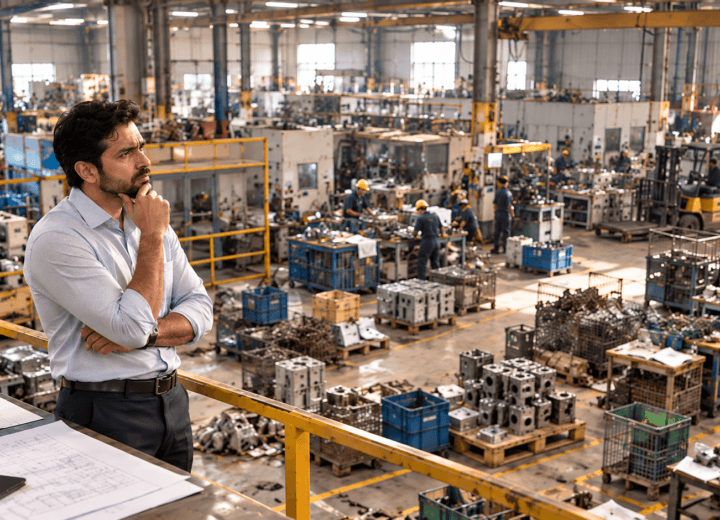
As facilities expand over time, layouts often become fragmented. New machines, temporary storage areas, and process adjustments are added incrementally until operational flow becomes increasingly complex.
The factory continues functioning, but with hidden productivity losses embedded into routine execution.
Why Layout Directly Affects Operational Flow
The objective of an effective factory layout is not simply organizing equipment inside available space. The objective is creating uninterrupted operational flow.
When layouts are designed around process continuity, organizations typically experience smoother material movement, lower congestion, faster throughput, and greater operational stability. Fewer interruptions exist between value-adding activities, allowing production to move with greater consistency and responsiveness.
This becomes increasingly important in modern manufacturing environments where shorter lead times, operational agility, and efficient resource utilization directly influence competitiveness.
An efficient layout allows operations to move with clarity rather than friction.
Final Perspective
An inefficient factory layout rarely creates one major visible failure. Instead, it creates hundreds of small inefficiencies repeated throughout the day: extra movement, additional waiting, interrupted flow, and unnecessary handling.
Over time, these small inefficiencies accumulate into significant operational cost.
The most effective manufacturing organizations understand that productivity is not determined only by machines, automation, or labor efficiency. It is also determined by how intelligently the operation itself is physically designed to move