For productivity consultants, Manufacturing productivity has become one of the most important drivers of competitiveness for businesses operating in Kenya. Rising production costs, fluctuating energy prices, supply chain disruptions, and growing regional competition mean manufacturers must continuously improve efficiency while maintaining product quality and meeting customer expectations.
For many factories, the challenge is not insufficient demand but underperforming production systems. Equipment downtime, inconsistent workflows, production bottlenecks, excessive material handling, and quality defects can quietly reduce output and increase costs long before they appear in financial reports.
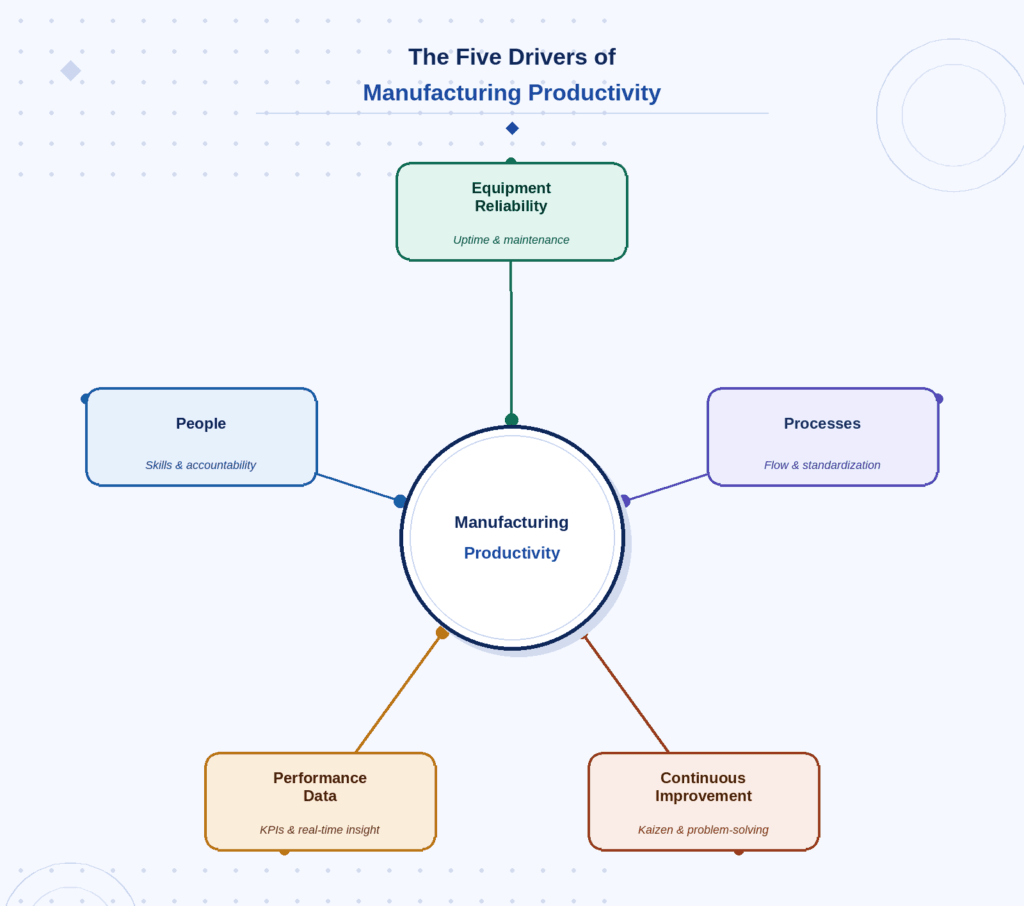
Improving manufacturing productivity requires more than working faster or investing in new equipment. It involves understanding how people, processes, machines, and performance data work together to create a reliable production system.
This guide explores the most effective strategies for improving manufacturing productivity in Kenya, the operational methods manufacturers use to increase efficiency, and how productivity consultants support sustainable performance improvements.
What Is Manufacturing Productivity?
Manufacturing productivity measures how efficiently a factory converts resources such as labor, equipment, materials, energy, and time into finished products.
A productive factory is not simply one that produces more units. It consistently achieves high output while minimizing waste, maintaining product quality, and controlling operating costs.
Common productivity metrics include:
- Output per labor hour
- Machine uptime
- Overall Equipment Effectiveness (OEE)
- Production cycle time
- Cost per unit
- Defect and rework rates
- On-time delivery performance
Tracking these indicators helps manufacturers identify where production losses occur and where improvement efforts should be focused.
Common Productivity Challenges in Kenyan Manufacturing
Many productivity problems develop gradually as factories grow and processes become more complex.
Some of the most common operational challenges include:
- Frequent equipment downtime
- Inefficient production scheduling
- Poor material flow between workstations
- Long machine changeover times
- Inconsistent shift performance
- High defect and rework rates
- Limited production visibility
- Ineffective maintenance planning
These issues rarely occur in isolation. For example, delayed maintenance can increase equipment failures, which disrupt production schedules and create additional quality problems downstream.
Over time, these inefficiencies reduce production capacity, increase operating costs, and make it more difficult for manufacturers to compete in local and export markets.
Practical Strategies to Improve Manufacturing Productivity
Improving productivity begins with understanding where time, resources, and capacity are being lost.
Optimize Production Processes
Every production process should be designed to minimize unnecessary movement, waiting time, and duplication of work.
Manufacturers often improve efficiency by:
- Simplifying workflows
- Eliminating redundant process steps
- Improving workstation layouts
- Balancing production lines
- Reducing changeover times
Small improvements across multiple processes often produce greater long-term gains than one large operational change.
Improve Equipment Reliability
Reliable equipment is essential for maintaining consistent production output.
Rather than responding only after breakdowns occur, manufacturers increasingly adopt preventive and predictive maintenance practices that reduce unplanned downtime and extend equipment life.
Operators also play an important role by conducting routine inspections and reporting issues before they become major failures.
Strengthen Workforce Performance
Even highly automated factories rely on skilled operators and supervisors.
Clear work instructions, standardized operating procedures, effective training, and well-defined performance expectations help improve consistency across shifts while reducing errors and rework.
Productivity improves when employees spend more time performing value-added work and less time waiting for materials, information, or equipment.
Use Data to Drive Decisions
Factories generate large amounts of operational data, but collecting information alone does not improve performance.
Managers should regularly monitor key metrics such as machine utilization, production output, downtime, quality performance, and labor productivity to identify trends and respond quickly to emerging issues.
Visual dashboards and daily production meetings help ensure that operational decisions are based on real-time information rather than assumptions.
Manufacturing Improvement Methods That Deliver Results
Successful productivity improvement programs typically combine several established manufacturing methodologies.
Lean Manufacturing
Lean Manufacturing focuses on eliminating activities that do not create value for customers.
Common examples include unnecessary transportation, waiting time, excess inventory, overproduction, defects, and inefficient movement.
By reducing waste, manufacturers improve production flow while lowering operating costs.
5S Workplace Organization
The 5S methodology creates organized, efficient work environments through five principles:
- Sort
- Set in Order
- Shine
- Standardize
- Sustain
Well-organized workplaces reduce search time, improve safety, and support more consistent production.
Total Productive Maintenance (TPM)
TPM aims to maximize equipment performance by combining preventive maintenance with operator involvement.
Instead of relying entirely on maintenance departments, operators perform routine inspections and basic maintenance activities that improve equipment reliability.
Overall Equipment Effectiveness (OEE)
OEE measures manufacturing performance using three factors:
- Availability
- Performance
- Quality
Monitoring OEE helps manufacturers understand whether production losses result from downtime, slow operating speeds, or product defects.
Continuous Improvement
Continuous improvement encourages employees at every level to identify opportunities for making production processes safer, faster, and more efficient.
Rather than relying only on major improvement projects, manufacturers build a culture where small improvements become part of everyday operations.
Why Productivity Assessments Matter
Before implementing improvements, manufacturers need an accurate understanding of current performance.
A structured productivity assessment typically evaluates:
- Production flow
- Machine utilization
- Downtime patterns
- Labor productivity
- Material movement
- Quality performance
- Energy consumption
- Process bottlenecks
This baseline helps manufacturers prioritize improvement opportunities according to operational impact rather than assumptions or anecdotal observations.
How Productivity Consultants Support Improvement
Many manufacturers engage productivity consultants to accelerate improvement initiatives and provide objective operational analysis.
Consultants typically assist with:
- Factory productivity assessments
- Process mapping
- Bottleneck identification
- Lean manufacturing implementation
- Performance KPI development
- Workflow redesign
- Change management
- Continuous improvement systems
Because consultants work across multiple manufacturing environments, they often recognize inefficiencies that internal teams have accepted as normal.
More importantly, they help manufacturers implement sustainable systems rather than temporary fixes.
Business Benefits of Higher Manufacturing Productivity
Manufacturers that implement structured productivity improvement programs often achieve measurable operational and financial benefits.
These include:
- Increased production output
- Lower cost per unit
- Reduced operational waste
- Improved equipment utilization
- Better product quality
- More predictable delivery schedules
- Higher workforce engagement
- Increased profitability without significant capital investment
Many factories discover that they already have unused production capacity. Improving workflows and reducing operational losses often allows them to produce more without purchasing additional machinery.
The Future of Manufacturing Productivity in Kenya
Manufacturing productivity is becoming increasingly data-driven.
More manufacturers are adopting technologies such as:
- Real-time production dashboards
- Enterprise Resource Planning (ERP)
- Manufacturing Execution Systems (MES)
- Equipment monitoring
- Predictive maintenance
- Digital quality management
- Production scheduling
While technology alone does not solve operational problems, it provides manufacturers with better visibility and faster decision-making, enabling continuous improvement at scale.
Conclusion
Improving manufacturing productivity is not about working harder or investing immediately in new equipment. It is about building efficient production systems that maximize the performance of existing people, processes, and assets.
By combining Lean Manufacturing principles, reliable maintenance practices, standardized workflows, data-driven performance management, and continuous improvement, Kenyan manufacturers can increase output while reducing waste and operating costs.
Whether improvements are led internally or supported by experienced productivity consultants, a structured approach enables manufacturers to build more competitive, resilient, and profitable operations in an increasingly demanding industrial landscape.
Frequently Asked Questions
What is manufacturing productivity?
Manufacturing productivity measures how efficiently a factory converts labor, materials, equipment, and energy into finished products while maintaining quality and controlling costs.
How can manufacturers improve productivity?
Manufacturers can improve productivity by optimizing production processes, reducing downtime, strengthening maintenance systems, monitoring operational KPIs, and implementing Lean manufacturing practices.
What is the purpose of a productivity assessment?
A productivity assessment identifies operational inefficiencies, establishes baseline performance, and prioritizes improvement opportunities based on measurable data.
Which productivity methods are most effective?
Lean Manufacturing, 5S, Total Productive Maintenance (TPM), Overall Equipment Effectiveness (OEE), and continuous improvement practices are among the most widely used methods.
When should a manufacturer hire a productivity consultant?
Manufacturers should consider consulting support when they experience recurring downtime, declining efficiency, quality issues, production bottlenecks, or when they need an objective assessment of factory performance.
Contact us