The main benefits of 5S Lean manufacturing include improved productivity, reduced operational waste, better workplace organization, lower equipment downtime, and increased production efficiency. In Kenyan manufacturing environments, it helps factories operate more consistently by standardizing workflows and improving visual control on the shop floor.
Key Takeaways
- 5S improves productivity by reducing non-value-added activities
- It enhances workplace safety and organization
- It reduces downtime through better equipment care and visibility
- It improves consistency across shifts and production lines
- It supports long-term operational efficiency and cost control
Why 5S Matters for Manufacturing Performance in Kenya
Manufacturing competitiveness in Kenya is increasingly shaped by operational efficiency rather than just production capacity. As input costs, labor expectations, and market demands evolve, factories must find ways to produce more with fewer inefficiencies.
The 5S methodology in manufacturing provides a structured way to achieve this by improving how workspaces are organized, how processes are followed, and how resources are utilized on the shop floor.
Unlike technology-heavy transformations, 5S focuses on practical, low-cost operational discipline that directly impacts daily productivity.
Core Benefits of 5S Lean Manufacturing in Kenya
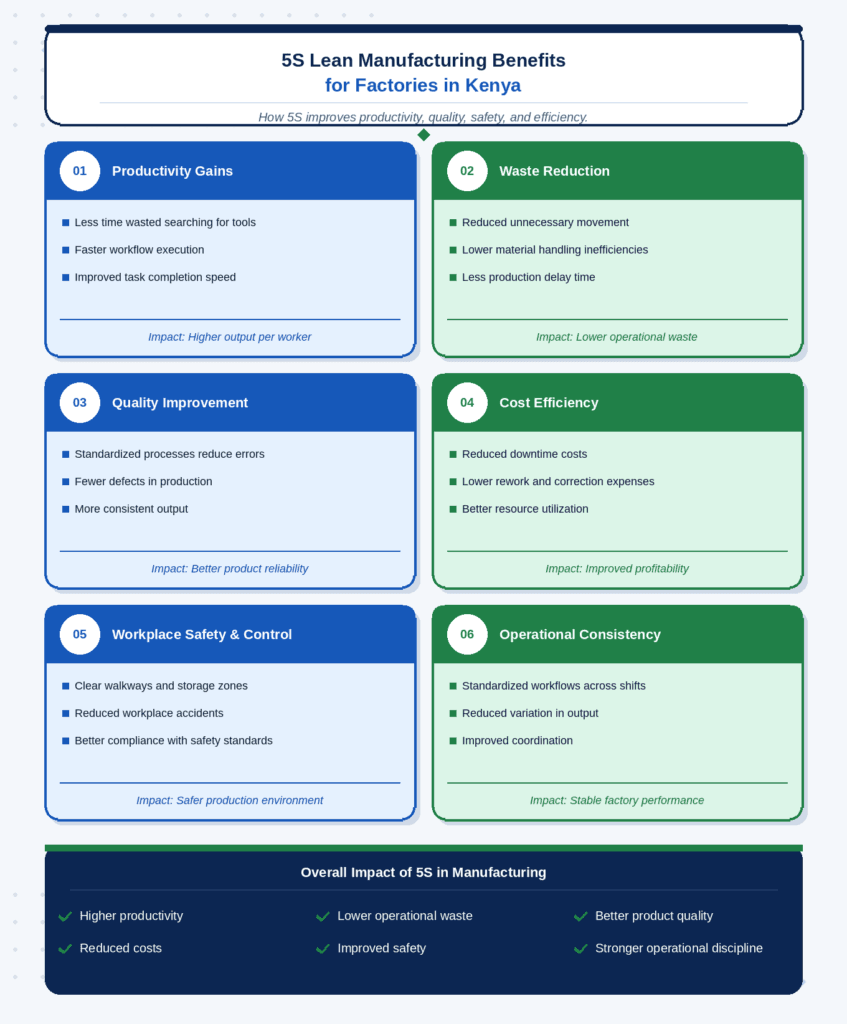
1. Improved Productivity Across the Shop Floor
One of the most immediate benefits of 5S Lean Manufacturing in Kenya is improved productivity.
When workspaces are organized and tools are easily accessible, employees spend significantly less time on non-productive activities such as searching for equipment, waiting for materials, or correcting workflow interruptions.
This allows production teams to focus more on actual value-adding tasks, improving output without increasing operational input.
2. Reduced Operational Waste
Waste in manufacturing is not always visible. It often appears as unnecessary movement, inefficient workflows, or underutilized resources.
Through structured 5S Lean manufacturing practices, organizations reduce waste in several forms:
- Wasted time searching for tools
- Unnecessary movement between workstations
- Excess inventory buildup
- Avoidable production delays
By eliminating these inefficiencies, factories achieve smoother and more cost-effective operations.
3. Better Workplace Organization and Flow
A well-implemented workplace organization using 5S methodology creates a structured production environment where every item has a defined place and purpose.
This improves workflow predictability and reduces confusion on the shop floor. Materials move more logically through production stages, and workers operate in clearly defined zones that align with production requirements.
The result is a more coordinated and efficient manufacturing environment.
4. Reduced Equipment Downtime
Equipment downtime is one of the most significant hidden costs in manufacturing operations.
The Shine principle of 5S plays a critical role in reducing this risk by encouraging regular cleaning and inspection routines. These routines help identify early signs of machine wear, leaks, or misalignment before they develop into major breakdowns.
This preventive approach improves equipment reliability and supports more stable production schedules.
5. Improved Workforce Efficiency and Accountability
5S improves how employees interact with their work environment. When expectations are clearly defined and visual systems are in place, workers operate with greater clarity and accountability.
This leads to:
- Faster task execution
- Fewer operational errors
- Improved coordination between teams
Over time, this creates a more disciplined and performance-oriented workplace culture.
6. Greater Operational Consistency
Consistency is a key challenge in many manufacturing environments, especially where multiple shifts operate independently.
Through standardization in 5S, processes are clearly defined and reinforced across all teams. This ensures that work is performed in the same structured way regardless of shift or operator.
The result is more predictable output quality and reduced variation in production performance.
How 5S Impacts Cost, Quality, and Safety Performance in Kenya
Beyond operational efficiency, 5S Lean manufacturing has a direct influence on three critical performance areas in manufacturing: cost control, product quality, and workplace safety. These three dimensions are often interdependent, meaning improvements in one area typically strengthen the others.
From a cost perspective, 5S reduces hidden operational expenses that arise from inefficiencies. These include time lost searching for tools, unnecessary movement across workstations, and avoidable equipment damage caused by poor handling or disorganized storage. While these costs are often indirect, they accumulate significantly over time and affect overall production margins.
In terms of quality, a well-organized and standardized workspace reduces variability in production processes. When tools are consistently stored and procedures are clearly defined, operators are less likely to make errors caused by confusion or inconsistent workflows. This leads to more stable output quality and fewer defects in finished products.
Safety is another critical benefit. A structured workplace organization using 5S methodology reduces hazards such as misplaced tools, blocked walkways, or cluttered work areas. Clear visual systems and designated zones help prevent accidents and improve compliance with workplace safety standards. In manufacturing environments, this also contributes to reduced downtime caused by avoidable incidents.
Together, these improvements make 5S not only an efficiency tool but also a broader operational risk management system.
Why 5S is a Foundation for Lean Manufacturing Transformation in Kenya
In most manufacturing improvement journeys, 5S is considered the foundational step before implementing more advanced Lean manufacturing systems. This is because it establishes the basic discipline, structure, and visual control required for sustained operational improvement.
Without 5S, advanced systems such as inventory optimization, process automation, or production planning improvements often fail to deliver consistent results due to underlying workplace inefficiencies.
The 5S Lean manufacturing approach creates a stable operational base by ensuring that the physical environment is organized, standardized, and predictable. This allows other improvement initiatives to build on a consistent system rather than fragmented or unstructured workflows.
In practical terms, 5S improves data reliability, process visibility, and execution discipline; all of which are essential for scaling manufacturing operations effectively.
For this reason, many organizations view 5S not as an isolated efficiency tool, but as a prerequisite for long-term manufacturing transformation and competitiveness.
Strategic Value of 5S for Kenyan Manufacturing Enterprises
For manufacturers in Kenya, the value of 5S extends beyond operational improvements. It directly supports broader business objectives such as cost efficiency, scalability, and competitiveness.
By improving organization and reducing waste, 5S helps organizations operate more efficiently within existing resource constraints. This is particularly important in environments where operational margins are sensitive to inefficiencies.
In addition, 5S creates a strong foundation for further Lean manufacturing practices, making it a starting point for broader operational transformation.
Frequently Asked Questions
What are the main benefits of 5S in manufacturing?
The main benefits of 5S include improved productivity, reduced waste, better organization, lower downtime, and increased operational efficiency.
How does 5S improve manufacturing efficiency?
It improves efficiency by reducing time loss, optimizing workflows, and standardizing workplace processes.
Does 5S reduce production costs?
Yes, it reduces indirect costs by minimizing waste, downtime, and inefficiencies in daily operations.
Why is 5S important for Kenyan manufacturers?
It helps improve competitiveness by increasing efficiency and reducing operational waste without requiring heavy capital investment.
Is 5S a long-term strategy or short-term improvement?
It is a long-term operational system that requires discipline and continuous reinforcement to maintain benefits.