5S Lean manufacturing is a workplace organization methodology that helps manufacturers improve efficiency, safety, and productivity by eliminating waste and creating clean, organized, and standardized work environments. As Kenya’s manufacturing sector becomes increasingly competitive, many organizations are adopting 5S to streamline operations, improve product quality, and build a culture of continuous improvement.
What is 5S Lean Manufacturing?
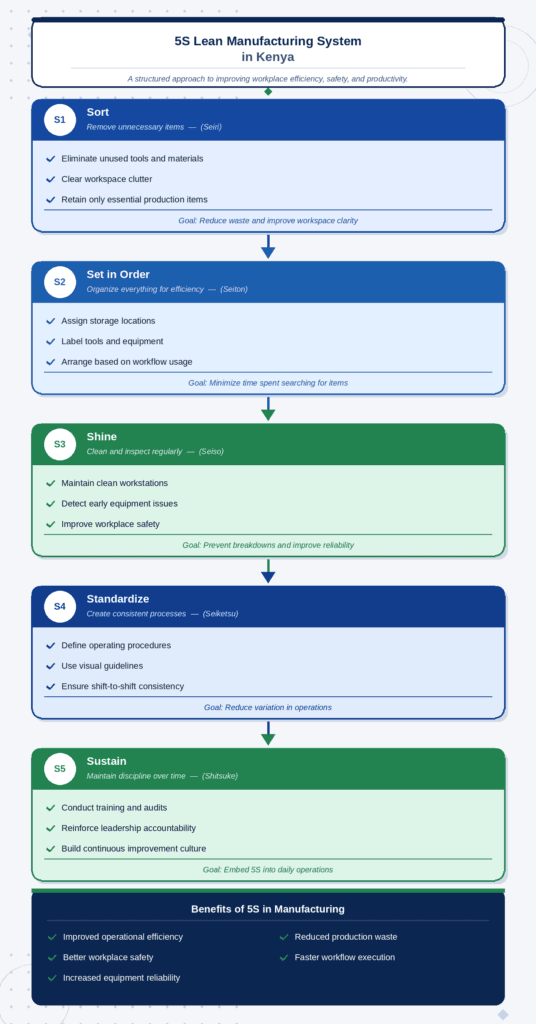
5S is a foundational lean manufacturing system that focuses on organizing and maintaining the workplace to improve operational performance. Developed in Japan, the methodology consists of five interconnected principles:
- Sort (Seiri): Remove unnecessary items from the workplace.
- Set in Order (Seiton): Organize tools and materials for easy access.
- Shine (Seiso): Clean equipment and work areas regularly.
- Standardize (Seiketsu): Establish consistent procedures and visual standards.
- Sustain (Shitsuke): Maintain improvements through training, discipline, and continuous monitoring.
Together, these principles create an efficient, visually managed production environment that reduces downtime, minimizes waste, improves safety, and supports consistent product quality. For manufacturers in Kenya, implementing the 5S methodology provides a practical foundation for lean operations and long-term operational excellence.
Key Takeaways
5S is more than a housekeeping exercise, it is a structured operational discipline. When properly implemented, it improves factory efficiency, reduces production waste, and enhances workplace safety. It also strengthens visual control systems, making it easier for teams to maintain consistency across shifts and departments. Most importantly, 5S requires long-term discipline and leadership commitment to remain effective.
Why 5S Matters in Kenyan Manufacturing Environments
Manufacturing operations in Kenya often face challenges related to workspace inefficiency, inconsistent processes, and equipment mismanagement. These issues may appear operationally minor but can significantly impact productivity and output quality over time.
Implementing 5S Lean manufacturing in Kenya helps organizations address these challenges by introducing structure into the production environment. Instead of relying on informal practices, 5S establishes a standardized way of organizing tools, materials, and workflows.
This leads to more predictable operations, fewer disruptions, and improved utilization of both time and physical space. Over time, factories that adopt 5S tend to experience smoother production flow and better coordination between teams.
Understanding the 5S Methodology in Practice
The 5S methodology in manufacturing is a structured approach used to improve workplace organization, efficiency, and operational discipline. In Kenya’s manufacturing environment, it is increasingly adopted as a foundational Lean system that helps reduce waste, improve workflow clarity, and create more controlled and predictable production spaces.
Rather than being a set of isolated actions, 5S functions as a continuous improvement system where each stage builds logically on the previous one to strengthen overall operational performance.
Sort
The process begins with Sort, which focuses on removing unnecessary items from the production environment. Over time, manufacturing spaces tend to accumulate excess tools, unused materials, or outdated equipment. This creates clutter that slows down operations and increases the likelihood of errors. Sorting helps reset the workspace so that only essential items required for production remain, improving clarity and reducing unnecessary distractions.
Set in Order
Once the workspace is decluttered, the next stage is Set in Order. This step focuses on arranging all remaining tools and materials in a structured and logical way based on usage frequency and workflow requirements. In practical terms, it involves assigning clear storage locations, implementing labeling systems, and organizing workstations to reduce unnecessary movement. The goal is to ensure that everything has a defined place and can be accessed quickly during production.
Shine
The third stage, Shine, goes beyond surface-level cleaning. It involves maintaining cleanliness in a way that also supports operational reliability. Regular cleaning routines allow operators to detect early signs of equipment issues such as wear, leaks, or misalignment. This makes Shine both a housekeeping practice and a form of preventive maintenance that supports equipment uptime and reliability.
Standardize
The fourth stage, Standardize, ensures that improvements made in the earlier steps are consistently applied across all shifts and teams. This involves establishing clear procedures, visual guidelines, and repeatable workflows so that processes do not vary between operators or production lines. Standardization is essential for maintaining stability in manufacturing environments where inconsistency can quickly lead to inefficiencies.
Sustain
The final stage, Sustain, focuses on embedding 5S into daily operations and organizational culture. This requires continuous training, leadership involvement, and regular reinforcement. Sustainment is often the most challenging stage because it depends on long-term behavioral discipline rather than one-time implementation efforts. Without it, even well-structured 5S systems tend to gradually weaken over time.
Workplace Organization Using 5S Methodology
One of the key outcomes of workplace organization using 5S methodology is the creation of a structured and visually controlled production environment. Instead of relying on informal practices, operations are guided by clear visual systems that improve order and workflow clarity.
These may include visual cues such as labeled storage zones, floor markings, and defined workstation layouts that help employees quickly understand where tools and materials belong. The result is improved coordination, reduced confusion, and more consistent workflow execution across the shop floor.
Manufacturing Efficiency Through 5S Systems
The impact of manufacturing efficiency through the 5S system is generally reflected in improved workflow stability and reduced time wasted on non-productive activities. When workspaces are properly organized, employees can focus more on production tasks rather than searching for tools or correcting avoidable inefficiencies.
Over time, this contributes to smoother operations, better resource utilization, and more consistent production output without requiring additional equipment or labor input.
Visual Management in Lean Manufacturing
Visual management in lean manufacturing supports 5S by making workplace standards visible and easy to follow. It allows teams to quickly identify whether processes are being followed correctly without relying heavily on supervision or reporting.
This improves awareness on the shop floor and helps maintain consistency in daily operations by making deviations immediately noticeable.
5S Audit and Sustainment Process
To maintain long-term effectiveness, organizations use 5S audit and sustainment processes to regularly review workplace organization and adherence to standards.
These reviews help ensure that 5S practices remain consistent over time and do not gradually weaken after initial implementation. They also provide feedback for continuous improvement and reinforce discipline across teams.
Frequently Asked Questions
What is 5S Lean manufacturing methodology?
It is a structured workplace organization system that improves efficiency and safety by sorting, organizing, cleaning, standardizing, and sustaining work environments.
How is 5S implemented in manufacturing plants in Kenya?
It is implemented through structured rollout of the five principles, supported by training, visual management systems, and leadership reinforcement.
Why is 5S important in manufacturing?
It improves productivity, reduces waste, enhances safety, and creates more organized and efficient production environments.
How is 5S sustained over time?
Through regular audits, employee training, leadership involvement, and continuous adherence to standardized procedures.