The 5S methodology improves factory efficiency by organizing the workplace, reducing time waste, improving equipment reliability, and standardizing operations. In Kenyan manufacturing environments, it helps streamline workflows, minimize downtime, and improve overall productivity through better workplace discipline and visual management.
Key Takeaways
- 5S reduces time wasted searching for tools and materials
- It improves workflow speed and operational clarity
- Equipment downtime is reduced through better maintenance habits
- Productivity increases through structured workplace organization
- Consistency improves across shifts and production lines
Why 5S is Important for Factory Efficiency in Kenya
In many Kenyan manufacturing environments, inefficiencies are not always caused by technology gaps; they are often caused by workplace disorganization, inconsistent processes, and lack of standard operating discipline.
The 5S methodology addresses these challenges by introducing structure into everyday operations. Instead of relying on informal systems, 5S creates a predictable and organized production environment where every tool, material, and process has a defined place.
This shift directly impacts how efficiently factories operate, especially in high-volume production environments where small delays accumulate into significant output losses.
How 5S Improves Manufacturing Efficiency in Kenya
1. Reduces Time Waste in Daily Operations
One of the most immediate impacts of 5S is the reduction of time wasted on non-productive activities.
In unorganized factories, employees often spend significant time:
- Searching for tools
- Locating materials
- Moving between workstations
With a structured 5S Lean manufacturing system, everything has a defined place, which significantly reduces unnecessary movement and delays. This leads to faster task completion and smoother workflow execution.
2. Improves Workplace Organization and Flow
Factory efficiency depends heavily on how well materials and people move through production processes.
Through structured workplace organization using 5S methodology, production areas are designed to support logical workflow movement. Tools are positioned based on frequency of use, and materials are arranged to align with production sequences.
This reduces congestion, eliminates confusion, and improves coordination between workers on the shop floor.
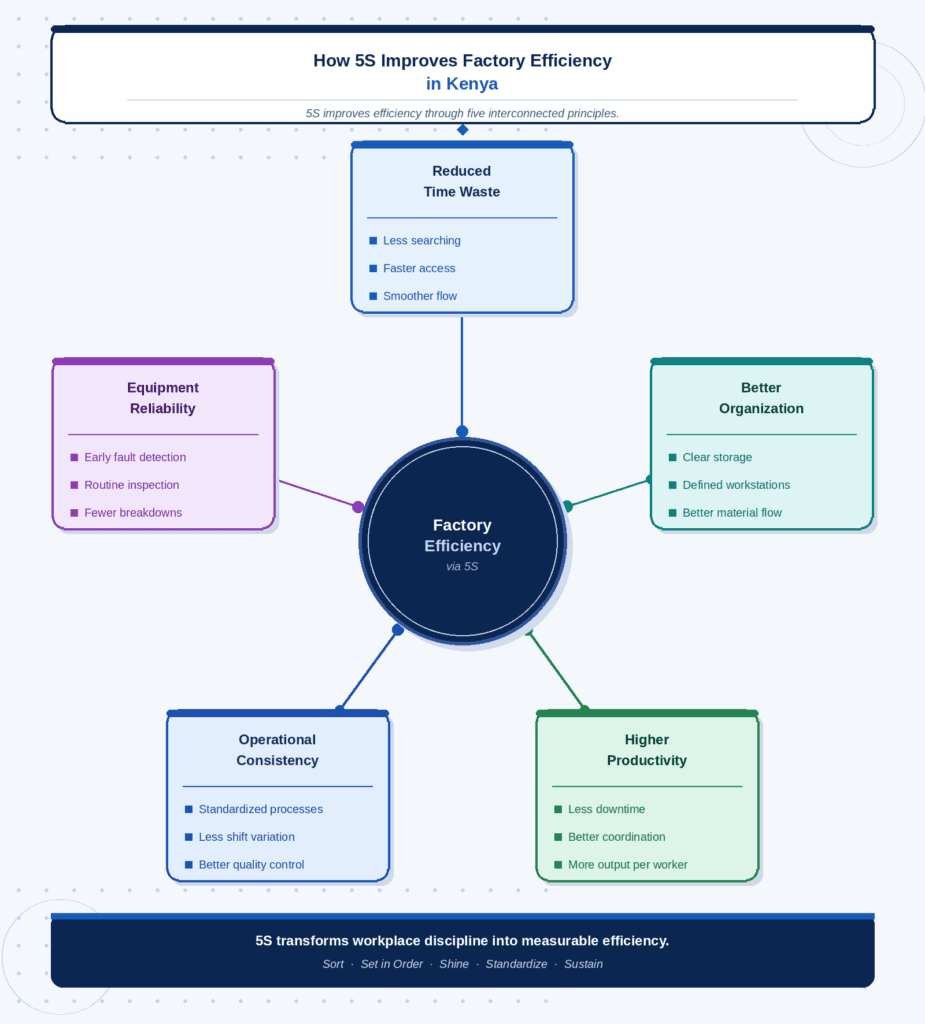
3. Reduces Equipment Downtime
Equipment breakdowns are often accelerated by poor maintenance habits or lack of early issue detection.
The Shine principle of 5S introduces routine cleaning and inspection practices that allow operators to identify issues early, such as:
- Leaks
- Wear and tear
- Abnormal machine behavior
This helps reduce unexpected downtime and improves equipment reliability over time.
4. Improves Workforce Productivity
When the workspace is organized and standardized, employees can focus more on production tasks rather than searching, fixing errors, or waiting for instructions.
This improves:
- Task completion speed
- Coordination between teams
- Overall output per worker
A structured environment also reduces mental load, allowing workers to operate more efficiently and consistently.
5. Strengthens Operational Consistency
Factories often experience variation in output quality and speed across different shifts or teams.
Through standardization in 5S, processes are clearly defined and visually reinforced, ensuring that every team follows the same operational structure.
This leads to:
- Consistent production output
- Fewer process deviations
- Improved quality control
Over time, this stability directly contributes to higher overall factory performance.
Visual Management as a Driver of Efficiency in Kenya
A critical enabler of 5S Lean manufacturing is visual management, which transforms workplace organization from a set of written procedures into a fully visible and self-explanatory system on the shop floor.
In many manufacturing environments, inefficiencies arise not because processes are undefined, but because they are not easily visible or consistently interpreted across teams. Visual management addresses this gap by embedding operational standards directly into the physical workspace.
Instead of relying on manuals, verbal instructions, or supervisory reminders, workers interact with clear visual cues that guide behavior in real time. This significantly reduces interpretation errors and improves execution speed across production lines.
Common visual management systems include:
- Floor markings for movement control, which define walking paths, safety zones, and material flow routes, helping reduce congestion and improve workplace safety
- Labeled storage zones, which ensure every tool and material has a clearly defined location, reducing time spent searching or repositioning items
- Tool shadow boards, which visually indicate where each tool belongs, making missing equipment immediately noticeable
- Color-coded work areas, which differentiate functions such as raw material storage, work-in-progress zones, and finished goods areas
When properly implemented, these systems create a self-regulating environment where deviations from standard practice become immediately visible. This reduces dependence on supervision and allows operational discipline to be maintained consistently across shifts.
Over time, visual management becomes a foundational element of factory efficiency because it aligns people, processes, and physical space into a single coordinated system.
The Role of Discipline in Sustaining Efficiency Gains
While 5S methodology in manufacturing can deliver rapid improvements in organization and productivity, its long-term effectiveness depends heavily on discipline and sustained behavioral consistency across the workforce.
Many organizations experience initial efficiency gains after implementation, but these gains can diminish if structured follow-through is not maintained. This is where the Sustain principle becomes critical, as it ensures that improvements are embedded into daily operational routines rather than treated as temporary initiatives.
Sustainment in 5S is not a single action but an ongoing management system supported by structured reinforcement mechanisms. These typically include:
- Regular training and refresher programs, which ensure that employees understand both the purpose and practical application of 5S standards
- Workplace audits, which provide a structured way to measure compliance, identify gaps, and track improvements over time
- Leadership reinforcement, where supervisors and managers actively model and enforce 5S practices within daily operations
- Continuous improvement practices, which encourage teams to identify inefficiencies and refine processes rather than simply maintaining the status quo
From an operational perspective, discipline is what converts 5S from a workplace organization tool into a long-term performance system. Without it, factories often revert to inconsistent practices, leading to gradual increases in waste, inefficiency, and process variability.
In contrast, organizations that maintain strong sustainment systems tend to preserve and compound efficiency gains over time, resulting in more stable production performance and higher operational reliability.
Frequently Asked Questions
How does 5S improve factory efficiency?
It improves efficiency by reducing time waste, organizing workflows, improving equipment reliability, and standardizing operations.
Why is 5S important in manufacturing?
5S creates structured, efficient workplaces that reduce waste, improve productivity, and enhance operational safety.
What is the biggest benefit of 5S in factories?
The most significant benefit is the reduction of non-productive time, which directly increases production efficiency and output.
How does 5S reduce downtime?
Through structured cleaning and inspection practices that help detect early signs of equipment issues before they lead to breakdowns.
Is 5S suitable for Kenyan manufacturing plants?
Yes, it is widely applicable across Kenyan manufacturing sectors where improving workflow efficiency and operational discipline is a priority.