The 5S implementation process in manufacturing involves five structured steps: Sort, Set in Order, Shine, Standardize, and Sustain. In Kenyan manufacturing environments, it is implemented by removing unnecessary items, organizing workspaces, cleaning and inspecting equipment, standardizing workflows, and maintaining discipline through audits and training.
Key Takeaways
5S implementation is a structured, phased approach to workplace organization and efficiency improvement. It begins with removing unnecessary items and progresses toward standardization and long-term discipline. Visual management plays a critical role in ensuring consistency, while leadership involvement and audits are essential for sustaining results over time.
Why 5S Implementation Matters in Kenyan Manufacturing
Many manufacturing organizations in Kenya face operational inefficiencies that are not necessarily caused by lack of technology, but by unstructured workplace systems. Common challenges include poor layout design, inconsistent workflows, misplaced tools, and lack of standardized procedures.
These inefficiencies often result in:
- Unnecessary production delays
- Increased operational waste
- Reduced workforce productivity
- Inconsistent product quality
The 5S Lean manufacturing approach provides a structured and practical way to address these challenges by transforming the physical workspace into an organized, efficient, and controlled environment.
Unlike complex transformation programs that require heavy investment, 5S is incremental in nature. It can be introduced step by step across production lines, making it suitable for both small and large manufacturing operations in Kenya.
Step 1: Sort (Remove Unnecessary Items)
The first stage of 5S implementation focuses on identifying and eliminating items that are not required for daily production activities. This step is critical because clutter is often one of the biggest hidden causes of inefficiency in manufacturing environments.
In many factories, over time, tools, materials, spare parts, and outdated equipment accumulate without structured review. These items occupy valuable space and create confusion, making it harder for workers to access what they actually need.
During the Sort phase, items are typically categorized into:
- Essential items required for daily production
- Occasionally used items that need controlled storage
- Unnecessary or obsolete items that should be removed
This classification helps teams make clear decisions about what should remain in the workspace and what should be relocated or eliminated.
By the end of this stage, the workplace becomes significantly more structured, with reduced clutter and improved clarity in production areas.
Goal: Create a clutter-free environment that supports efficient workflow and reduces operational confusion
Step 2: Set in Order (Organize for Workflow Efficiency)
Once unnecessary items have been removed, the next step is to organize the remaining tools and materials in a way that supports efficient workflow and minimizes movement waste.
This stage is highly dependent on understanding how production processes actually flow within the factory. The layout is designed to ensure that materials move logically from one stage of production to the next without unnecessary backtracking or delays.
Key implementation actions include:
- Assigning fixed and clearly labeled storage locations
- Organizing tools based on frequency and sequence of use
- Designing logical movement paths between workstations
- Implementing visual labeling systems for quick identification
This stage directly strengthens workplace organization using 5S methodology, ensuring that every item has a designated place and can be easily accessed when needed.
As a result, workers spend less time searching for tools and more time focusing on productive tasks, which improves overall operational efficiency.
Goal: Reduce time loss caused by searching, movement inefficiency, and workplace disorganization
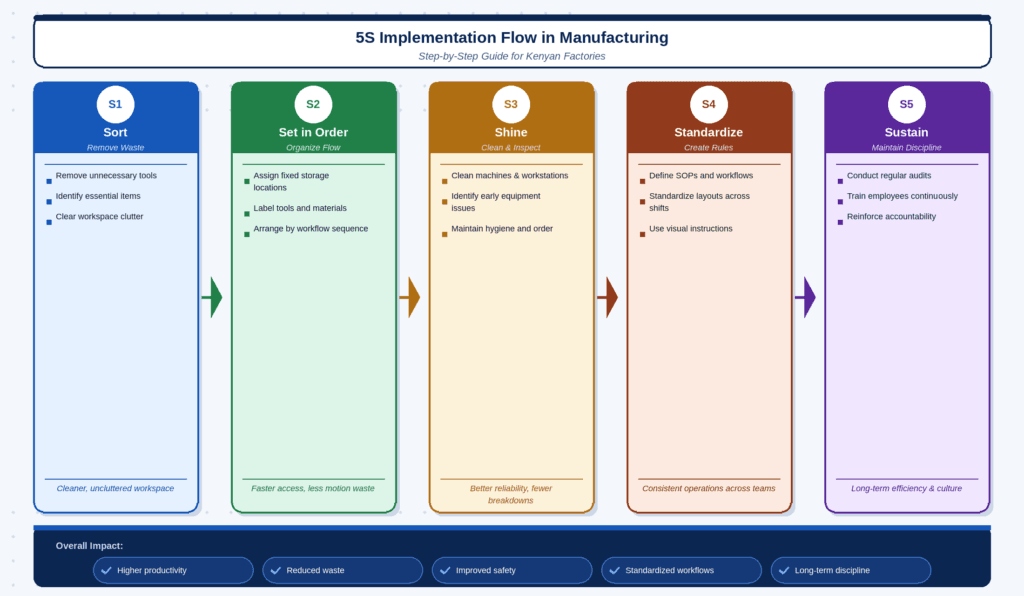
Step 3: Shine (Clean and Inspect Regularly)
The Shine stage goes beyond cleaning for appearance, it is a structured maintenance and inspection practice that supports equipment reliability and operational stability.
In manufacturing environments, cleaning plays a dual role:
- Maintaining hygiene and workplace standards
- Identifying early signs of equipment issues
During this stage, machines and workstations are cleaned on a regular schedule. While cleaning, operators also inspect equipment for:
- Wear and tear
- Leaks or fluid abnormalities
- Misalignment or mechanical issues
- Dust or buildup affecting performance
This proactive approach helps identify potential breakdowns before they occur, reducing unexpected downtime and improving machine reliability.
In structured systems, Shine becomes part of daily operations rather than a periodic activity, ensuring continuous equipment monitoring.
Goal: Improve equipment reliability, reduce breakdowns, and enhance operational safety
Step 4: Standardize (Create Repeatable Processes)
Standardization ensures that improvements achieved in the first three stages are not temporary but become embedded into daily operations across all teams and shifts.
Without standardization, different teams may interpret procedures differently, leading to inconsistencies in output, workflow, and workplace organization.
This stage introduces structured operational consistency through:
- Documented standard operating procedures (SOPs)
- Visual work instructions displayed on the shop floor
- Standardized workstation layouts across production lines
- Consistent labeling and storage systems
Standardization ensures that every operator follows the same process, regardless of shift or department. This significantly reduces variability in production outcomes and improves overall process stability.
Goal: Eliminate process variation and ensure consistent execution across all operations
Step 5: Sustain (Build Long-Term Discipline)
The final stage of 5S implementation focuses on ensuring that improvements are maintained over time and do not deteriorate after initial implementation.
This stage is often the most difficult because it depends on human behavior, discipline, and organizational culture rather than physical systems.
Sustainment is achieved through a combination of:
- Regular employee training and refresher programs
- Structured internal audits and performance checks
- Leadership involvement and accountability reinforcement
- Continuous improvement practices across teams
Audits play a particularly important role because they help track compliance and identify areas where standards are slipping.
Without sustainment mechanisms in place, even well-implemented 5S systems tend to gradually lose effectiveness as old habits return.
Goal: Embed 5S into organizational culture and ensure long-term operational discipline
Visual Management in 5S Implementation for Kenya
Visual management is a supporting system that ensures 5S principles are easy to follow and consistently applied across the workplace.
By making standards visible, it reduces reliance on memory or supervision. Examples include:
- Floor markings for movement and safety zones
- Labeled storage and inventory areas
- Shadow boards for tool placement
- Color-coded operational zones
These visual systems help workers immediately recognize whether processes are being followed correctly, improving accountability and reducing errors.
Frequently Asked Questions
What are the steps of 5S implementation?
The steps are Sort, Set in Order, Shine, Standardize, and Sustain.
How do you implement 5S in a factory?
By applying structured workplace organization, visual management, and continuous audits across production areas.
What is the first step of 5S?
Sort, which involves removing unnecessary items from the workplace.
How long does 5S implementation take?
It depends on factory size and complexity, but it is usually implemented in phases rather than all at once.
Why do 5S implementations fail?
Most failures occur due to lack of sustainment, weak leadership involvement, and poor standardization practices.