Manufacturers in Egypt are increasingly looking for practical ways to reduce production costs without compromising quality or output. One of the most effective and proven industrial engineering methods for achieving this is the Time and Motion Study (TMS).
A Time and Motion Study helps reduce manufacturing costs by identifying inefficiencies in production processes, eliminating wasted effort, and improving the use of labor, time, and materials. Instead of relying on cost-cutting measures that reduce capacity or quality, TMS focuses on optimizing how work is performed so that existing resources deliver more value.
In simple terms, it answers a critical question for manufacturers:
Where is money being lost in the production process, and how to stop it?
Key Takeaways
- Time and Motion Study reduces manufacturing costs by eliminating inefficiencies in production processes.
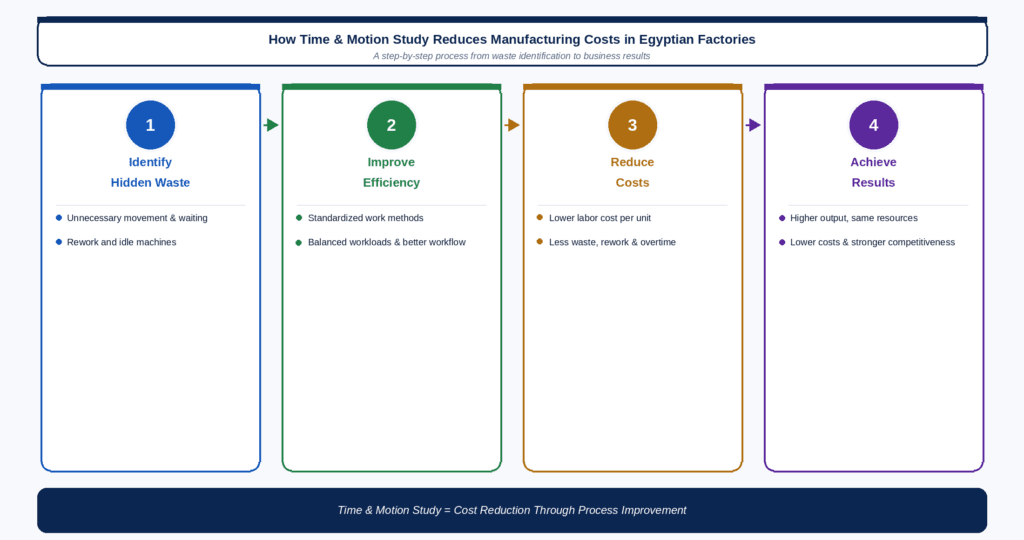
- It identifies waste such as unnecessary movement, waiting time, and rework.
- TMS improves resource utilization, reducing cost per unit of output.
- It supports better planning, reducing overtime and operational inefficiencies.
- Cost savings come from process optimization, not workforce reduction.
Why Manufacturing Costs Increase Over Time
In many manufacturing environments, costs do not rise due to a single issue but due to small inefficiencies that accumulate over time.
Common cost drivers include:
- Excess labor hours caused by inefficient workflows
- High overtime due to poor production planning
- Material waste from handling and process errors
- Idle machine time and production delays
- Rework caused by inconsistent methods
- Inefficient use of workforce capacity
These issues often become embedded in daily operations and are not immediately visible. As a result, manufacturers may continue absorbing hidden costs without realizing their root causes.
A Time and Motion Study helps uncover these inefficiencies in a structured and measurable way.
How Time and Motion Study Reduces Costs
1. Eliminates Wasted Labor Time (Direct Cost Leakage Control)
One of the most significant and often underestimated cost drivers in manufacturing is lost labor time that does not contribute to output. In cost accounting terms, this is “paid time without value creation.”
A Time and Motion Study identifies and quantifies this waste by breaking work into measurable elements and categorizing them into value-added and non-value-added activities.
Typical inefficiencies include:
- Walking between distant workstations or storage areas
- Searching for tools, fixtures, or raw materials
- Waiting for machine cycles or approvals
- Repeating tasks due to unclear instructions
- Handling materials multiple times before processing
Each of these activities may only take seconds individually, but when multiplied across hundreds of cycles per shift, they significantly increase labor cost per unit produced.
Cost impact mechanism:
- Same wage cost
- Fewer productive units per shift
- Higher labor cost per unit output
By eliminating these inefficiencies, manufacturers effectively increase output without increasing labor cost, which directly improves cost efficiency.
2. Reduces Overtime and Premium Labor Costs
Overtime is one of the most visible but often misdiagnosed cost problems in manufacturing. It is frequently treated as a labor shortage issue when in reality it is usually a process inefficiency problem.
A Time and Motion Study reduces overtime by identifying structural inefficiencies such as:
- Bottlenecks causing work accumulation
- Unbalanced workloads across operators or stations
- Excess cycle time variability between shifts
- Poor sequencing of operations
- Idle time hidden within production delays
When these issues are addressed, production becomes more stable and predictable within standard working hours.
Here’s why this reduces cost,
Overtime typically costs:
- 1.25x to 2x standard labor rates (depending on labor laws and company policy)
- Additional indirect costs such as supervision and utilities
By improving flow efficiency, TMS helps manufacturers:
- Increase output within regular shifts
- Reduce dependency on overtime staffing
- Stabilize labor scheduling
This leads to direct and recurring cost savings, not one-time improvements.
3. Minimizes Material Waste and Handling Losses
Material cost is often the largest component of total manufacturing cost, and even small inefficiencies in handling or processing can lead to significant financial losses.
A Time and Motion Study identifies material-related inefficiencies such as:
- Excessive handling or re-handling of materials
- Damage during transport between stations
- Poor storage conditions causing deterioration or loss
- Overproduction leading to excess work-in-progress (WIP) inventory
- Rework caused by improper handling or inconsistent methods
How cost reduction happens:
- Reduced scrap and rejection rates
- Lower rework cycles (which consume both labor and material)
- Improved material flow efficiency
- Reduced WIP holding cost
Even a 1–3% reduction in material waste can have a major financial impact in high-volume manufacturing environments.
4. Improves Machine Utilization and Reduces Idle Cost
Machines represent fixed capital investment, and any idle time directly increases the cost per unit produced.
A Time and Motion Study evaluates how effectively machines are integrated into the production process and identifies delays such as:
- Operators not ready when machines complete cycles
- Waiting for material loading or unloading
- Inefficient coordination between manual and automated steps
- Uneven production pacing between upstream and downstream processes
Cost impact mechanism, when machines sit idle:
- Fixed depreciation cost remains constant
- Output decreases
- Cost per unit increases
By improving synchronization between human and machine activities, TMS ensures:
- Higher equipment utilization rates
- Reduced idle cycles
- More consistent production flow
This leads to better capital efficiency, which is a key driver of manufacturing profitability.
5. Reduces Rework, Defects, and Quality-Related Costs
Quality issues are among the most expensive hidden costs in manufacturing because they compound across multiple stages.
A Time and Motion Study helps reduce defects by identifying root causes such as:
- Inconsistent work methods between operators
- Poorly defined task sequences
- Missing or unclear standard procedures
- Excessive handling that increases damage risk
- Fatigue caused by inefficient workstation design
Cost impact includes:
- Scrap material costs
- Reprocessing labor costs
- Inspection and quality control overhead
- Customer returns or warranty claims (in some industries)
By standardizing the method of work and reducing variation, TMS improves first-pass yield, which directly reduces cost per finished unit.
6. Lowers Cost per Unit Through System Efficiency Gains
The ultimate financial outcome of Time and Motion Study is a reduction in cost per unit produced, which is the most important KPI for manufacturing competitiveness.
This happens because TMS improves three key cost drivers simultaneously:
- Labor Efficiency
More output is achieved with the same workforce.
- Material Efficiency
Less waste, scrap, and rework per unit.
- Equipment Efficiency
Higher utilization of existing machines and assets.
When these three elements improve together, the cumulative effect is a structural reduction in unit cost, not just operational savings.
This is what makes TMS fundamentally different from traditional cost-cutting approaches, it improves efficiency rather than reducing capability.
7. Cost Reduction Without Reducing Production Capacity
A critical principle of Time and Motion Study is that cost reduction should not compromise production capability.
Unlike cost-cutting strategies such as reducing workforce size or limiting output, TMS focuses on:
- Eliminating wasted effort
- Improving process design
- Optimizing resource allocation
- Increasing throughput from existing systems
This ensures that cost reduction is:
- Sustainable
- Scalable
- Non-disruptive to operations
- Compatible with growth strategies
In other words, manufacturers reduce cost by improving flow, not by shrinking capacity.
Cost Reduction Through Process Efficiency, Not Cuts
A critical distinction in Time and Motion Study is that cost reduction does not come from reducing workforce or cutting capacity.
Instead, it comes from:
- Removing non-value-added activities
- Improving process flow
- Optimizing resource utilization
- Standardizing operations
This ensures that cost reduction is sustainable and does not negatively impact production capability.
Where Cost Savings Are Most Visible
TMS typically delivers the highest cost impact in:
- Assembly operations
- Packaging lines
- Material handling processes
- Repetitive manual production tasks
- High-volume manufacturing environments
These areas contain repeated activities where small inefficiencies accumulate into large cost impacts.
Conclusion
Time and Motion Study (TMS) is a powerful method for reducing manufacturing costs by improving how work is performed rather than reducing production capacity. By eliminating waste, reducing inefficiencies, and optimizing resource utilization, manufacturers in Egypt can significantly lower operational costs while improving output quality and consistency.
As manufacturing competition increases, cost efficiency becomes a key differentiator. TMS provides a structured and data-driven way to achieve this without compromising productivity or workforce stability.
FAQs
How does Time and Motion Study reduce manufacturing costs?
It reduces costs by eliminating wasted labor time, improving workflow efficiency, reducing material waste, and increasing machine utilization.
Does TMS require reducing workforce to save costs?
No. Cost savings come from improving processes, not reducing workforce size.
What types of waste does TMS identify?
It identifies wasted motion, waiting time, rework, inefficient material handling, and idle machine time.
Can TMS reduce overtime costs?
Yes. By improving workflow efficiency and balancing workloads, TMS reduces the need for overtime production.
Contact us