
Lean Six Sigma improves Operational Excellence by creating a structured system that aligns process efficiency, quality performance, and cost control into a single continuous improvement framework. In Egypt’s manufacturing environments, this is especially important because operational performance is directly tied to production stability, export competitiveness, and customer satisfaction.
Unlike isolated improvement initiatives, Lean Six Sigma consulting builds an end-to-end operating model where every process is measured, analyzed, improved, and controlled to ensure consistent performance over time.
Operational Excellence is achieved when organizations can consistently deliver high-quality output at minimum cost and maximum efficiency, and Lean Six Sigma provides the structured pathway to reach that state.
Key Takeaways
- Lean Six Sigma improves Operational Excellence by integrating waste reduction and defect reduction
- It aligns processes with strategic business objectives such as cost, quality, and speed
- Tools like Value Stream Mapping (VSM) and Statistical Process Control (SPC) improve visibility and process stability
- Data-driven decision-making replaces assumptions with measurable insights
- Standardization ensures long-term sustainability of improvements
- Workforce training builds internal continuous improvement capability
- It is widely used in Egyptian manufacturing industries to improve competitiveness
How Lean Six Sigma Improves Operational Excellence
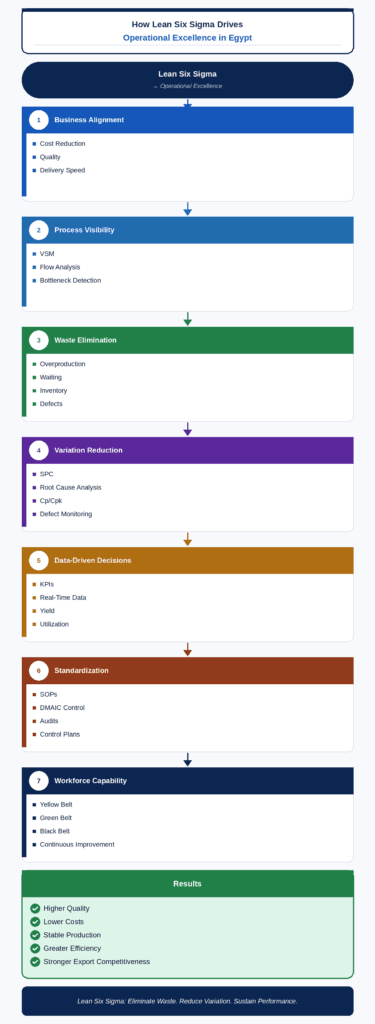
1. Alignment of Processes With Business Objectives
One of the first steps in Lean Six Sigma consulting is ensuring that operational processes are aligned with strategic business goals such as:
- Reducing manufacturing costs
- Improving product quality consistency
- Increasing production capacity
- Reducing delivery lead times
This alignment ensures that improvement efforts are not isolated at the shop floor level but directly contribute to overall business performance.
In many Lean Six Sigma consulting engagements in Egypt, consultants map operational processes against Key Performance Indicators (KPIs) to identify gaps between current performance and business expectations.
2. End-to-End Process Visibility and Control
Operational Excellence cannot be achieved without full visibility of how processes interact across the value chain.
Lean Six Sigma introduces tools such as:
- Value Stream Mapping (VSM)
- Process flow analysis
- Bottleneck identification
- Cycle time analysis
These tools help organizations visualize how materials, information, and resources flow through production systems.
This visibility allows manufacturers to detect inefficiencies such as delays, rework loops, and unnecessary handling that often go unnoticed in traditional operations.
3. Waste Elimination Across All Operational Layers
A key driver of Operational Excellence is the systematic elimination of waste (Lean principle). Waste can occur in multiple forms, including:
- Overproduction beyond demand
- Excess inventory holding costs
- Machine waiting time or downtime
- Unnecessary transportation of materials
- Rework caused by defects
By removing these inefficiencies, organizations improve throughput while reducing operational cost structures.
This is particularly impactful in Six Sigma in manufacturing across Egypt, where production efficiency directly influences competitiveness in export markets.
4. Reduction of Process Variation and Defects
Operational Excellence also depends heavily on process stability. Six Sigma contributes by reducing variation in production processes, ensuring outputs remain consistent within defined quality limits.
This is achieved through:
- Statistical Process Control (SPC)
- Root cause analysis
- Capability studies (Cp/Cpk analysis)
- Defect trend monitoring
When variation is reduced, manufacturing systems become more predictable, leading to fewer defects, reduced rework, and improved customer satisfaction.
5. Performance Measurement and Data-Driven Decision Making
Lean Six Sigma embeds a strong culture of measurement into operations. Instead of relying on assumptions, decisions are based on:
- Real-time production data
- KPIs
- Defect rates and yield metrics
- Efficiency and utilization rates
This data-driven structure allows management teams to identify problems early and take corrective action before they escalate.
Over time, this creates a culture where continuous improvement becomes part of daily operations, not a separate initiative.
6. Standardization and Sustainability of Improvements
A major challenge in manufacturing improvement initiatives is sustaining gains over time. Lean Six Sigma addresses this through standardization mechanisms such as:
- Standard Operating Procedures (SOPs)
- Control plans
- Training and certification programs
- Audit systems and compliance checks
The Control Phase of DMAIC ensures that improvements are not temporary but embedded into operational systems.
This is a critical factor in achieving long-term Operational Excellence in industrial environments.
7. Workforce Capability and Continuous Improvement Culture
Lean Six Sigma consulting also strengthens human capability within organizations by training employees in structured problem-solving techniques.
Common training levels include:
- Yellow Belt (basic awareness)
- Green Belt (project execution level)
- Black Belt (advanced analytics and leadership)
This creates an internal workforce capable of identifying inefficiencies and driving improvements without external dependency.
Over time, organizations develop a self-sustaining continuous improvement culture, which is a core element of Operational Excellence.
What Lean Six Sigma Consultants Do
A Lean Six Sigma consultant helps organizations identify inefficiencies, reduce waste, and improve quality using structured methodologies and statistical tools.
Their responsibilities typically include:
- Mapping and analyzing business processes
- Identifying non-value-added activities (waste)
- Reducing defects and process variation
- Improving workflow efficiency
- Training teams on continuous improvement tools
- Implementing performance measurement systems
In industrial environments, their role is critical for achieving Operational Excellence and sustainable improvement.
Why Lean Six Sigma is Important in Egypt
The demand for Lean Six Sigma consulting Egypt is increasing due to challenges faced by manufacturing and industrial sectors, such as:
- High production costs
- Inefficient workflows
- Excess operational waste
- Inconsistent product quality
- Supply chain inefficiencies
Lean Six Sigma helps organizations systematically eliminate these issues using a structured, data-driven approach.
Conclusion
Lean Six Sigma consulting plays a critical role in improving Operational Excellence in manufacturing industries in Egypt. By combining Lean and Six Sigma principles, organizations can reduce waste, minimize defects, improve efficiency, and stabilize production systems.
Companies that adopt Lean Six Sigma consulting in Egypt benefit from improved quality, lower costs, and stronger competitiveness in both local and international markets. This makes Lean Six Sigma not just a methodology, but a long-term operational strategy for sustainable industrial growth.
FAQs
What is Lean Six Sigma consulting?
Lean Six Sigma consulting is a methodology that combines Lean waste reduction and Six Sigma defect reduction to improve efficiency, quality, and operational performance.
How does Lean Six Sigma improve Operational Excellence?
It improves Operational Excellence by reducing waste, minimizing process variation, improving efficiency, and creating a structured continuous improvement system.
What is the difference between Lean and Six Sigma?
Lean focuses on eliminating waste and improving flow, while Six Sigma focuses on reducing defects and variation.
Why is Lean Six Sigma important for Egyptian manufacturers?
It helps manufacturers reduce costs, improve quality, and increase competitiveness in global export markets.
Contact us